
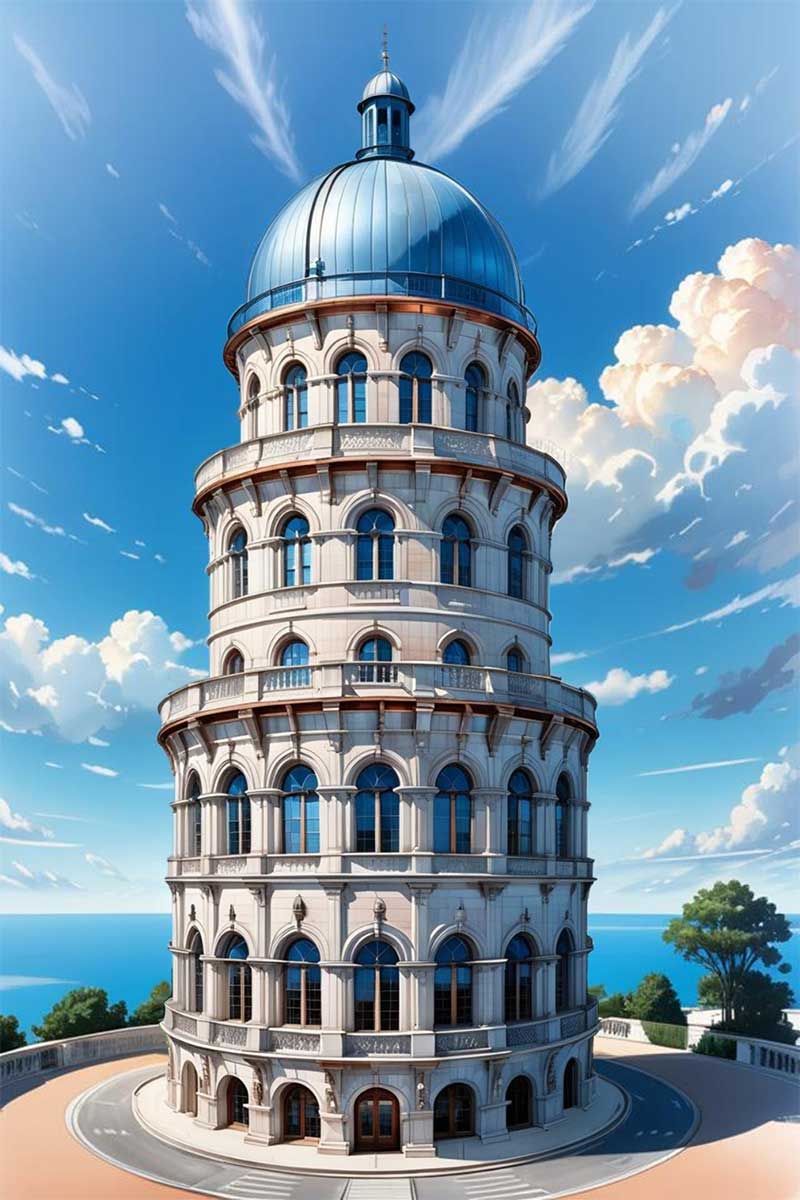
In a region where water should have been a constraint, Amona turned it into a strength.
Rising above the city with its circular structure crowned by an azure dome, the water tower is more than an architectural landmark. It embodies a rupture — a silent transition between two worlds: one of dependence on natural resources… and one of mastery over them.
At the origin of this transformation lies the ingenuity of Michihiro Ikemizu.
Far from relying on a simple principle of communicating vessels, the system is built on a far more robust approach. Water, extracted from icebergs brought from distant cold seas, is stored and redistributed through a network designed to endure.
At first glance, it seems to flow on its own, as if the city were breathing through its pipes. In reality, this balance relies on a more discreet mechanism: gravity ensures distribution, while a mechanical pumping system, powered by the currents of the Saphir Abyss, continuously sustains the tower’s supply.
Invisible to most, this constant motion provides a level of stability few cities can claim.
As a result, water no longer depends on the seasons or the whims of the climate. It flows. It responds. It is available.
In the streets of Amona, this translates into active fountains, functional troughs, and above all, an unprecedented daily comfort: running water — almost nonexistent elsewhere, yet a standard here.
But beyond innovation, for those who know how to observe, the tower tells another story.
A more discreet function, less obvious — and one few still take the time to question.