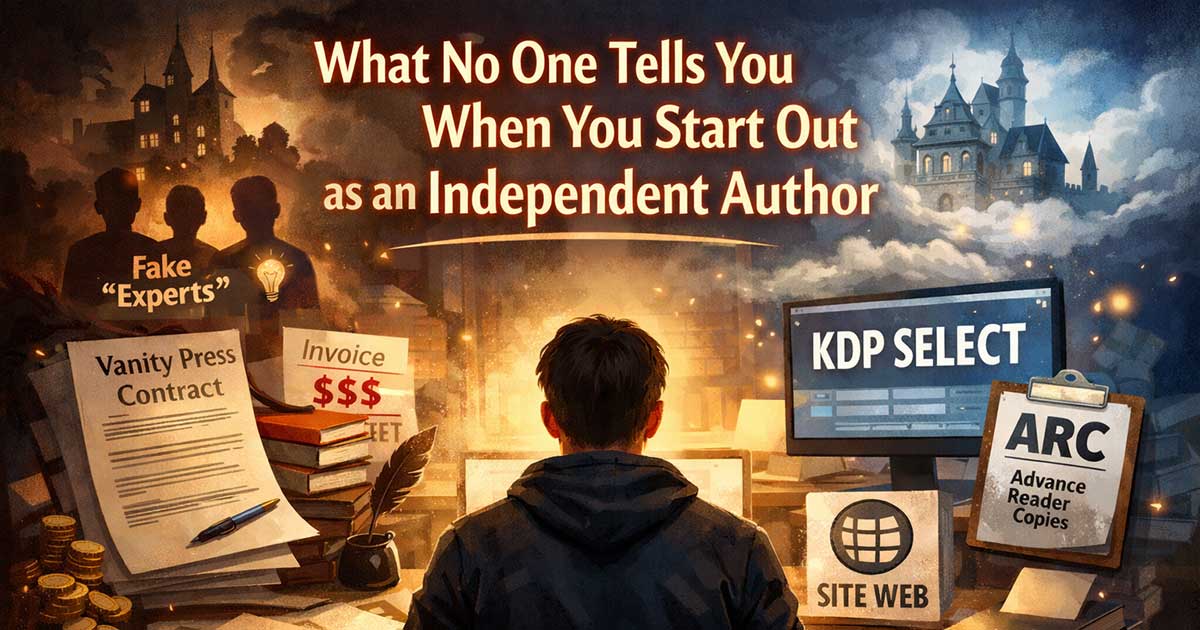
When you start out as an independent author, you’re often driven by something simple: the desire to write, to publish, to be read.
Naturally, you focus on the text, the story, the book. And that’s normal. It’s healthy.
But very quickly, you discover another world—far less visible, rarely explained, yet decisive: the world of advice, offers, promises… and “experts”.
And that’s where the real traps begin.
Why Beginner Authors Become Targets
A beginner author is enthusiastic, motivated, sometimes in a hurry. They’re looking for guidance, answers, a direction—without always knowing where to find it.
On social media—especially on Facebook—many people present themselves as:
- experienced authors;
- industry professionals;
- or simply “well-intentioned” people who want to help.
The tone is often reassuring, kind, almost familial. It creates the impression of natural support.
But in most cases, that discourse doesn’t lead to a real understanding of the steps involved. It leads to spending money.
Self-Proclaimed “Experts” and Role Confusion
Many of these people can’t clearly explain:
- what you should prioritize;
- what is secondary;
- what can wait;
- what is truly essential.
Instead, they recommend:
- services;
- other “experts”;
- ready-made solutions.
They talk about results, rarely about process. They promise shortcuts, even though independent writing and publishing work through a sequence of steps, not magic.
That’s why you need to learn to identify the most common traps—and to distinguish what’s useful from what’s merely selling.
Money Traps
Vanity Press: A Well-Designed Illusion
One of the most common traps is “author-paid publishing,” often called vanity press.
These structures present themselves as real publishers:
- they mention editorial committees;
- they imply selective manuscript acceptance;
- they hint at media or bookstore contacts;
- they promise full “support” for the author.
The language is flattering:
“Your book is excellent.”
“The possibilities are huge.”
“We’ll guide you.”
In reality, most manuscripts are accepted. The business model isn’t based on selling books to readers—it’s based on charging authors.
The paid services—layout, websites, printing, distribution—are often:
- doable by the author;
- available elsewhere for less;
- or offered for free by certain platforms.
Giveaways: Money Thrown Out the Window
Another common trap is paid “giveaways.”
The idea is simple: you pay a platform to distribute a large number of free copies—sometimes a hundred—in exchange for promised visibility.
The pitch is always the same:
- you’ll reach lots of readers;
- you’ll get your book known;
- you’ll obtain reviews.
On paper, it sounds logical. In reality, it rarely works.
Most participants want a free book, not a new author. There is:
- no reading commitment;
- no timeline;
- no obligation to leave feedback.
Result: dozens or hundreds of copies distributed, and often very few concrete returns, for a cost that can be significant.
A Mistake I Made Myself
This isn’t a theoretical warning.
I fell into that trap. I paid a significant amount to distribute my book widely.
The result was clear: almost no feedback, almost no reviews, no measurable impact.
In hindsight, that money would have been far better invested elsewhere—or simply kept.
A Healthy Alternative to Paid Giveaways: Using KDP Select Smartly
There is, however, a simple, legitimate, and often more effective alternative than paid giveaways: making your ebook available through KDP Select, Amazon’s program that notably allows you to offer your ebook for free temporarily.
(Clarification: the correct name is KDP Select, not “KDP Direct.”)
If your book fits the model—novels, thrillers, nonfiction aimed at a broad digital readership—then offering your book for free for a few days can be an excellent strategy, especially during your first year.
Why?
- you get real readers;
- you receive organic reviews;
- you give Amazon’s algorithm a chance to notice your book.
Let’s be clear: for a first book to start moving, it needs reviews. Not bought reviews. Not forced reviews. Real reviews from people who actually read the book.
And that’s exactly what KDP Select can help you generate.
In some markets, Amazon also surfaces review highlights or summaries, which makes having a solid base of reviews even more valuable.
Getting reviews for your first book is a rite of passage. The sooner you go through it, the better.
Unlike paid giveaways:
- you’re not throwing away your money;
- you’re not distributing your book to people who will never read it;
- you’re not dependent on an external platform;
- you’re working with Amazon’s ecosystem, not against it.
It’s a simple, clean, effective strategy—aligned with how the market actually works.
ARC Systems: A Structured Way to Get Reviews
Another option for honest, useful reviews is ARC systems (Advance Reader Copies), meaning services that connect authors with reviewers.
Be careful not to confuse ARC systems with paid giveaways. The principle is different: you provide the book for free, and in return, readers commit to reading it and leaving a review within a reasonable timeframe.
But, as always, not all platforms are equal.
Two kinds of platforms exist:
1) Platforms where you must find reviewers yourself
These bring little to no added value:
- you do everything yourself;
- there’s no tracking;
- there’s no existing reader pool.
2) Platforms with an existing reader/reviewer network
These can actually help. They provide:
- a built-in pool of readers;
- tracking and follow-up;
- reading commitments;
- reasonable deadlines for feedback.
Some platforms even let you contact reviewers directly. Others are more automated. Either way, there are good platforms—and very bad ones.
An Important Recommendation: Favor Free ARC Platforms
Some ARC platforms are paid, but I recommend avoiding them:
- you’ll need your money for more essential parts of your career;
- free platforms can be enough to get your first reviews;
- paid platforms don’t guarantee better feedback.
Use your budget where it truly matters.
A Major Advantage: Negative Feedback Can Be Useful
In self-publishing, a negative review isn’t necessarily a disaster. On the contrary:
- you don’t have thousands of printed copies locked in;
- you can adjust your book;
- you can correct errors;
- you can improve your blurb or presentation.
Feedback—positive or negative—is an opportunity to improve your work before investing more in promotion.
Choosing the Right Reviewers: Avoid “Out-of-Genre” Reviews
Another underestimated trap is reviewer fit. Even on a good ARC platform, not every reviewer is right for your book.
A reviewer who doesn’t like your genre, doesn’t read that kind of story, or isn’t familiar with your niche codes may leave a negative review—not because your book is bad, but because it simply isn’t for them.
And that kind of review can be very damaging early on, when your book only has a handful of ratings.
How to avoid it:
- choose reviewers who already read your genre;
- clearly state the genre, tone, and style of your book;
- check reviewer profiles when possible;
- politely decline reviewers who don’t match your target audience.
An “out-of-genre” negative review has little value for you. An “in-genre” negative review can help you improve.
Why does this matter?
Because early reviews:
- influence Amazon’s algorithm;
- influence potential readers;
- influence your credibility;
- can make or break a launch.
The wrong reviewer can slow your growth; the right reviewer can help you build a strong foundation.
Time Traps
False “Tech Shortcuts”
You’ll also see endless talk about “miracle tools.”
People claim you can:
- publish everywhere at once;
- multiply platforms;
- automate the entire process.
These pitches often ignore:
- real contractual constraints;
- temporary exclusivities;
- free tools already provided by platforms.
Sometimes you’re sold a paid system even though the necessary functionality already exists.
Again, it’s not the tool that’s missing. It’s understanding the framework.
Traps That Can Cost You a Career
Translating Too Much, Too Early
This is a less visible—but extremely expensive—trap.
In my case, I write in French. But my main readership is in the English-speaking market. The choice was clear: publish in French, then translate into English.
Where I made a mistake was going too far, too fast.
Seeing interest elsewhere, I translated some books into Spanish, then German. I had no real way to validate the linguistic quality.
The first reviews made it obvious:
- the translation was poor;
- the book was removed;
- the money was already spent.
The Real Problem: Spreading Yourself Too Thin
The issue wasn’t only language. The real issue was dispersion:
- too many markets;
- too early;
- without control;
- without measurable return.
An independent author doesn’t have unlimited resources. Every euro, every dollar, every hour matters.
The Real Issue: Professionalism
At some point, a simple question must be asked:
Have I actually done what’s needed to be professional at every level?
Not only in writing, but also in presentation, consistency, structure, and understanding the steps.
Professionalism isn’t measured by perceived talent. It’s measured by the invisible rigor of the work.
Your Book Page: A Neglected Strategic Space
Many authors publish their book… then move on.
But your sales page is a tool in itself:
- it reassures readers;
- it structures your universe;
- it shows you control your work to the end.
Ignoring it means letting your book defend itself alone.
What I Wish I Had Known When I Started
What you’ll find in these articles is what I wish I had understood from the beginning.
Not recipes. Not promises. But a clear vision of:
- the steps;
- the traps;
- the decisions you must own.
Starting as an independent author isn’t only learning to write. It’s learning to think about your work as a whole.
And that understanding can’t be bought. It’s built.
How to Avoid Most of These Traps
Most traps don’t come from lack of talent—they come from lack of preparation. You fall into them because you want to go fast, because you want to do well, or because you don’t yet know how the industry works.
The good news: you can avoid most of these mistakes by learning, understanding, and keeping control.
The moment you choose self-publishing, you must accept one reality: you need to acquire a baseline set of skills and a few essential tools.
I won’t go into every skill here—they’re covered elsewhere on my site—but these are the foundations.
1) Your Author Website: Your First Investment
Your author website is your base, your storefront, your anchor. It should be:
- under your name;
- professional, clear, credible;
- structured to present who you are and what you write.
It’s your “home.” Everything else—social media, platforms, promotions—should point back to it.
2) Master the Platform Where You Publish
Every platform has rules, tools, and levers.
If you publish on Amazon (dominant in ebooks), you must learn to:
- present your book properly;
- use A+ content;
- optimize your author page;
- understand internal visibility.
It’s your main commercial storefront. Mastering it isn’t optional.
3) If You Write a Series: Prepare Multiple Volumes Before Publishing
Don’t publish a standalone book 1 with nothing behind it. Prepare 3 to 4 volumes before releasing the first.
Why?
- if book 1 works, readers will immediately want the next;
- you avoid long gaps that kill momentum;
- you build a coherent release dynamic.
But above all: build your author website before releasing volume 1.
4) Set Up a Newsletter
Your newsletter is one of the most powerful tools you can own.
- host it on your author website;
- add the signup link at the end of your books;
- encourage readers to subscribe.
It’s a direct channel, independent from platforms and algorithms.
5) Use Social Media Intelligently
Social media isn’t primarily a place to “sell.” It’s a place to:
- build credibility;
- share your thoughts, your articles, your universe;
- demonstrate professionalism.
Whatever platform you use, what matters is:
- consistency;
- a professional tone;
- posts that point back to your author website.
Your site is your hub. Social media is your entry point.
6) Distribute Your Content Strategically
Every article published on your website can then be:
- shared on social media;
- reused as excerpts;
- turned into short content;
- used to attract new readers.
The goal: bring readers back to your site, your universe, your books.
7) Keep Control of Your Image
Your author image is an asset. It can be strengthened—or damaged.
Working with unqualified providers creates two risks:
- you pay for mediocre results;
- your image is weakened by low-quality content published under your name.
Every time you publish something, make sure:
- the content is professional;
- the image is coherent;
- everything points back to your website.
Keeping control is how you protect credibility.
8) Invest Wisely in Advertising
At some point, you’ll need to invest in advertising. That’s normal—and healthy.
For a beginner independent author, the most relevant place is often: Amazon Ads.
Why?
- it reaches readers directly;
- it appears at the right place, at the right time;
- it allows precise genre targeting;
- it can generate real sales and real reviews.
Running Amazon Ads well takes skill. But you can use AI to:
- understand the basics;
- select keywords;
- structure campaigns;
- control your budget;
- avoid common mistakes.
Yes, you will spend money. But it will be far better spent than handing it to self-proclaimed “experts.”
Conclusion
These are the first essential building blocks:
- protect your image;
- keep control;
- invest wisely;
- rely on reliable tools rather than questionable promises.
To go deeper into each point—platforms, advertising, author websites, newsletters, launch strategy—I invite you to browse the articles on the site.
And if some topics aren’t published yet, they’re already planned in upcoming content.