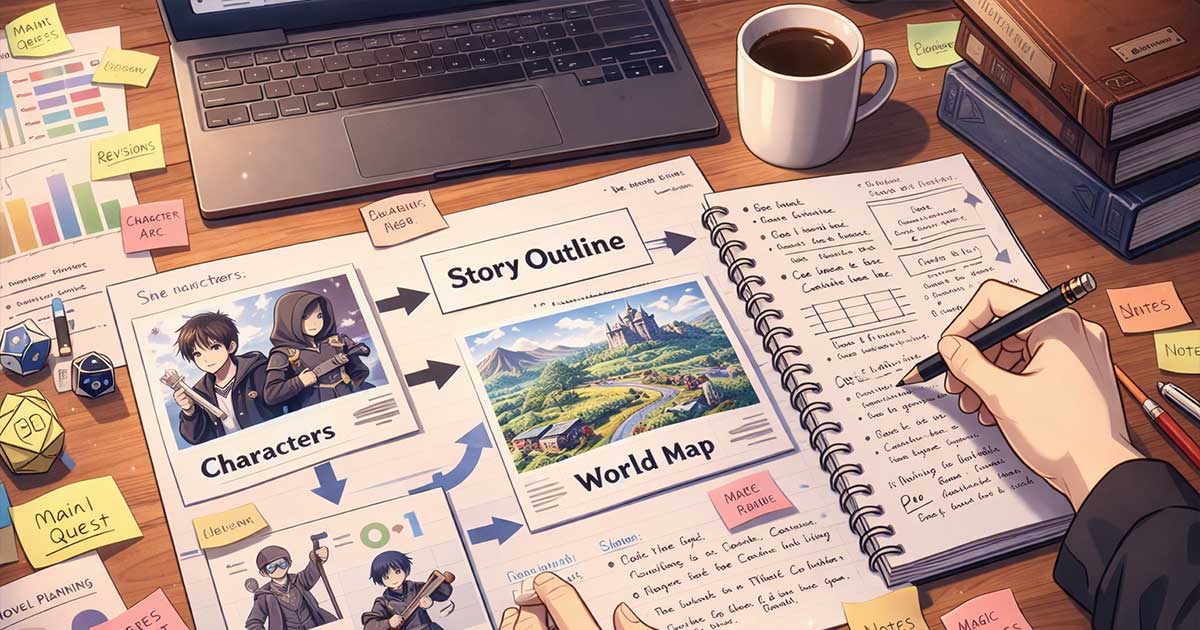

Writing — Methods, analysis, and behind-the-scenes craft
Writing forms the foundation upon which all dimensions of a narrative are built: storytelling, characters, worlds, and progression. This section approaches writing not as spontaneous inspiration, but as a structured process shaped by deliberate choices, techniques, and narrative trade-offs.
The focus here lies on the construction of a story: structural organization, rhythm management, character development, and the articulation between plot, world, and stakes. Writing is examined as a coherent set of mechanisms whose mastery determines readability, emotional impact, and narrative solidity.
Insights drawn from the development of the series ISEKAI – The Otherworlder’s Heir are used as concrete reference points. Reflections on narrative decisions, progressive refinements, and constraints specific to serialized storytelling help illustrate how a work evolves over time, from initial intent to published form.
Particular attention is given to writing practices as they apply to light novels and isekai. The conventions, reader expectations, and narrative tools specific to these formats are examined to show how writing choices adapt to a defined framework without compromising coherence or depth.
This space is intended for readers and writers seeking to better understand the mechanics of storytelling. It offers analytical perspectives and experience-based insights aimed at refining narrative method, critical awareness, and long-term creative consistency.
-

Why Light Novels Favor Internal Narration
In many light novels, especially within isekai and Japanese fantasy, one characteristic appears repeatedly: the significant emphasis placed on the protagonist’s thoughts. The reader does not merely see what the character does. They also hear their hesitations, reasoning, contradictions, immediate reactions, and interpretations of the world around them. For some Western readers, this approach can…
-

How I Build the Psychology of My Characters
A character’s psychology cannot be reduced to a sheet filled with personality traits. In many discussions surrounding Light Novels, Fantasy, or Isekai, character psychology is often presented as an accumulation of labels: introverted, cold, courageous, ENFP, traumatized, loyal, and so on. The problem is that these approaches frequently produce characters who are theoretically coherent… but…
-

Integrating Economy into Worldbuilding Without Weighing Down the Narrative
Why Economy Often Becomes a Problem in Worldbuilding Economy is one of the most difficult elements to integrate into a fantasy universe or a light novel isekai setting. When it is absent, the world quickly loses credibility. Cities seem to function “by magic,” armies appear without logistics, guilds feel as though they exist solely to…
-

Integrating Economics Into Worldbuilding Without Weighing Down the Narrative
The Real Problem Is Not the Economy The real problem is an economy that becomes invisible when it should carry weight. In many fantasy, Light Novel, or Isekai stories, the economy exists only on the surface of the world. Capitals are vast, yet nothing seems to sustain them.Armies cross entire continents with no visible logistics.Guilds…
-

The Power of Suggestion in Japanese Storytelling
Introduction: Why Suggestion Holds Such an Important Place in Japanese Storytelling Japanese storytelling often relies on a principle that surprises many Western readers: emotions are not always explained directly. In many light novels, manga, and anime, characters do not openly verbalize what they feel. Relationships evolve through hesitation, silence, incomplete gestures, or ambiguous reactions. For…
-

How Light Novels Use Short-Arc Structure
Introduction: an often invisible mechanism This structural choice directly shapes how a reader enters, leaves, and returns to a story. Understanding this structure is not only a matter of analyzing a narrative format.It means acquiring a directly usable tool for structuring a fantasy light novel effectively. Definition: what is a short arc in a light…
-

Why Secondary Characters Are Essential
Introduction: a common mistake in light novels This approach works… up to a point. Understanding their role is not about enriching the hero’s surroundings.It is about transforming a centered narrative into a living narrative system. Definition: what is a secondary character? A secondary character is not defined by screen time. They are defined by their…
-

The Relationship to the Reader in Japanese Narrative: Understanding and Reproducing Immersive Storytelling
Introduction: Why Japanese Narratives Feel More Immersive In many light novels, isekai works, and Japanese fantasy narratives, a recurring phenomenon can be observed: the reader does not merely watch the story unfold — they experience it. This sense of immersion does not stem solely from stylistic choices or worldbuilding quality. It arises from a precise…
-

The Importance of Focalization on the Protagonist
Introduction: Understanding Focalization in Light Novels and Isekai In a light novel—especially in isekai and fantasy—focalization is a core element of narrative writing. It determines the narrative point of view, the coherence of the story, and, above all, the reader’s immersion. Often confused with POV (point of view), focalization actually refers to the filter through…
-

Why Light Novels Are Not “Inferior” Fiction
Introduction: a widespread misunderstanding The term light novel is often misunderstood. When compared to traditional novels, it is frequently perceived as a simplified or lesser form of fiction. This perception is based on surface-level characteristics—shorter length, direct writing style, and the presence of illustrations—but it fails to reflect the actual nature of the format. In…