
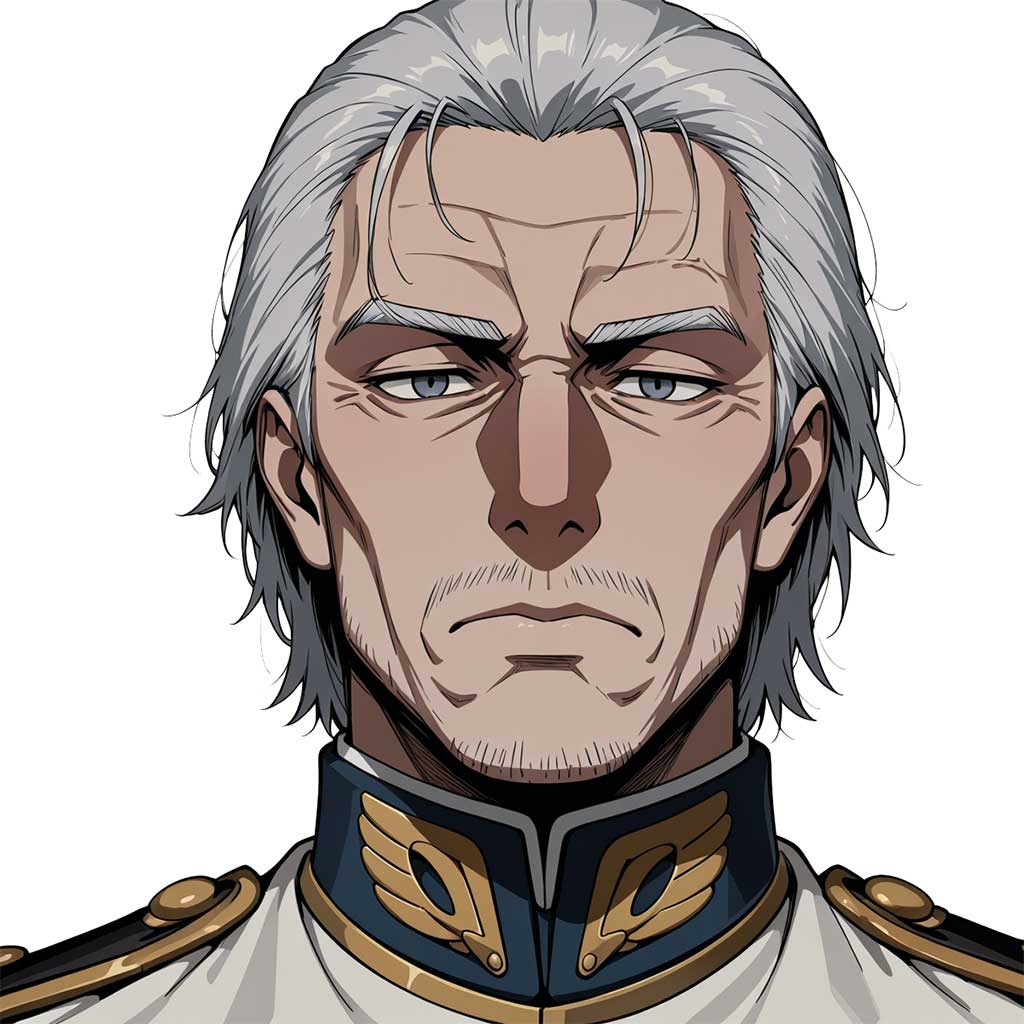
Regional Commander of the North-Western Marches
Commander of the 2nd Royal Infantry Division
Victor Dardel belonged to a lineage forged at the borders. For generations, his family had held the marches, contained incursions, and stabilized the lines where the kingdom ceased to be a certainty.
It was said in the garrisons of the North-West that a wall held better under the command of a Dardel than under that of any other lord.
Where Adrien de Kerval embodied movement, Dardel embodied stability. He had built his career in the management of fortifications, the securing of routes, and the organization of layered defenses. His approach was neither spectacular nor fast—it was structured, gradual, and difficult to destabilize.
In the service of the Marquis of Valombre, he had taken part in the stabilization of the marquisate, consolidating positions, reinforcing garrisons, and ensuring military continuity in a territory under tension. He knew Vergo not as a man, but as a political force: influential, respected, and capable of weighing on the balance of the kingdom.
In the Vergo affair, his role was more discreet, but no less decisive.
He did not manipulate the registers.
He did not produce the accusations.
That work fell to others, who remained in the shadows.
But when the figures were presented, when the apparent inconsistencies had to be interpreted, it was to him that people turned.
The framework was already in place when he intervened. The elements had been ordered, the inconsistencies reduced to the strict minimum, and the whole presented a coherence difficult to contest. Dardel did not seek to trace their origin. He relied on what was given to him, as one relies on a system already in place. It was not his role to judge the source, but to measure its solidity. Thus, he examined each line to ensure that each could, on its own, bear the weight of the consequences that would be drawn from it.
He confronted the data with military realities, validated their plausibility, and declared that, if the alleged embezzlements were accurate, they explained certain weaknesses observed in the defensive arrangements. He did not merely accept the dossier: he translated it into strategic terms.
What had been nothing more than a set of registers became, through his intervention, a tangible threat to the security of the kingdom.
He did not create the fault.
He gave it military weight.
And in a council where war often dictated decisions, that was enough.
Following the execution, the king entrusted him with the supervision of the North-Western Marches. He obtained authority over several garrisons, as well as the right to reorganize the frontier defenses according to his own doctrine. The 2nd Royal Infantry Division was also placed under his command, strengthening his role within the military structure of the kingdom.
Dardel governed as he fought: by consolidating. He favored holding the lines, troop discipline, and the coherence of defensive systems. Every position had to be understandable, every movement justified, every weakness anticipated.
It was said of him that he did not fear war.
Only the unpredictable.
A former officer of the Marquisate of Farca, he knew the fortifications, supply routes, and defensive logics inherited from Valombre. But this knowledge rested on a fundamental principle: war obeys rules.
And that principle had never yet been truly challenged.
Profile
Role : Lord involved in the Vergo affair conspiracy.
MBTI : ISTJ
Race : Human
Formal, methodical, precise language, controlled and firm tone
- Anticipation
- Organization
- Authority
- Discipline
- Lucidity
- Rigor
- Stability
- Conformism
- Dogmatism
- Inflexibility
- Influenceable
- Predictability
- Rigidity