
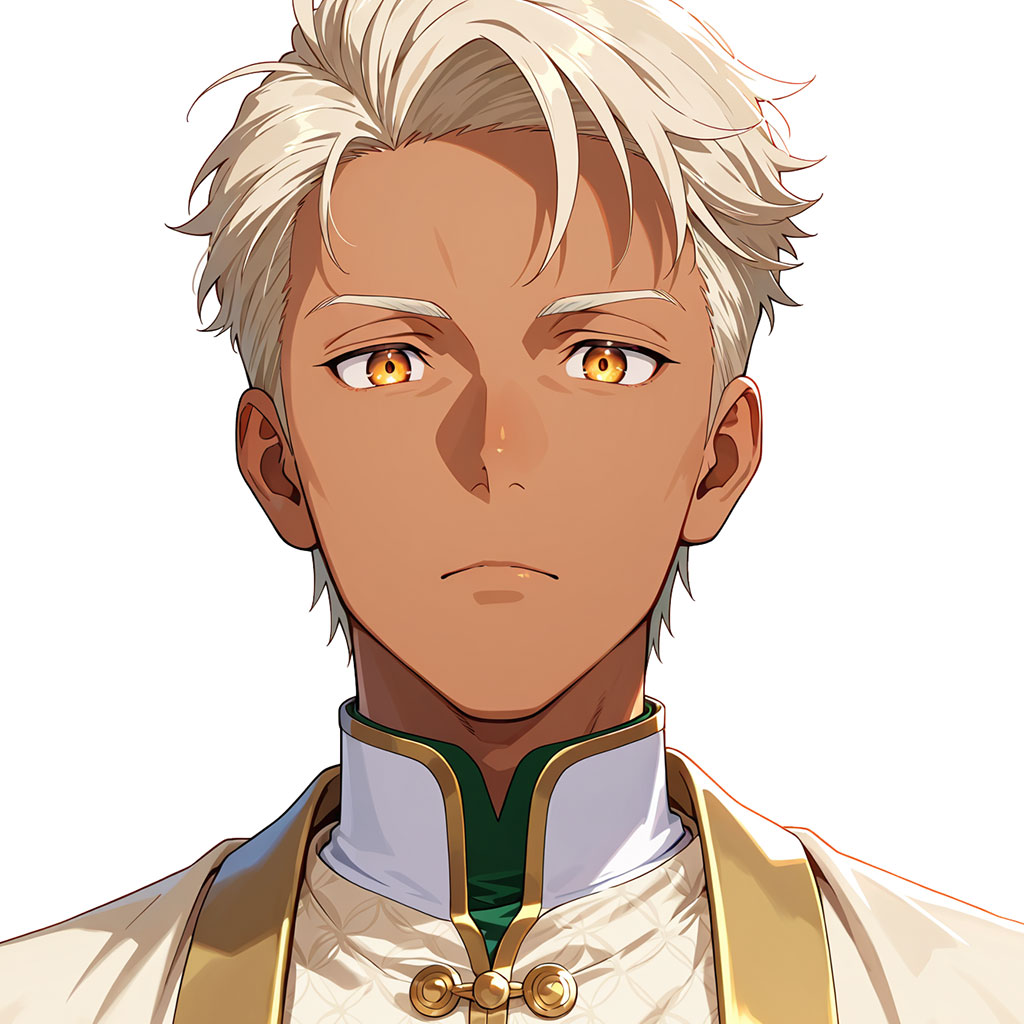
On the morning of his departure for Eldoris, Achard rose before dawn. The house was still silent, and the pale light filtering through the windows cast long shadows across the floor. He had already checked his documents, reread the clauses of the contract, and gone over each step of the upcoming mission in his mind. Yet a persistent feeling lingered at the back of his thoughts—a faint premonition he could not quite dispel.
As he finished gathering his belongings, his wife entered the room. She watched him for a moment, as though trying to understand what weighed on him.
“You barely slept,” she observed softly.
Achard offered a faint smile.
“It’s nothing.”
She lifted her eyebrows slightly, unconvinced.
“You look like that when something is troubling you.”
He remained silent for a few seconds before replying in a calm, almost mechanical tone.
“My father always said that a plan should be devised when one’s mind is calm. Those are the moments when one thinks clearly. Changing it under pressure means abandoning one’s own strategy.”
The memory returned to him with unexpected clarity.
Born in the kingdom of Fenos, Achard had grown up in the shadow of a man respected by many. His father had been a colonel in the kingdom’s army, an officer known for his discipline and his sense of strategy. In their household, these values were not abstract principles—they shaped every aspect of daily life. From an early age, Achard learned that preparation and self‑control often made the difference between success and failure.
His father’s career seemed destined for steady advancement. Already a colonel, he appeared well on his way to becoming a commander. But certain changes within the military hierarchy disrupted that future. The arrival of men with dubious reputations—among them Victor Dardel—profoundly altered the balance within the army. Rather than serve under these new officers, the colonel chose to step down.
Officially, it was presented as a voluntary decision. But Achard never believed that version. To him, his father had been pushed aside—and worse, had accepted it without a fight.
The family gradually lost the position and the standard of living to which they had been accustomed. The king of Fenos showed no particular recognition toward an officer who had always been loyal. That period left a deep mark on the young Achard.
From it, he drew a conclusion that never left him: in this world, honor alone protects no one. Only power commands respect.
When the time came to choose his own path, Achard made a decisive choice. He left Fenos and offered his talents to Manoro, the great island power renowned for valuing those who served it. By turning his back on his native kingdom, he also abandoned the family name carried by his lineage in Fenos. That name belonged to a world he had chosen to leave behind, and Achard no longer intended to owe anything to a crown that had failed his own.
In Manoro, he built his reputation on what his father had taught him: discipline, method, and absolute confidence in carefully prepared plans. Over the years, his abilities naturally led him toward diplomacy, where his sense of organization and steady demeanor made him an effective representative of the island’s interests.
When he left the house that morning to begin his journey to Eldoris, Achard had already reviewed every stage of the mission ahead. The prince he was to meet had left him with a particularly unpleasant impression during their previous encounter.
But that changed nothing.
Achard had prepared this meeting with the same rigor he brought to every negotiation conducted in Manoro’s name. The galley waiting for him at the harbor was no simple merchant vessel: it was armed, as befitted an emissary representing the island’s power. Its mere presence served as a quiet reminder that Manoro did not negotiate only—it also knew how to command respect.
He had also taken care to depart earlier than the official deadline required. Surprise was often an advantage many negotiators underestimated. Arriving before one’s counterpart expected it allowed him to seize the initiative, set the pace of the discussions, and observe reactions before the other side was fully prepared.
The rest of his plan was equally clear. Once negotiations with Eldoris were concluded, he would not linger. The galley would depart immediately. Agreements may be signed around a table, but their consequences often unfold elsewhere—and Achard always preferred to have already left the harbor by the time they did.
But that changed nothing.
A well‑prepared plan leaves no room for improvisation.
He fastened the clasps of his coat and turned toward his wife. Without a word, he drew her briefly against him and placed a kiss on her forehead.
“Kiss the children for me,” he said softly.
She laid a hand on his arm.
“Come back soon.”
Achard gave a single nod, then stepped across the threshold of the house. Outside, dawn was beginning to light the still‑quiet streets.
The road to Eldoris awaited him.
Profile
Role : Diplomatic envoy of Manoro
MBTI : ENFJ
Race : Human
Uses a high-level register, condescending, with an aggressive, contemptuous, and sarcastic tone
- Empathetic
- Influential
- Organized
- Emotional
- Stubborn
- Demanding
- Arrogant
Achard is an official emissary of the insular territory of Manoro, tasked with representing his nation’s interests before the continental principalities. Accustomed to operating from a position of advantage, he displays a marked self-assurance, fueled by the military and economic superiority of his country.
His attitude betrays a deep contempt for authorities he deems inferior, whom he regards primarily as cogs subject to Manoro’s will. Direct and readily condescending, he shows no hesitation in reminding his interlocutors of this dominance when addressing them.
Pragmatic and methodical, Achard pays close attention to procedures, contracts, and formal guarantees, convinced that strict adherence to rules safeguards his interests. This apparent rigor is nevertheless accompanied by an excessive confidence in his position and in the frameworks he believes he fully controls.
Reluctant to question his own certainties, he interprets events through the lens of the authority he embodies, persuaded that nothing can truly elude him so long as he acts in the name of Manoro.