
Isekai worldbuilding, legacy, and power in fantasy
In an isekai story, changing worlds does not always mean starting from nothing.
Sometimes, the past is already waiting there—embedded in a name, a bloodline, or a lineage the world recognizes long before the protagonist understands its weight.
This article explores lineage and legacy in isekai worldbuilding, not as shortcuts to power, but as structuring constraints. Drawing from my experience as an author, I examine how legacy can reinforce narrative coherence by shaping political tension, the world’s expectations, and the protagonist’s emerging identity.
Legacy as a rule of the world in a coherent isekai
In a rigorously constructed isekai, legacy should not function as a narrative reward. It is first and foremost a rule of the world, one that predates the protagonist and governs the transmission of power, status, and responsibility.
In my universe, the protagonist carries several forms of legacy tied to his lineage. One of them, in particular, cannot be ignored—even if he wished to. It is neither negotiable nor conditional; it exists because the world is built that way. Anything related to power, control, politics, risk management, or imperial influence affects him directly, sometimes before he is even aware of it.
Concretely, this means that certain situations do not depend on his immediate choices. At several points during the writing process, I had to adjust scenes or narrative trajectories—not because they lacked emotional coherence, but because they contradicted the structural rules of the world.
These adjustments stem from a constraint I impose on myself consistently: preserving the psychological logic of the characters, in order to maintain credible internal coherence between their intentions, their limitations, and the world they inhabit. Within this framework, legacy could not simply be put on hold without weakening the overall logic of the story.
Biological lineage and political legacy: when blood becomes visible
Biological lineage stops being private the moment it is recognized. It becomes a political fact. Blood is not merely inherited; it is observed, interpreted, and integrated into power dynamics that extend far beyond the protagonist.
In my work, this visibility appears very early. The protagonist has not yet achieved anything of note, and already certain familial and political figures begin to take positions. His grandmother—a central and powerful figure—fully assumes the responsibilities that come with blood ties. The affection is genuine, but it does not erase expectations or political implications.
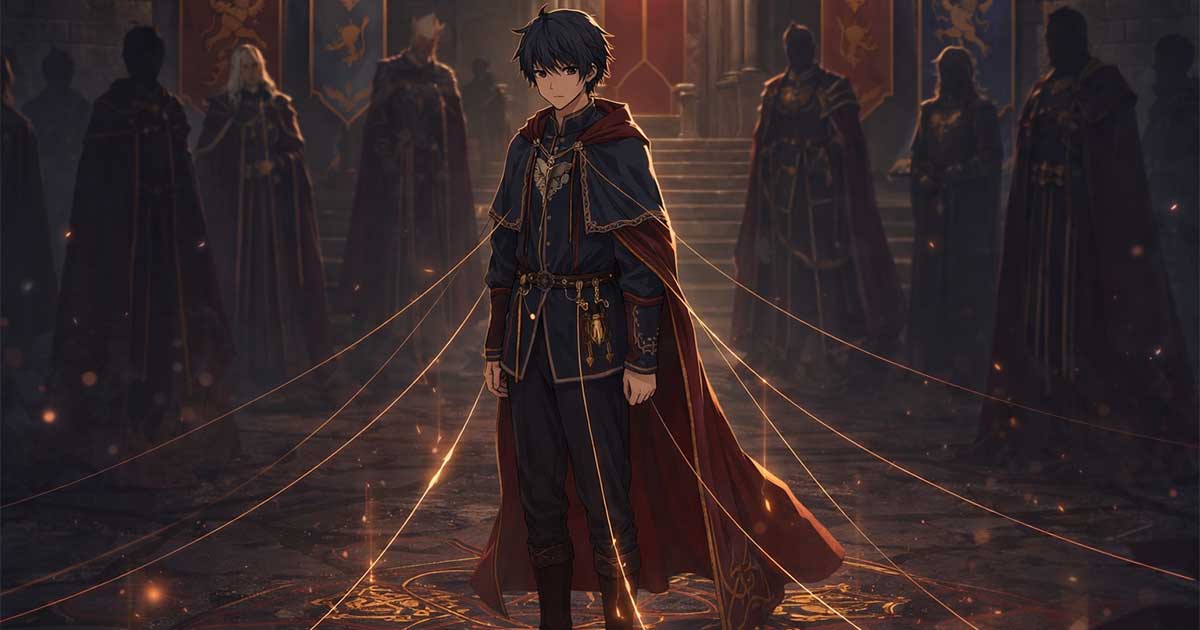
A clear thread emerges: the more the protagonist attempts to build his independence, the more the world reacts to what he represents rather than what he does. This tension—between growing autonomy and a legacy assumed by others—structures the narrative over the long term.
Narrative debt and legacy: the impossibility of staying aside
In an isekai built around lineage, legacy generates a narrative debt. This is not an explicit obligation, but a diffuse pressure: the world expects something from the bearer of that legacy, even if he does not yet know what that is.
While constructing the novel, certain realities impose themselves. The protagonist may distance himself, move away, or attempt to remain on the margins. Yet a persistent gap remains between what he believes he can do and what the world will actually allow. His lineages—particularly those inherited through his maternal line—continue to exist, influence events, and produce consequences.
Ignorance never suspends the world’s mechanisms. It merely transforms refusal into an implicit choice, with delayed but very real effects. Legacy thus acts as a constant tension—sometimes invisible, but always active.
Isekai worldbuilding and tropes: a contrastive approach
In many isekai stories, the protagonist arrives in a new world and quickly becomes a central actor, often through an initial power or an outsider position that allows him to reshape the rules.
The approach taken here is different. The protagonist is not the one who arrives—he is the son of the one who arrived. He was born in this world, and it is the only one he has ever known. His childhood unfolds in a relatively ordinary way, until that normalcy collides with a political reality shaped by strategy, alliances, and power games.
The legacy he carries is not perceived as an immediate advantage. It gradually reveals itself as a set of constraints—sometimes misunderstood—that shape his decisions long before he can articulate them clearly.
Legacy, responsibility, and identity: a foundational tension
In my work as an author, I have found that treating legacy as a narrative constraint rather than a privilege strengthens both worldbuilding coherence and character credibility. Legacy does not define what the protagonist can do; it defines what the world already expects from him.
This approach naturally opens onto broader themes such as responsibility and identity. When power precedes choice, the true stake is no longer the ability to act, but how the character positions himself in relation to what he did not choose. It is within this space—between inherited burden and constructed identity—that the narrative depth of an isekai truly unfolds.
Conclusion — Legacy and narrative coherence in an isekai
When lineage and legacy are integrated as rules of the world, they become far more than background elements. They structure expectations, tensions, and character trajectories over the long term.
In a coherent approach to isekai worldbuilding, legacy is not a shortcut to power, but a constraining framework that shapes choice, responsibility, and identity. What matters is not what the protagonist receives, but how the world responds to what he represents.