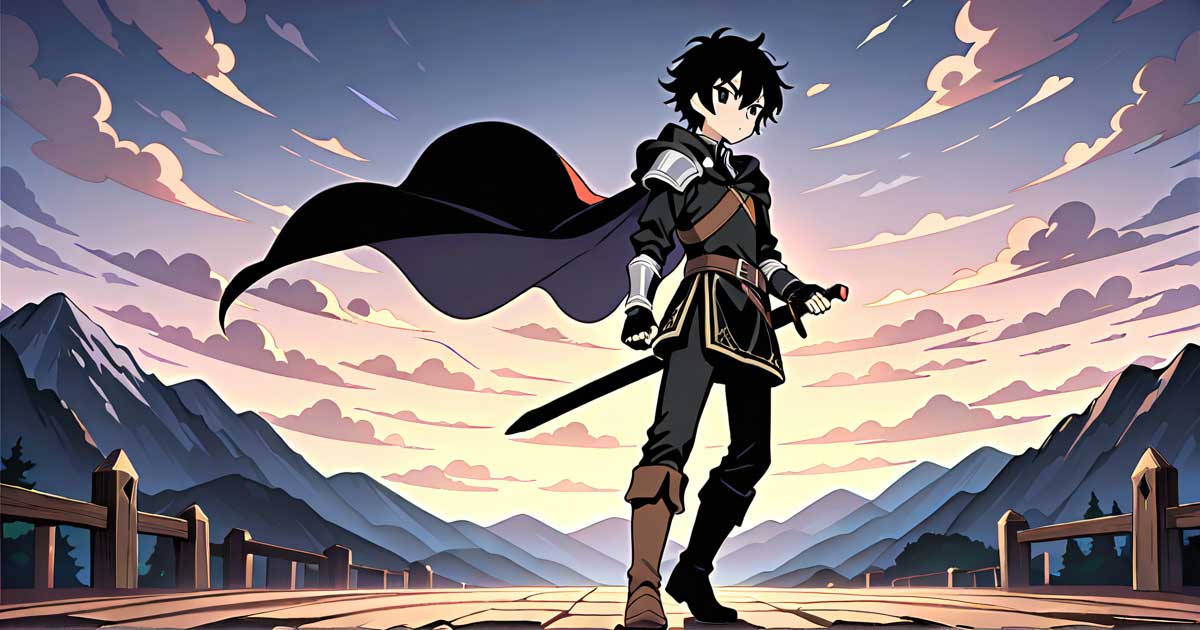

Isekai protagonist — Second chances and a fresh lens
The isekai protagonist holds a distinctive place in contemporary fiction. Torn from their original world and thrust into a reality governed by unfamiliar rules, they become both the reader’s anchor and a lens through which the new world is discovered. Their often disoriented perspective allows fantasy to unfold not as a static backdrop, but as a space to explore, understand, and sometimes challenge.
In isekai narratives, the protagonist is not merely a hero in the making. They carry memories, habits, and cultural references from another world, naturally generating narrative tension. Every rule uncovered, every ability acquired, every limitation imposed strengthens immersion, as the reader learns alongside the character. This shared discovery is one of the genre’s strongest tools for identification.
The construction of an isekai protagonist often relies on a delicate balance between progression and vulnerability. Their rise in power is framed by explicit or implicit game mechanics, which structure the evolution of skills and overall power progression. Yet this growth only matters if it reshapes the character’s choices, relationships, worldview, and role within the conflicts that surround them.
The isekai protagonist is also a central tool for worldbuilding. Through their initial ignorance, they reveal the structures of the fantasy world, its implicit laws, hierarchies, and myths. Their reactions to magic, creatures, or institutions make it possible to explore narrative consistency without direct exposition, weaving the rules of the world into action and moral dilemmas.
This section brings together articles focused on the isekai protagonist, their construction, evolution, and narrative function, offering insight into how this type of character shapes the reading experience and provides long-term structure to portal fantasy narratives.
-

Why Light Novels Favor Internal Narration
In many light novels, especially within isekai and Japanese fantasy, one characteristic appears repeatedly: the significant emphasis placed on the protagonist’s thoughts. The reader does not merely see what the character does. They also hear their hesitations, reasoning, contradictions, immediate reactions, and interpretations of the world around them. For some Western readers, this approach can…
-

Why Secondary Characters Are Essential
Introduction: a common mistake in light novels This approach works… up to a point. Understanding their role is not about enriching the hero’s surroundings.It is about transforming a centered narrative into a living narrative system. Definition: what is a secondary character? A secondary character is not defined by screen time. They are defined by their…
-

Why Politics Matters in an Isekai
Introduction: an often underestimated dimension This approach works at a small scale. But as soon as the world expands, a limitation appears: the setting stops existing beyond the protagonist. Without this layer, an isekai remains functional, but rarely credible. The goal of this article is to explain why politics is a structural tool of worldbuilding,…
-

The Relationship to the Reader in Japanese Narrative: Understanding and Reproducing Immersive Storytelling
Introduction: Why Japanese Narratives Feel More Immersive In many light novels, isekai works, and Japanese fantasy narratives, a recurring phenomenon can be observed: the reader does not merely watch the story unfold — they experience it. This sense of immersion does not stem solely from stylistic choices or worldbuilding quality. It arises from a precise…
-

Antagonists and Their Motivations
Introduction: Understanding a Common Mistake in Light Novels In a light novel, an isekai, or a fantasy work, the antagonist is often reduced to a simplistic function: that of an obstacle to eliminate. This approach is insufficient. Why is this distinction essential? Because it determines both: Definition: What Is a Narrative Antagonist? An antagonist is…
-

The World as a Mirror of the Protagonist
Introduction: moving beyond decorative worldbuilding In many light novels, isekai, and fantasy stories, the world is often treated as a simple backdrop: coherent, rich, but disconnected from the protagonist.This approach significantly limits narrative impact. In storytelling, narrative worldbuilding is not just about creating a coherent universe—it is about structuring the protagonist’s arc. Effective worldbuilding does…
-

The Importance of Focalization on the Protagonist
Introduction: Understanding Focalization in Light Novels and Isekai In a light novel—especially in isekai and fantasy—focalization is a core element of narrative writing. It determines the narrative point of view, the coherence of the story, and, above all, the reader’s immersion. Often confused with POV (point of view), focalization actually refers to the filter through…
-

The Role of the Mentor in a Light Novel Isekai
In a light novel isekai, the mentor plays a central role in the protagonist’s progression. More than a simple guide, they shape the character’s transformation, influence their decisions, and directly contribute to their development. But unlike in traditional fantasy, the mentor in an isekai is not meant to accompany the hero all the way to…
-

Worldbuilding Guide for Isekai
Worldbuilding Guide for Isekai: Building Another World Without Losing Narrative Tension The Core Principle: A Rule Revealed Through Failure A magic system should never be explained before it is experienced. Mini-scene 1 — The Rule Revealed Through Collapse The protagonist attempts to activate an inherited power for the first time.He has been told he is…
-

Isekai Novel vs. Isekai Light Novel
Isekai Novel vs. Isekai Light Novel: Understanding the Narrative Distinction The isekai genre is now global. But not all isekai works fall under the category of light novels. Confusing an isekai novel with an isekai light novel means mixing two distinct narrative approaches. The difference is not merely about format or length—it concerns structure, pacing,…