
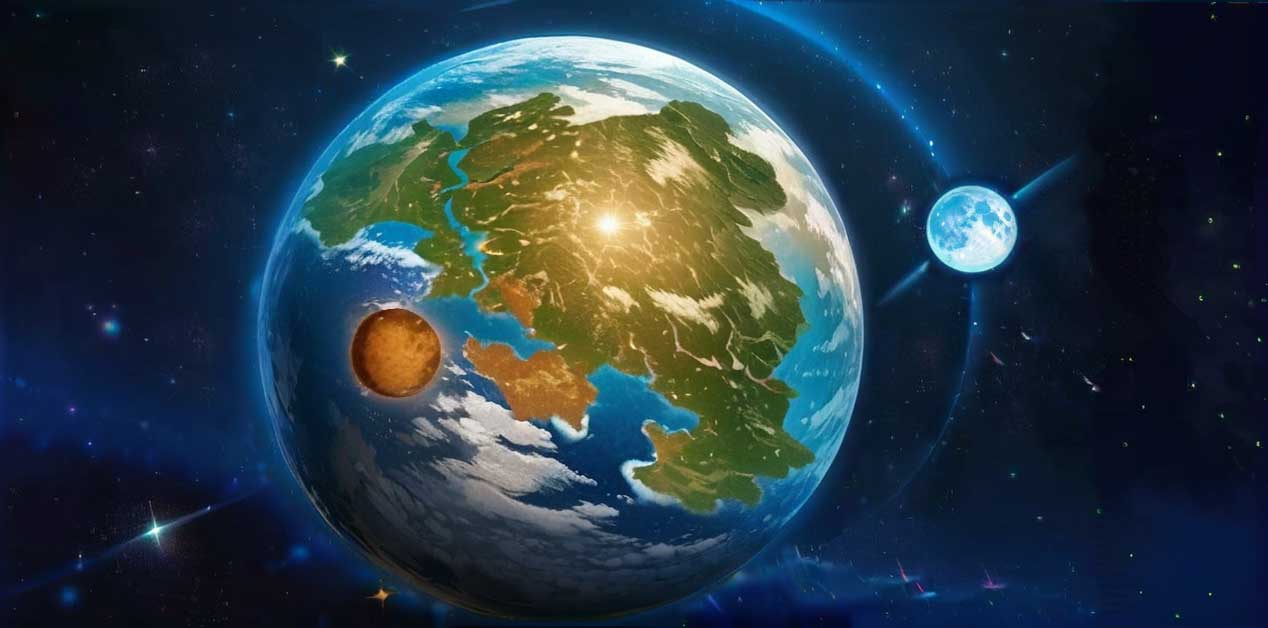
The birth of a myth
People say that before the arrival of the second moon — Vespera —, at the dawn of the cataclysm that marked the birth of a new era, no one knew what shape the world truly had.
Nations lived by the rhythm of the seasons, convinced that the land simply stretched “as far as life could carry the eye.”
Then came the cataclysm of The Endless Night, an event so brutal that its memory has endured through the centuries.
The unimaginable shock
In the southern waters, a volcanic island was swallowed by a mountain of fire.
The titan of rock and magma erupted in a roar that seemed to surge from the world’s very foundations.
The wave that followed no longer belonged to storms or earthquakes; its violence bordered on the mythic, as though creation and destruction had collided in a single instant.
The blast that swept across the plains uprooted forests, made the stones of distant cities tremble, and erased entire villages.
Accounts speak of trembling air, wavering light, and a shared conviction among all nations that the final day had come.
An impossible phenomenon
The wave struck the shores, faded… then returned.
And when it returned again, this time from the opposite horizon, the chroniclers understood that the phenomenon defied all logic.
The cycle repeated for several days, and successive tsunamis only worsened the devastation.
Then the incomprehension gave way to a deeper dread: the sky itself dimmed for several years.
The climate shifted, temperatures dropped, and the peoples of the world realized that the event exceeded anything they had ever known.
The revelation
The first mages, terrified, recorded the successive impacts in their annals.
Amid their confusion, one certainty slowly emerged:
- If the wave returned… then it had gone around the world.
- And if it had gone around the world… then the Earth was not flat.
For the first time, people understood that the ground beneath their feet was not an endless expanse, but the curved surface of a giant drifting through the void.
The birth of a name
To distinguish this vast world from the simple lands they cultivated, the scholars gave it a solemn name: The Great Land — not the soil of the fields, but the world itself, the Land that holds all that lives, breathes, and dreams.
The name survived empires, wars, and centuries.
It became the foundation of maps, chronicles, and official records.
Even today, when astronomers observe the heavens or scribes trace the borders of kingdoms, all remember that deadly event — now spoken of as legend.
But its legacy endures: The Great Land is round.