
Meaning and Origin of the Name Vespera
The name Vespera derives from the Latin word vesper, meaning “evening.” In ancient times, the term referred to the celestial body visible at twilight — the “evening star” — appearing when daylight fades but night has not yet fully taken hold. In classical tradition, this star corresponded to the planet Venus, when it appeared near the horizon after sunset.
In many mythologies and fantasy settings, celestial bodies often take on symbolic meanings. They may represent cycles of the world, omens, or forces capable of shaping the fate of entire civilizations.
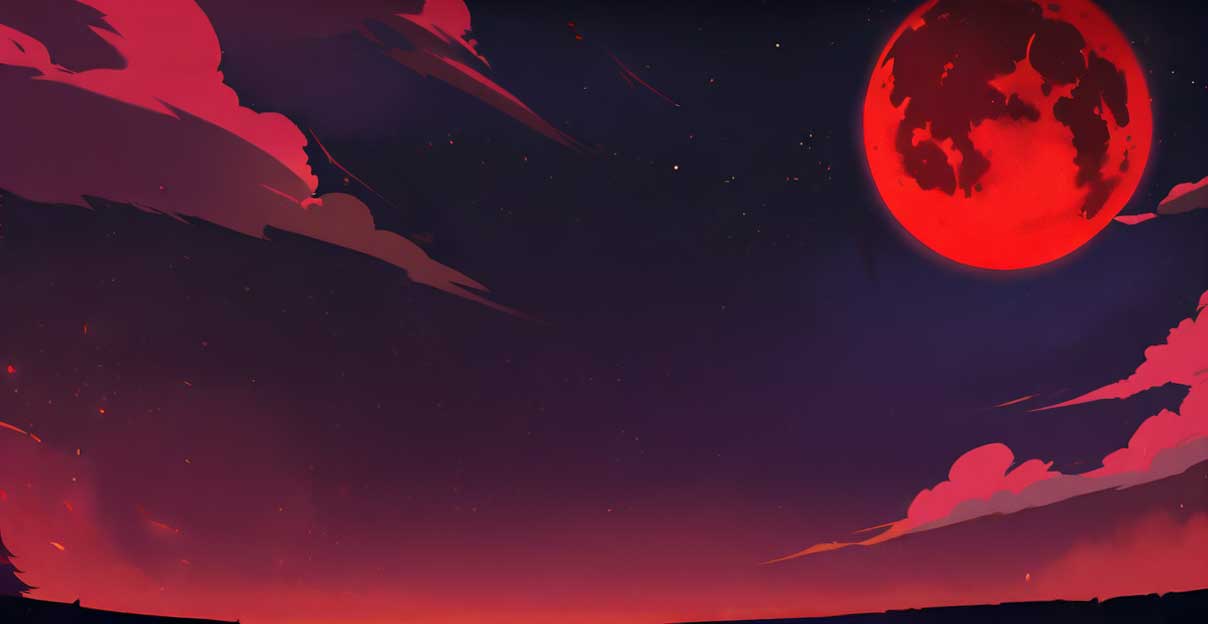
In the universe of ISEKAI The Otherworlder’s Heir, the name Vespera has been adopted to designate a red moon connected to the ancient myths of the Great Land.
Vespera in the Myths of the Great Land
Certain traditions claim that, before becoming a captive celestial body of the Great Land, the red moon known as Vespera once followed the orbit of another world. The oldest chronicles speak of the intervention of that world’s mages, fascinated by its presence, who allegedly sought to draw it into their own sky. Other sources, equally ancient, describe a planet now lost—or profoundly altered—of which only fragmented knowledge and contradictory accounts remain.
This ancient world, shaped by pride, escalating conflicts, and the reckless use of forces beyond the control of those who wielded them, is said to have gradually fallen into irreversible instability. Although the precise mechanisms of this collapse were never fully understood, the gravitational and energetic balance of its celestial system was permanently disrupted.
The Cataclysm of Year 0
Freed from its original orbit, Vespera drifted through space for an indeterminate period before entering the gravitational field of the Great Land. Its near collision with the planet triggered the foundational cataclysm of Year 0, marking the end of the ancient era and the emergence of a world forever changed.
Since then, the red moon has remained in orbit, suspended above the Great Land like the silent remnant of a long-forgotten catastrophe. Its presence continues to exert a lasting influence on the world’s equilibrium, a reminder that certain upheavals, no matter how distant in time, never truly cease to shape the present.
Cultural and Symbolic Perception
Because of its scarlet hue and the mysterious atmosphere it cast when appearing during the transition between day and night, the ancients named it Vespera, meaning “the evening star.”
Its presence was said to soften tempers, inspire poetry, and, at times, awaken feelings of romance.
Celestial Cycles and Magical Influence
Scholars have long observed that Vespera follows a cycle noticeably shorter than that of the tidal moon. Its interaction with other celestial bodies gives rise to irregular periods, sometimes marked by nights entirely devoid of moonlight, and at other times by rare and unusual astronomical configurations.
Though broadly predictable, these phenomena remain sufficiently uncommon to disrupt magical practices and fuel superstition and belief. In certain regions, moonless nights are carefully avoided, while alignments are closely monitored by academies and ancient cults alike.