
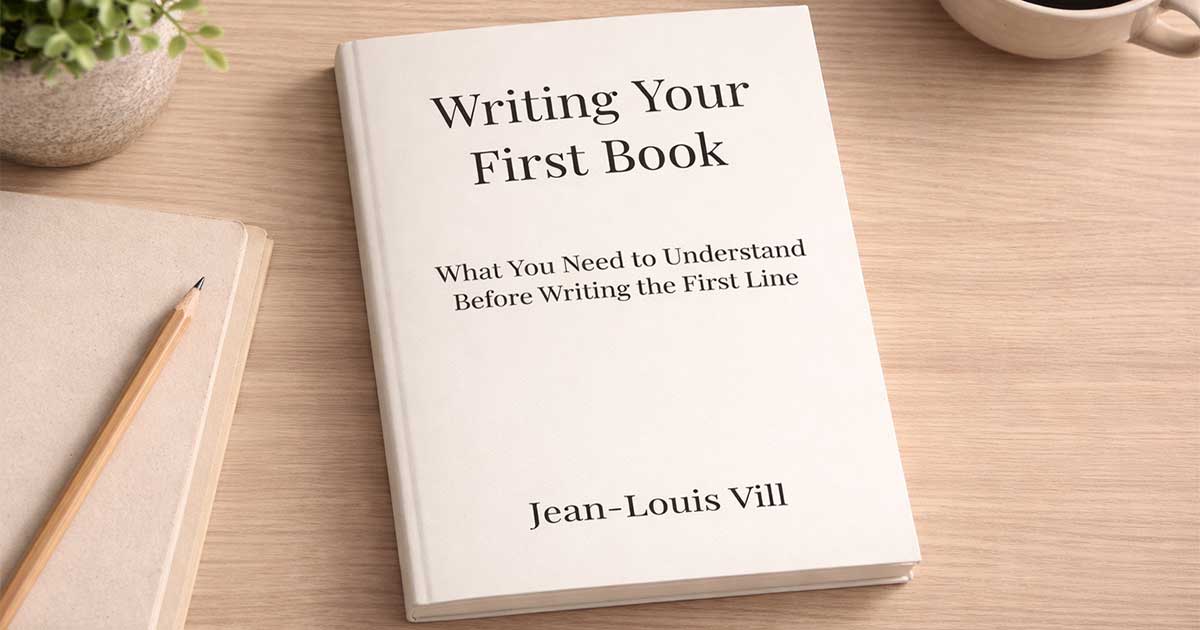
An essential guide to understanding the key decisions behind writing a first book — and avoiding structural mistakes that can compromise a project from the start.
Writing a book begins long before the first line.
Before style, inspiration, or motivation, there are fundamental decisions that shape the entire project: the type of book, the intended audience, the format, the continuity, the level of quality expected, and the publishing approach.
Ignoring these decisions often leads to the same outcomes: abandoned projects, unreadable texts, scattered efforts, or books that fail to reach their audience.
This book offers a different approach.
It is not about learning how to write, but about understanding what you are stepping into — and making coherent decisions before you begin.
Why Writing Your First Book Is Often Misunderstood
Today, there is no shortage of content about writing: books, courses, and articles.
Most of these resources cover similar ground: style, structure, storytelling techniques, and writing methods.
Many of them, while not useless, are largely interchangeable.
They revolve around the same advice, the same principles, and the same approaches.
A simple search for “write a book” makes this clear.
This book takes a different angle.
It does not focus on how to write, but on the structural decisions that shape a writing project as a whole.
Writing a Book vs Becoming a Writer: A Common Confusion
Before even considering style, narrative, or publishing, a fundamental distinction must be made.
Writing a book and becoming a writer are not the same endeavor.
Writing a book can be a one-time, personal project. Once completed, the objective is fulfilled.
Becoming a writer implies a trajectory — one that involves choices, constraints, continuity, and long-term vision.
This confusion lies at the root of many difficulties faced by beginner authors.
Many authors confuse the two: they believe they are starting a trajectory when they are only writing a book — or the opposite.
Not because of a lack of talent, but because of a lack of clarity from the beginning.
The Invisible Mistake: When the Problem Is Not the Writing
A project can stagnate or disappear without the author understanding that the issue does not lie in the writing itself, but in the decisions made beforehand.
These mistakes are not always visible.
A book can be published and available, yet fail to reach readers — not because of its quality, but because of structural decisions that were never properly considered.
Consider a simple example.
A manuscript that is too long may result in a higher price and create a psychological barrier for potential readers. In some cases, dividing the content into multiple volumes would have made the project more accessible without altering its substance.
When such an issue is not identified, it cannot be corrected.
It is simply endured.
Anticipating these constraints does more than prevent late-stage corrections. It also shapes the writing itself: structuring the text, controlling its length, and integrating real-world constraints from the start.
What This Book Does Not Do
This is not a writing guide.
It does not provide step-by-step methods.
It does not promise results.
It does not teach style or storytelling techniques.
There are already countless resources for that.
This book operates upstream.
Its purpose is to clarify the framework within which those skills make sense, and to prevent authors from building a project on unstable foundations.
A Coherent Approach to My Work as an Author
This approach is not limited to this book.
The book and the website address two complementary dimensions of the same work.
The book focuses on the foundational decisions of the author’s journey: direction, structure, early choices, and their long-term implications.
The website extends this reflection by addressing the environment in which these decisions take effect: writing, structuring, publishing, visibility, and building an author presence.
Together, they form a coherent framework designed to support both understanding and execution.
Conclusion
Clarifying these decisions before writing helps avoid structural mistakes that cost time, energy — and sometimes an entire project.
This book provides a clear and lucid framework to make those decisions early, before constraints begin to take hold.
Access the Book
The book is intentionally concise, designed to remain direct and actionable.
It is available in digital format as well as audio.
👉 Access the ebook: Writing Your First Book : What You Need to Understand Before Writing the First Line
👉 Access the audiobook: Writing Your First Book : What You Need to Understand Before Writing the First Line
Reading (or listening to) it helps establish clear foundations before starting a writing project — and avoid mistakes that can be costly to correct later.