
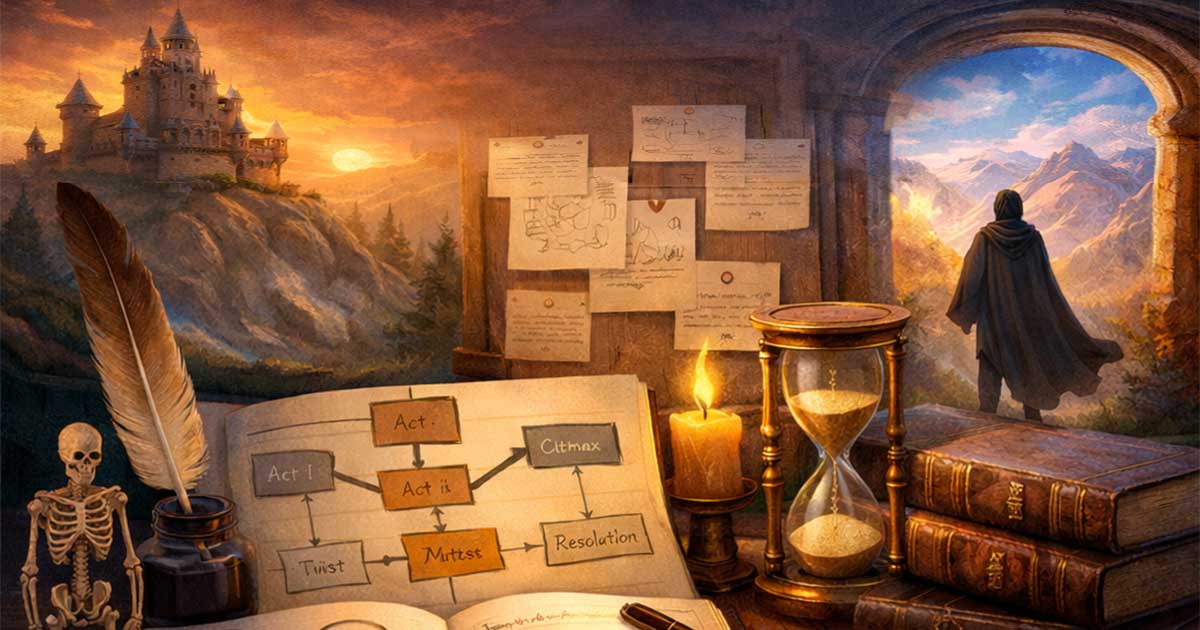
Before drafting the first line of a novel, it is possible to build the story as an architectural structure.
This approach, which I call the narrative skeleton, consists of fixing the progression of events before telling them.
It offers a structured way to plan a saga and to work on narrative arcs with a clear, overarching vision.
For a long time, I wrote while knowing my destination, yet I was still making certain decisions along the way. The story progressed, but its stability depended on constant vigilance.
Eventually, I reversed the process.
What the Narrative Skeleton Is Not
It is neither a synopsis nor a detailed summary.
It does not describe emotions or style.
It establishes facts only.
Each point corresponds to an action or a decision placed within a precise chronology.
The goal is not to narrate, but to organize progression.
Related Methods
Several writing traditions rely on similar principles.
Outline-first / Skeleton-first writing
A detailed plan written before the prose. Often descriptive, but less precise at the event level.
Structural Beat Mapping
A mapping of dramatic units (decisions, reversals, revelations) before drafting.
Beat Sheet
A structural framework for key narrative moments (inciting incident, midpoint, climax).
Narrative Architecture
The global design of a story before writing scenes, common in epic fantasy and screenwriting.
Top-down narrative design
Macro-to-micro construction: overall vision, then sequences, then scenes.
Macro-to-micro plotting
Organizing the general arc before descending into details.
The narrative skeleton belongs to this family of structured approaches, without claiming to be an entirely new method.
Fictional Example of a Narrative Skeleton (Micro-Event Level)
Sequence: An Ordinary Day That Goes Wrong
• Jimmy rides his bike to the store to buy a birthday cake.
• He runs into Jeanne and her sister, who are heading to the beach.
• Jeanne invites Jimmy to join them later.
• Jimmy promises to come after informing his brother.
• When he returns home, he discovers his brother has already eaten the cake.
• An argument breaks out.
• Their mother intervenes and punishes them: no going out.
• Meanwhile, Jeanne waits for Jimmy at the bus stop.
• Jimmy does not arrive.
• Jeanne, convinced he ignored her, misses her bus while waiting.
• She resents him without knowing the real reason.
No prose.
No dramatization.
And yet, the progression is clear and the consequences are established.
The scene can then be developed freely.
Why This Method Works
It simplifies the drafting phase.
The major decisions have already been made.
Writing is no longer used to solve structural problems.
Construction becomes faster because the architectural phase is lighter than prose.
The rhythm of the narrative — tension, action, release — appears from the structural stage onward.
A More Demanding Level of Quality Control
The first benefit concerns the architecture of the story.
The skeleton allows you to verify:
- the progression of narrative arcs,
- the logic of decisions,
- dramatic balance,
- alignment with genre conventions.
In a fantasy saga or an isekai, this stage prevents late structural imbalances.
But the main gain appears afterward.
Once the structure is fixed, attention can focus exclusively on the writing.
Stylistic work becomes more precise:
- rhythm,
- fluidity,
- dialogue,
- emotional density,
- musicality.
The mind is no longer divided between planning and expression.
This approach has allowed me to prepare several volumes in advance while dedicating more energy to the quality of the prose.
A Method Particularly Suited to Long Narratives
The longer a story is, the more decisive its architecture becomes.
In a saga with multiple arcs, this approach makes it possible to anticipate future tensions and avoid forced adjustments.
It offers a global perspective that becomes essential when writing a multi-volume fantasy saga.
Limits and Nuances
This method does not suit everyone.
Some authors prefer to discover their story as they write.
Others rely on improvisation.
The narrative skeleton does not eliminate spontaneity.
It simply provides a more stable framework.
Conclusion
The narrative skeleton is a structured writing method that allows authors to plan a long novel or a fantasy saga with a clear overarching vision.
By constructing the architecture before drafting, the writer gains stability and control.
The story stands firmly.
Writing can then focus on what truly belongs to it: style, rhythm, and embodiment.