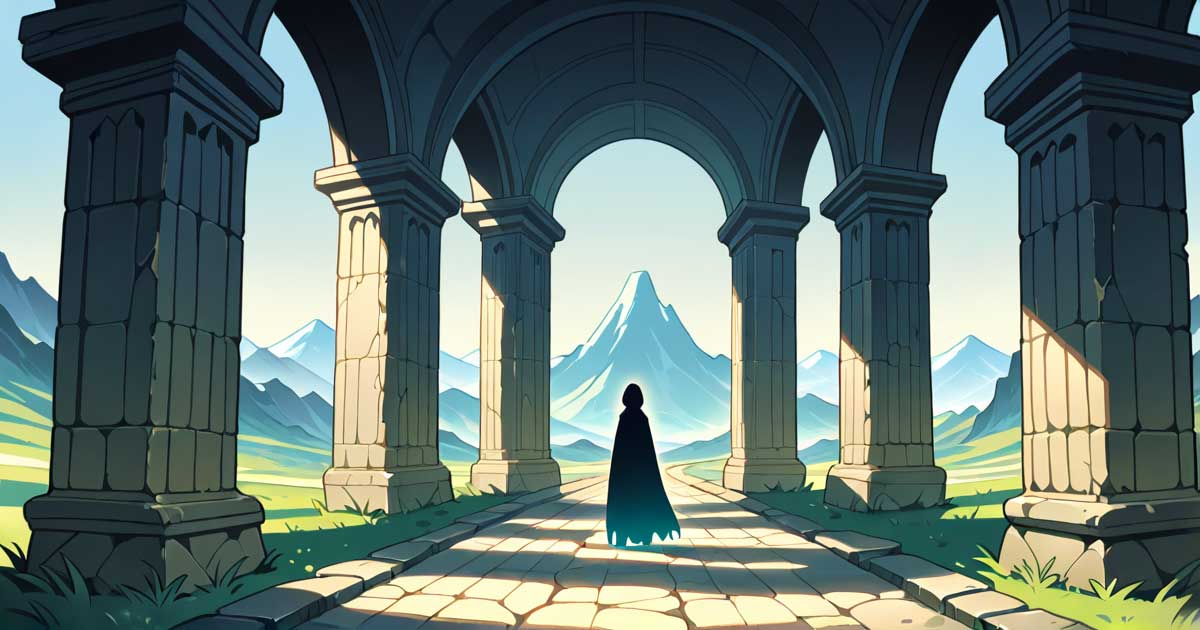

Isekai — Otherworld fantasy centered on a protagonist’s second chance
Isekai refers to a narrative genre of fantasy whose central principle is based on the passage of a protagonist into another world. This transition can take various forms—transportation, summoning, reincarnation, or a more ambiguous shift—but it always implies a rupture with the original world and entry into a universe governed by its own rules. The term isekai literally means “other world” in Japanese and refers to this idea of a radical change in setting and trajectory.
In an isekai narrative, the protagonist generally retains a consciousness, memory, or identity from their previous world. This continuity plays a central role: it creates a contrast between the individual and the new universe in which they now exist, and serves as a narrative anchor for exploring new systems, hierarchies, and possibilities. Isekai is therefore not limited to a simple change of scenery; it stages a confrontation between two distinct world logics.
The genre is frequently associated with the notion of a second chance. While not systematic, this idea runs through many narratives: the transition to another world allows the protagonist to rebuild themselves, correct past failures, or redefine their place within a different framework. This dimension gives isekai both a narrative and symbolic scope, where personal progression is closely tied to the discovery of the new world.
Isekai developed primarily within the realms of fantasy and the light novel, before branching into numerous forms, sometimes hybrid in nature. Whether it emphasizes action, reflection, progression, or exploration, the genre consistently relies on the relationship between a displaced protagonist and an otherworldly setting whose rules, limits, and stakes must be understood.
This section brings together articles related to isekai, approaching the genre from various conceptual and narrative perspectives. The associated texts explore its fundamental principles, its variations, and the ways in which the passage to another world is staged, interpreted, and integrated into the story.
-

When Lore Serves the Story (and When It Should Remain Invisible)
This article examines the role of lore in fantasy, light novel, and isekai stories by clearly distinguishing between constructed lore (what the author knows) and narrated lore (what the reader needs to know). It explains why excessive exposition can harm immersion and slow down the narrative through infodumps, while also showing how invisible lore can…
-

Writing a Saga: Thinking in Volumes and Arcs
How do you structure a saga across multiple volumes? This article explores the differences between volumes, narrative arcs, and the overall saga while presenting an alternative approach based on progression threads. Through practical examples, planning methods, common mistakes, and a useful checklist, learn how to build a more coherent Fantasy, Light Novel, or Isekai series…
-

Pacing as the Primary Narrative Tool in Light Novels
Poor pacing is not always easy to identify. But readers feel it immediately. More importantly, it is one of the main reasons why readers abandon a novel. When readers stop turning pages, the problem does not necessarily come from the characters, the magic system, or the worldbuilding. More often than not, it comes down to…
-

The Discipline of Writing Over the Long Term
Writing a novel over several months or several years rarely requires constant motivation. In practice, most authors who complete long projects mainly develop a writing discipline capable of withstanding: This article explains how to write regularly over the long term and develop a writing discipline capable of carrying a novel through to completion, especially in…
-

The Common Mistakes Western Authors Make When Imitating Japanese Light Novels
Why do Western authors often struggle to recreate the feeling of Japanese light novels, even when using familiar elements such as isekai settings, RPG systems, or anime-inspired archetypes? Over the past several years, more and more writers have tried to create light novels or isekai stories inspired by Japanese works. As a result, certain elements…
-

Maintaining a Character’s Emotional Consistency Over Time
Emotional Consistency in a Character: How to Maintain It in a Long Novel (Light Novel, Fantasy, Isekai) How do you maintain emotional consistency in a character across a long-running story? In Light Novel, isekai, and Fantasy narratives, preserving believable psychological development across multiple arcs is one of the most difficult narrative challenges. A character may…
-

The Influence of Japanese Culture on Worldbuilding
Introduction: a form of worldbuilding built on different cultural reflexes Japanese worldbuilding often differs from the Western model through a stronger emphasis on social structures, visible hierarchies, and the protagonist’s integration into a collective system. In many Light Novels, Isekai stories, and Japanese fantasy fiction, the world tends to operate according to narrative priorities that…
-

Write Natural Dialogue Without Repetition
How to Write Natural Dialogue Without Repetition Introduction: Why Some Dialogues Feel Artificial Most artificial dialogue does not come from vocabulary. It comes from a repetitive rhythm the writer no longer notices. The reaction then becomes almost automatic:to look for more synonyms. Yet in practice, this often makes the writing more noticeable without making the…
-

Why Light Novels Favor Internal Narration
In many light novels, especially within isekai and Japanese fantasy, one characteristic appears repeatedly: the significant emphasis placed on the protagonist’s thoughts. The reader does not merely see what the character does. They also hear their hesitations, reasoning, contradictions, immediate reactions, and interpretations of the world around them. For some Western readers, this approach can…
-

Integrating Economy into Worldbuilding Without Weighing Down the Narrative
Why Economy Often Becomes a Problem in Worldbuilding Economy is one of the most difficult elements to integrate into a fantasy universe or a light novel isekai setting. When it is absent, the world quickly loses credibility. Cities seem to function “by magic,” armies appear without logistics, guilds feel as though they exist solely to…