
When discussing light novels, one concept comes up again and again—sometimes without being clearly named: progression.
Many readers feel it instinctively, without always being able to define it. Yet it lies at the very heart of what makes the genre work, and even more so when it comes to isekai.
Progression in Light Novels: More Than Power Growth
In a light novel, progression is not limited to a protagonist becoming stronger.
It is far broader than that.
It encompasses:
- the evolution of the protagonist,
- the gradual revelation of the world,
- and the escalation of narrative stakes.
These elements move forward together, and it is precisely this combined dynamic that gives light novels their distinctive sense of momentum.
World and Protagonist: A Simultaneous Expansion
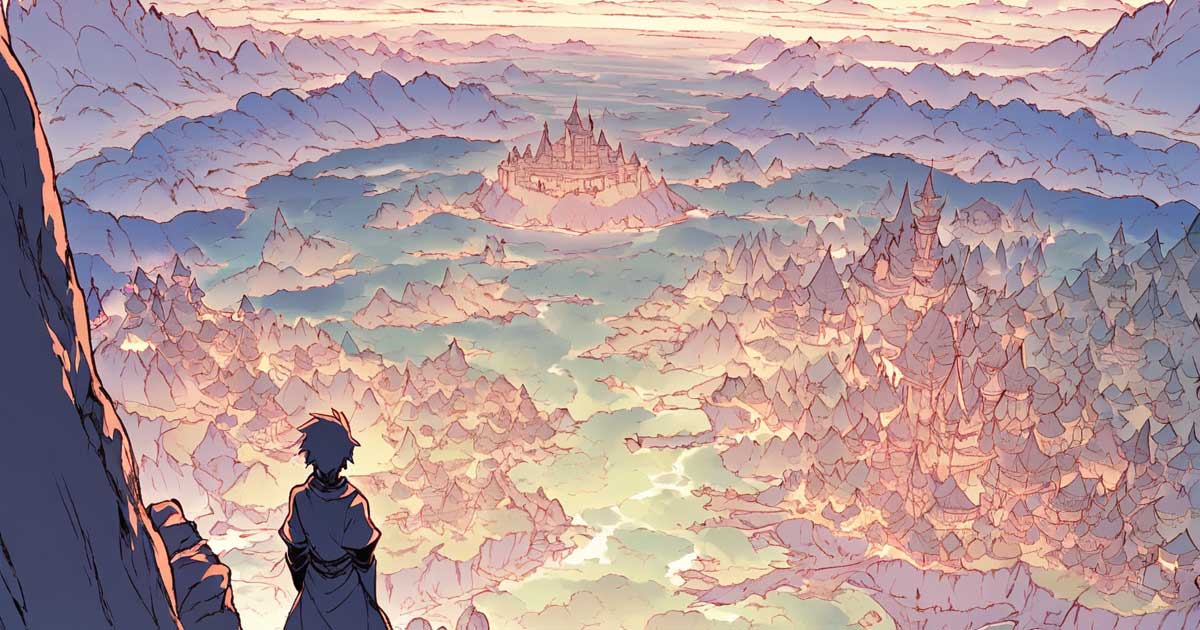
This is clearly visible in many isekai stories: as the protagonist progresses, the world opens up.
New regions become accessible, new factions emerge, and the implicit rules of the universe are gradually clarified. The reader is not given the world all at once; instead, it is discovered in layers, at the same pace as the protagonist’s development.
This is an approach I deliberately applied in ISEKAI The Otherworlder’s Heir.
At the beginning, the protagonist only has access to a limited portion of the world—geographically, politically, and magically. As he progresses in skills, understanding, and status, the world expands accordingly.
Larger structures appear, deeper conflicts emerge, and what was invisible or inaccessible at first gradually becomes intelligible.
The character’s progression acts as a key to the world itself.
Light Novels and Western Novels: A Difference of Narrative Center
This approach often distinguishes light novels from traditional Western novels, but the difference deserves nuance.
Many contemporary Western works—particularly in progression fantasy or LitRPG—also rely on systems, power growth, and worlds revealed step by step.
The distinction, therefore, is not about whether progression exists, but about how central it is to the narrative structure.
In light novels, progression is rarely just one element among others.
More often, it is the axis around which everything is organized.
The world, the pacing, the story arcs, and even the reader’s expectations are built around this forward movement. Where some Western novels can afford to slow progression in favor of introspection or stylistic exploration, light novels tend to rely on a sustained sense of forward momentum.
Isekai: Progression as a Condition for Survival
Isekai makes this mechanism even more explicit.
Being transported to another world necessarily involves a phase of adaptation. The protagonist does not understand the rules, lacks social and cultural codes, and is often vulnerable.
Progression becomes a condition for survival.
Even at a minimal level, it is essential: learning the language, understanding dangers, grasping power structures.
In an isekai context, stagnation often means remaining defenseless in an unfamiliar world.
Levels, Skills, and Statistics: A Language of Progression
This is why systems involving levels, skills, or statistics are so prevalent in the genre.
They are not mandatory, but they are extremely effective tools for making progression tangible. They allow:
- a clear starting point,
- visible milestones,
- and a concrete representation of growth.
Even when such systems become more discreet or fade over time, their initial role remains fundamental.
For readers who discover light novels through anime adaptations, one element often stands out as surprising: the explicit presence of stats, skills, or levels within the narrative itself.
Strength, agility, mana, mastery of a skill—elements reminiscent of video games.
This is no coincidence.
In many light novels—and especially in isekai—these systems exist to show what has changed, what has become possible, and how the protagonist evolves.
Progression Fantasy, LitRPG, and Light Novels: A Shared Foundation
This logic naturally brings light novels closer to subgenres such as progression fantasy and LitRPG.
The differences usually lie in:
- tone,
- pacing,
- and the emphasis placed on psychology,
but the foundation remains the same:
the story advances because something changes in a measurable or perceptible way.
Progression Is Not Just About Numbers
Reducing progression to statistics alone would be a mistake.
What truly matters are its narrative consequences.
Each step forward alters how the protagonist interacts with the world.
New choices become available, new dangers emerge, and the stakes shift. The narrative gains depth because the framework itself evolves.
Progression also acts as an implicit engine for the reader. Often without realizing it, the reader expects the story to unfold, the world to reveal new layers, and possibilities to expand.
When a light novel feels stagnant, the issue is rarely one of prose or style—it is usually a lack of meaningful progression.
External Progression and Inner Transformation
Sometimes, progression is not the starting point but the result of a more intimate journey.
Trauma, loss, or an old promise can drive a protagonist to change. In such cases, external progression reflects an internal transformation.
This approach is not incompatible with light novels. On the contrary, when handled well, it adds depth and resonance to the genre.
The Reception of Light Novels in the Francophone Sphere
In the French-speaking world, where light novels are still an emerging genre, the central role of progression is not always intuitive.
Readers are still discovering the genre’s codes, and progression may sometimes be perceived as secondary or merely a stylistic gimmick. This is, of course, not true of all readers, but the tendency is present enough to influence how the genre is received.
Progression as the Backbone of Light Novels
Progression is neither a gimmick nor a shortcut.
It is the backbone of the light novel.
It structures the character, the world, and the reading experience.
In a light novel, everything progresses:
the protagonist, the world, and the stakes—
and it is this triple progression that truly brings the genre to life.