
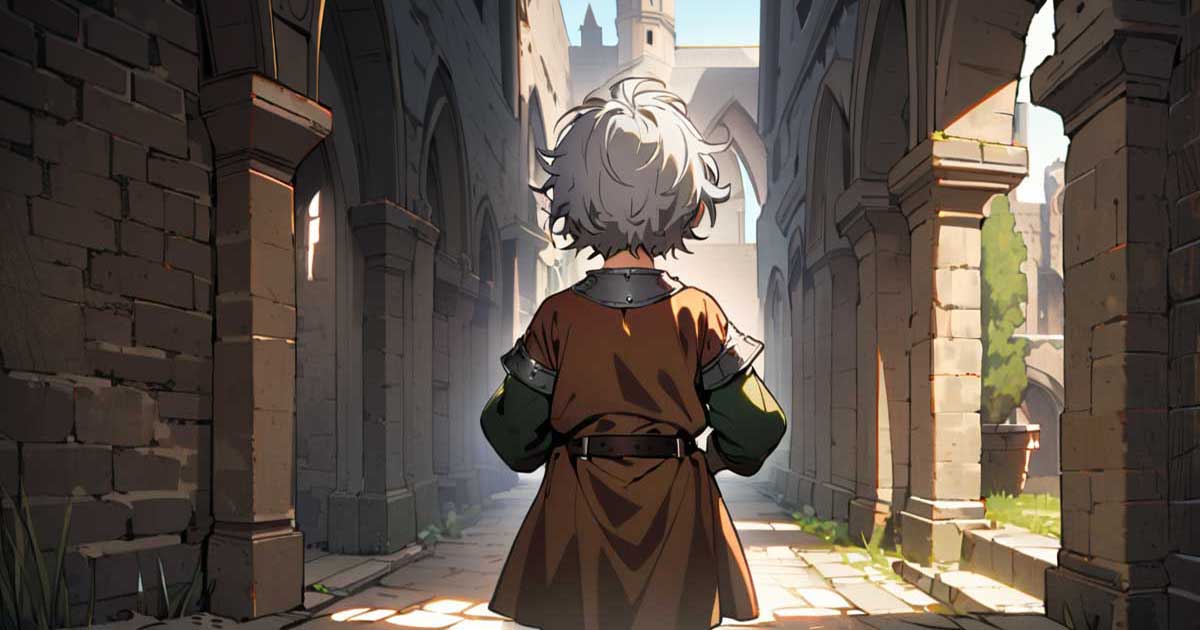
A Return of Experience with Arius Lovelace (Isekai)
Characters & Emotional Dynamics
In isekai, the question of progression comes up almost every time — and it is often reduced to a simple increase in power: more skills, higher numbers, greater advantages.
Yet this kind of progression, effective as it may be in the short term, does not always create lasting emotional attachment between the reader and the character.
In this article, I am not offering a universal method or a set of rules to follow. I am simply sharing the narrative choices I made with Arius Lovelace, the protagonist of ISEKAI The Otherworlder’s Heir, and explaining why those choices shaped his psychology, his relationships, and his trajectory so deeply.
Starting from a Healthy Foundation Rather Than Artificial Trauma
Arius does not begin his story in poverty, abandonment, or gratuitous violence.
He grows up in a loving, structured family, attentive to his development, where he is supported and stimulated. His childhood is, overall, stable.
A healthy foundation allows fractures to become visible when they appear, instead of being diluted in constant early chaos.
Arius is a disciplined, intelligent child, more mature than average for his age — but he is still a child. He lacks perspective on himself and has no real awareness of his own flaws. This initial lack of self-awareness is deliberate: it makes his later progression believable.
Thinking of Progression as a System, Not a Straight Line
From the beginning, I designed Arius’s progression around three inseparable axes:
– measurable progression,
– psychological progression,
– moral progression.
Measurable progression serves as an initial narrative reference. It shows the reader what the character can do, what he cannot yet do, and where he stands in relation to others.
But quite quickly, this progression stops being a simple comparison tool. It becomes less explicit, less numerical, while remaining perceptible. The reader knows Arius is progressing, without everything being reduced to values or stats.
Psychological progression, on the other hand, is constant but unstable. It advances in bursts — through partial realizations, mistakes, retreats, and internal resistance. Arius does not move toward an “ideal” version of himself; he learns to live with his own shadows.
To illustrate this kind of mechanism without revealing events from the novel, imagine a simple situation: a child gets briefly lost, and when she is found, her father — still shaken, still overwhelmed by fear — blurts out something he does not truly mean. He says that if her mother is no longer there, it is because she trusted the wrong person.
The child lacks the distance to separate panic from truth. She takes those words literally and turns them into an implicit survival rule: trusting others is dangerous; opening oneself leads to loss.
Moments like this, even when never explicitly explained in a story, can permanently shape how a character connects with others, interprets intentions, and protects themselves — sometimes excessively.
Moral progression follows no simplified heroic arc either. The choices Arius makes are often imperfect, sometimes questionable, but always consistent with who he is at that precise stage of his journey.
Letting Relationships Reveal the Cracks
In my approach, relationships are not there merely to support the protagonist.
They exist to confront him with what he cannot see in himself.
Arius is not an expressive character. He does not constantly analyze his emotions. He does not perceive himself as exceptional and instead places himself under constant pressure — sometimes for responsibilities that should not be his to bear.
This posture directly affects his relationships: emotional distance, misunderstandings, silent frustrations in those around him. None of this is theorized within the story. These are natural consequences of his internal functioning.
The guidance he receives also plays a central role. It prevents certain derailments, but it introduces a form of dependence. As long as this support exists, some decisions are never fully owned. That tension is an integral part of his trajectory.
How This Approach Fits Within Isekai — and Where It Differs
In many isekai stories, the protagonist appears already formed: an adolescent or an adult, with a past summarized in a few lines. The reader observes reactions before understanding their roots.
With Arius, I chose the opposite approach. He is not the hero summoned to another world, but the son of someone who could have been. This allows me to explore his development from childhood and to show how his strengths, flaws, beliefs, and contradictions take shape over time.
This choice enriches the typical isekai progression. Instead of an immediate rise in power, the reader witnesses the gradual formation of a human being — shaped by history, inheritance, and unresolved shadows.
Where many isekai rely on the “system” as the primary engine of progression, I wanted Arius’s psychology to be an equally important driving force. The way he learns, protects himself, makes mistakes, or forms attachments directly stems from what he experienced long before the adventure truly began.
Accepting Instability as a Narrative Engine
One fundamental narrative choice was accepting that nothing had to be irreversible.
Progression can slow down.
Acquired strengths can be weakened.
Supports can disappear.
Mistakes can have lasting consequences.
Arius is not protected by the structure of the story. He can fall, drift, or lose his way temporarily. This instability is not a flaw — it is the very engine of his evolution.
Only by fully owning his choices, without filters or crutches, can a protagonist truly define himself. Until that point is reached, progression remains under tension.
What This Changes for the Author
Treating a protagonist as a process rather than a fixed state allowed me to:
– maintain long-term behavioral consistency,
– avoid caricature without making characters opaque,
– generate organic emotional dynamics,
– leave the reader the pleasure of discovery, without artificial guidance.
Every author will follow their own path. But thinking of a character as a living trajectory — shaped by contradictions and inner tension — opens narrative possibilities far richer than a simple accumulation of traits or powers.
Mini-FAQ — Progression-Driven Protagonists & Isekai
Does a progression-driven protagonist have to become “stronger”?
No — and this is one of the most common misconceptions. Progression does not mean raw power increase. Being stronger does not necessarily mean being more lucid, more stable, or more capable of bearing the consequences of one’s choices. A character can gain power while remaining emotionally fragile or morally conflicted.
True progression lies in the ability to carry what one becomes.
How do you balance measurable progression and psychological progression?
The mistake is trying to synchronize them at all times. Measurable progression provides narrative landmarks, while psychological progression advances through resistance, denial, setbacks, and partial realizations. Accepting this gap creates a far more fertile tension than perfectly aligned growth.
Can you write an isekai without an explicit numerical system?
Yes — provided you understand what replaces it. A numerical system is a tool, not a requirement. It can structure progression, but it can also overwhelm the story. Progression can remain clearly perceptible without constant quantification, as long as internal coherence, visible consequences, and world logic are rigorously maintained. Readers do not need numbers to feel change; they need narrative proof.
Conclusion
In ISEKAI The Otherworlder’s Heir, the protagonist does not work because he is powerful, nor because he is tormented.
He works because the reader understands how he becomes who he is — step by step, choice after choice.
Arius is not a model to replicate, but a concrete example of what a character can become when we allow them to evolve, stumble, and transform under the reader’s gaze.
For an author, the challenge is not avoiding exaggeration, but anchoring it. In many manga and isekai stories, characters are intentionally exaggerated: explosive tempers, extreme shyness, comic obsessions. These traits help distinguish them instantly, and this is not a weakness of the genre.
What makes the difference is how those exaggerations connect to the character’s psychology. An amplified trait becomes a powerful tool when we understand where it comes from, what it protects, what it reveals, or what it conceals.
Over time, exaggeration stops being a mask — it becomes a language.