
Isekai Light Novel — World discovery, character perspective, and progressive narrative systems
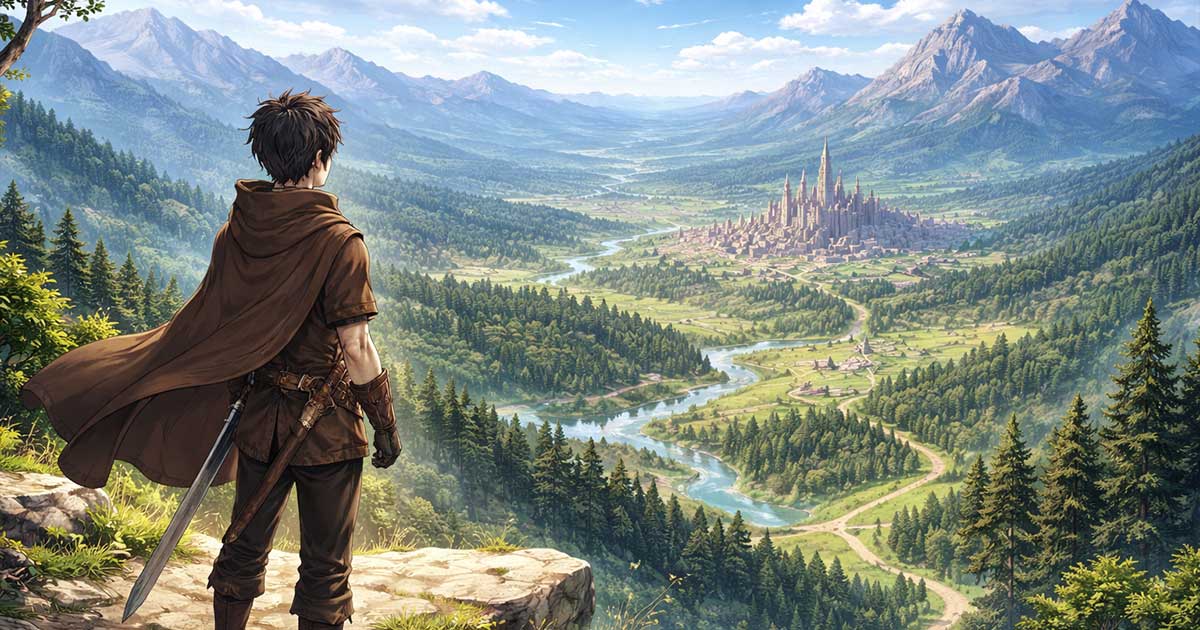
Isekai light novel fits within the framework of isekai, applied to the light novel format. The narrative is built around a simple principle: the transfer of a protagonist into another world serves as a narrative entry point, allowing the reader to progressively discover a new universe.
In this type of story, understanding the world primarily comes through the experience of the main character. Rules, customs, and dangers of the new environment are not explained upfront; they emerge through lived situations. This approach requires precise writing, where each scene must both move the plot forward and reveal an aspect of the world.
The isekai light novel often emphasizes readable progression: successive learning phases, preparation stages, training arcs, or gradual power growth. For these developments to remain credible, the rules established upon arrival in the other world must be respected, making narrative consistency essential.
The genre is strongly influenced by Japanese culture, particularly in arc-based structure, story rhythm, and the balance between action and introspection. This influence shapes a fluid reading experience designed for serialization and clarity of stakes.
This section brings together articles and analyses dedicated to the isekai light novel: how to use world transfer without narrative shortcuts, how to structure character progression, and how to sustain immersion over time.
-

Integrating Economy into Worldbuilding Without Weighing Down the Narrative
Why Economy Often Becomes a Problem in Worldbuilding Economy is one of the most difficult elements to integrate into a fantasy universe or a light novel isekai setting. When it is absent, the world quickly loses credibility. Cities seem to function “by magic,” armies appear without logistics, guilds feel as though they exist solely to…
-

Integrating Economics Into Worldbuilding Without Weighing Down the Narrative
The Real Problem Is Not the Economy The real problem is an economy that becomes invisible when it should carry weight. In many fantasy, Light Novel, or Isekai stories, the economy exists only on the surface of the world. Capitals are vast, yet nothing seems to sustain them.Armies cross entire continents with no visible logistics.Guilds…
-

The Power of Suggestion in Japanese Storytelling
Introduction: Why Suggestion Holds Such an Important Place in Japanese Storytelling Japanese storytelling often relies on a principle that surprises many Western readers: emotions are not always explained directly. In many light novels, manga, and anime, characters do not openly verbalize what they feel. Relationships evolve through hesitation, silence, incomplete gestures, or ambiguous reactions. For…
-

How Light Novels Use Short-Arc Structure
Introduction: an often invisible mechanism This structural choice directly shapes how a reader enters, leaves, and returns to a story. Understanding this structure is not only a matter of analyzing a narrative format.It means acquiring a directly usable tool for structuring a fantasy light novel effectively. Definition: what is a short arc in a light…
-

Why Secondary Characters Are Essential
Introduction: a common mistake in light novels This approach works… up to a point. Understanding their role is not about enriching the hero’s surroundings.It is about transforming a centered narrative into a living narrative system. Definition: what is a secondary character? A secondary character is not defined by screen time. They are defined by their…
-

Why Politics Matters in an Isekai
Introduction: an often underestimated dimension This approach works at a small scale. But as soon as the world expands, a limitation appears: the setting stops existing beyond the protagonist. Without this layer, an isekai remains functional, but rarely credible. The goal of this article is to explain why politics is a structural tool of worldbuilding,…
-

How to Balance Humor, Action, and Drama in a Light Novel (Isekai / Fantasy)
Introduction: A Problem of Rhythm, Not Content In a light novel—especially in isekai or fantasy—an imbalance between humor, action, and drama almost never comes from a lack of ideas, but from poor narrative control. An author may have: …and still produce an incoherent reading experience. Why? Because these elements are not treated as a system.…
-

The Relationship to the Reader in Japanese Narrative: Understanding and Reproducing Immersive Storytelling
Introduction: Why Japanese Narratives Feel More Immersive In many light novels, isekai works, and Japanese fantasy narratives, a recurring phenomenon can be observed: the reader does not merely watch the story unfold — they experience it. This sense of immersion does not stem solely from stylistic choices or worldbuilding quality. It arises from a precise…
-

The World as a Mirror of the Protagonist
Introduction: moving beyond decorative worldbuilding In many light novels, isekai, and fantasy stories, the world is often treated as a simple backdrop: coherent, rich, but disconnected from the protagonist.This approach significantly limits narrative impact. In storytelling, narrative worldbuilding is not just about creating a coherent universe—it is about structuring the protagonist’s arc. Effective worldbuilding does…
-

The Importance of Focalization on the Protagonist
Introduction: Understanding Focalization in Light Novels and Isekai In a light novel—especially in isekai and fantasy—focalization is a core element of narrative writing. It determines the narrative point of view, the coherence of the story, and, above all, the reader’s immersion. Often confused with POV (point of view), focalization actually refers to the filter through…