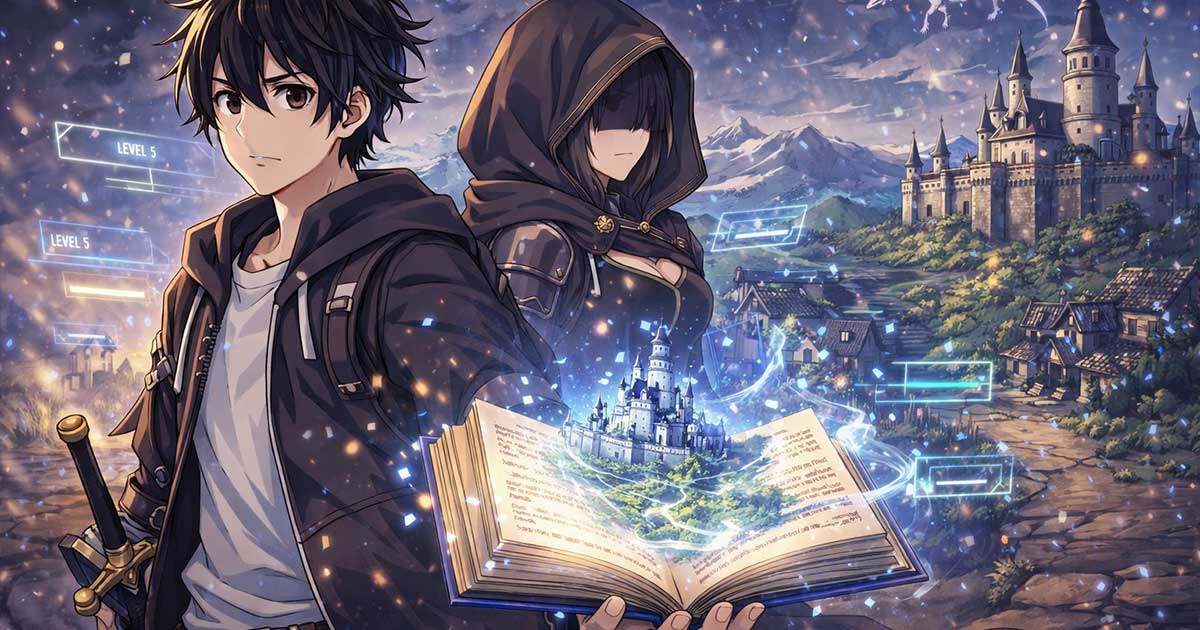

Fantasy Light Novel — Between worldbuilding, narrative pacing, and Japanese influences
Fantasy light novel stands at the intersection of fantasy and the light novel format. It builds on the foundations of fantasy—imaginary worlds, internal rules, epic or intimate stakes—while adapting them to a structure designed for readability, pacing, and serialization.
Writing a fantasy light novel introduces a central constraint: the density of the world must never slow down the reading experience. The universe must be clearly established, but without heavy exposition. This requires a precise command of the light novel style, where information is conveyed through action, dialogue, and the protagonist’s point of view.
This format often emphasizes progression: rising power, successive learning phases, training arcs, or narrative thresholds. These elements only remain effective if they stay aligned with the rules defined from the outset, which demands constant attention to narrative consistency and overall story rhythm.
The fantasy light novel is also shaped by strong Japanese inspirations, both in structure and in the way action, introspection, and character evolution are handled. This influence is not merely aesthetic; it directly affects how the story is segmented and experienced by the reader.
This section presents articles and analyses dedicated to the fantasy light novel as a demanding hybrid form: how to condense a rich universe, how to maintain immersion without overload, and how to use fantasy within a format built for narrative efficiency.
-

Inner Conflict as a Narrative Engine
This article explores inner conflict as a powerful narrative engine that deepens characters and strengthens reader engagement. It shows how dilemmas between competing values, goals, or needs create tension, fuel character transformation, and give weight to important decisions. The article clearly defines inner conflict, distinguishes it from emotions and personality traits, presents its main forms,…
-

Writing a Saga: Thinking in Volumes and Arcs
How do you structure a saga across multiple volumes? This article explores the differences between volumes, narrative arcs, and the overall saga while presenting an alternative approach based on progression threads. Through practical examples, planning methods, common mistakes, and a useful checklist, learn how to build a more coherent Fantasy, Light Novel, or Isekai series…
-

The Discipline of Writing Over the Long Term
Writing a novel over several months or several years rarely requires constant motivation. In practice, most authors who complete long projects mainly develop a writing discipline capable of withstanding: This article explains how to write regularly over the long term and develop a writing discipline capable of carrying a novel through to completion, especially in…
-

The Common Mistakes Western Authors Make When Imitating Japanese Light Novels
Why do Western authors often struggle to recreate the feeling of Japanese light novels, even when using familiar elements such as isekai settings, RPG systems, or anime-inspired archetypes? Over the past several years, more and more writers have tried to create light novels or isekai stories inspired by Japanese works. As a result, certain elements…
-

Write Natural Dialogue Without Repetition
How to Write Natural Dialogue Without Repetition Introduction: Why Some Dialogues Feel Artificial Most artificial dialogue does not come from vocabulary. It comes from a repetitive rhythm the writer no longer notices. The reaction then becomes almost automatic:to look for more synonyms. Yet in practice, this often makes the writing more noticeable without making the…
-

Why Light Novels Favor Internal Narration
In many light novels, especially within isekai and Japanese fantasy, one characteristic appears repeatedly: the significant emphasis placed on the protagonist’s thoughts. The reader does not merely see what the character does. They also hear their hesitations, reasoning, contradictions, immediate reactions, and interpretations of the world around them. For some Western readers, this approach can…
-

How I Build the Psychology of My Characters
A character’s psychology cannot be reduced to a sheet filled with personality traits. In many discussions surrounding Light Novels, Fantasy, or Isekai, character psychology is often presented as an accumulation of labels: introverted, cold, courageous, ENFP, traumatized, loyal, and so on. The problem is that these approaches frequently produce characters who are theoretically coherent… but…
-

Integrating Economy into Worldbuilding Without Weighing Down the Narrative
Why Economy Often Becomes a Problem in Worldbuilding Economy is one of the most difficult elements to integrate into a fantasy universe or a light novel isekai setting. When it is absent, the world quickly loses credibility. Cities seem to function “by magic,” armies appear without logistics, guilds feel as though they exist solely to…
-

Integrating Economics Into Worldbuilding Without Weighing Down the Narrative
The Real Problem Is Not the Economy The real problem is an economy that becomes invisible when it should carry weight. In many fantasy, Light Novel, or Isekai stories, the economy exists only on the surface of the world. Capitals are vast, yet nothing seems to sustain them.Armies cross entire continents with no visible logistics.Guilds…
-

The Power of Suggestion in Japanese Storytelling
Introduction: Why Suggestion Holds Such an Important Place in Japanese Storytelling Japanese storytelling often relies on a principle that surprises many Western readers: emotions are not always explained directly. In many light novels, manga, and anime, characters do not openly verbalize what they feel. Relationships evolve through hesitation, silence, incomplete gestures, or ambiguous reactions. For…