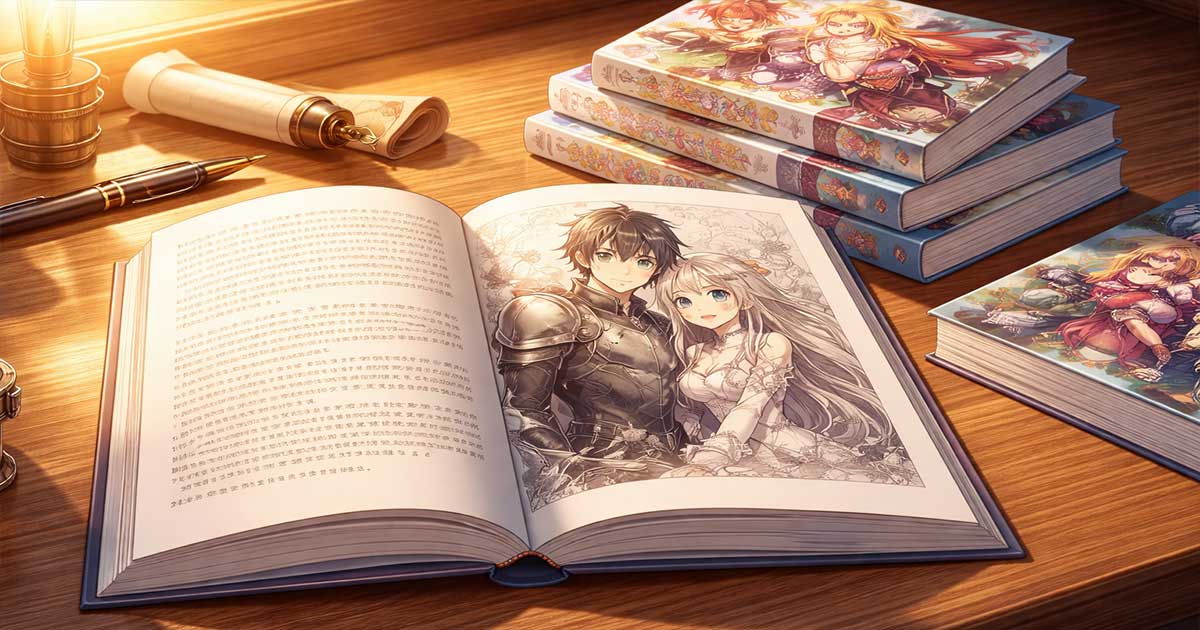

Light Novel — Analysis, writing, and specificities
The light novel constitutes a narrative format in its own right, whose specificities profoundly influence the way a story is written, structured, and paced. This section approaches the medium not as a simple derivative of the novel, but as a form of expression defined by its own codes, constraints, and narrative possibilities.
The perspective adopted here focuses on the close relationship between writing and readability, a defining trait of the light novel format. Volume-based structure, serialized progression, rhythm management, and the balance between narration, dialogue, and description are among the central elements examined. These formal choices directly shape how readers engage with a story over time.
A key aspect concerns the articulation between text and illustration. In light novels, imagery is not merely decorative; it contributes to character portrayal, atmosphere, and sometimes even to implicit narrative understanding. This interaction influences narrative focus and the construction of pivotal scenes.
The analysis also extends to genres frequently associated with this format, notably fantasy and isekai, whose narrative structures and conventions lend themselves particularly well to serialized storytelling. These elements are examined as narrative tools that can be understood, mastered, and adapted according to the intent of a given work.
This section therefore offers a space for reflection devoted to the light novel as a structured narrative format. It is intended for those who wish to analyze its mechanisms, understand its codes, and explore the creative possibilities it offers in terms of serialized storytelling and narrative efficiency.
-

Ranobe and Otaku Culture
Ranobe and Otaku Culture: How Light Novels Fit into the Japanese Media Mix Ranobe are closely connected to what is known in Japan as otaku culture. The term otaku refers to someone who is deeply passionate about a specific area of popular culture, often with an unusually high level of knowledge and involvement. In contemporary…
-

The World as a Mirror of the Protagonist
Introduction: moving beyond decorative worldbuilding In many light novels, isekai, and fantasy stories, the world is often treated as a simple backdrop: coherent, rich, but disconnected from the protagonist.This approach significantly limits narrative impact. In storytelling, narrative worldbuilding is not just about creating a coherent universe—it is about structuring the protagonist’s arc. Effective worldbuilding does…
-

The Importance of Focalization on the Protagonist
Introduction: Understanding Focalization in Light Novels and Isekai In a light novel—especially in isekai and fantasy—focalization is a core element of narrative writing. It determines the narrative point of view, the coherence of the story, and, above all, the reader’s immersion. Often confused with POV (point of view), focalization actually refers to the filter through…
-

Ranobe: Understanding the Japanese Light Novel Phenomenon
What Is a Ranobe? The term ranobe (ラノベ) is the Japanese abbreviation of raito noberu, a phonetic rendering of the English expression light novel. In modern Japanese, loanwords are often shortened for easier use. Over time, raito noberu became ra-nobe, and eventually simply ranobe. In Japan, the word refers to a specific type of illustrated…
-

Why Light Novels Are Not “Inferior” Fiction
Introduction: a widespread misunderstanding The term light novel is often misunderstood. When compared to traditional novels, it is frequently perceived as a simplified or lesser form of fiction. This perception is based on surface-level characteristics—shorter length, direct writing style, and the presence of illustrations—but it fails to reflect the actual nature of the format. In…
-

The Role of the Mentor in a Light Novel Isekai
In a light novel isekai, the mentor plays a central role in the protagonist’s progression. More than a simple guide, they shape the character’s transformation, influence their decisions, and directly contribute to their development. But unlike in traditional fantasy, the mentor in an isekai is not meant to accompany the hero all the way to…
-

Worldbuilding Guide for Isekai
Worldbuilding Guide for Isekai: Building Another World Without Losing Narrative Tension The Core Principle: A Rule Revealed Through Failure A magic system should never be explained before it is experienced. Mini-scene 1 — The Rule Revealed Through Collapse The protagonist attempts to activate an inherited power for the first time.He has been told he is…
-

How to Avoid Inconsistent Magic Systems
Magic systems are at the core of worldbuilding in fantasy, light novels, and isekai. Yet many become inconsistent, weakening both narrative tension and the credibility of the story. Building a coherent magic system is not about making it realistic, but about ensuring narrative consistency, clarity, and integration within the broader world. Here is a clear…
-

Isekai Novel vs. Isekai Light Novel
Isekai Novel vs. Isekai Light Novel: Understanding the Narrative Distinction The isekai genre is now global. But not all isekai works fall under the category of light novels. Confusing an isekai novel with an isekai light novel means mixing two distinct narrative approaches. The difference is not merely about format or length—it concerns structure, pacing,…
-

Can You Write a Light Novel in the West Without Losing Its Essence?
The global popularity of light novels, especially within fantasy and isekai settings, raises an increasingly common question among Western authors: Is it possible to write a light novel in the West without losing what makes the genre unique? At first glance, the answer may seem obvious. The narrative codes are visible, the tropes are recognizable,…