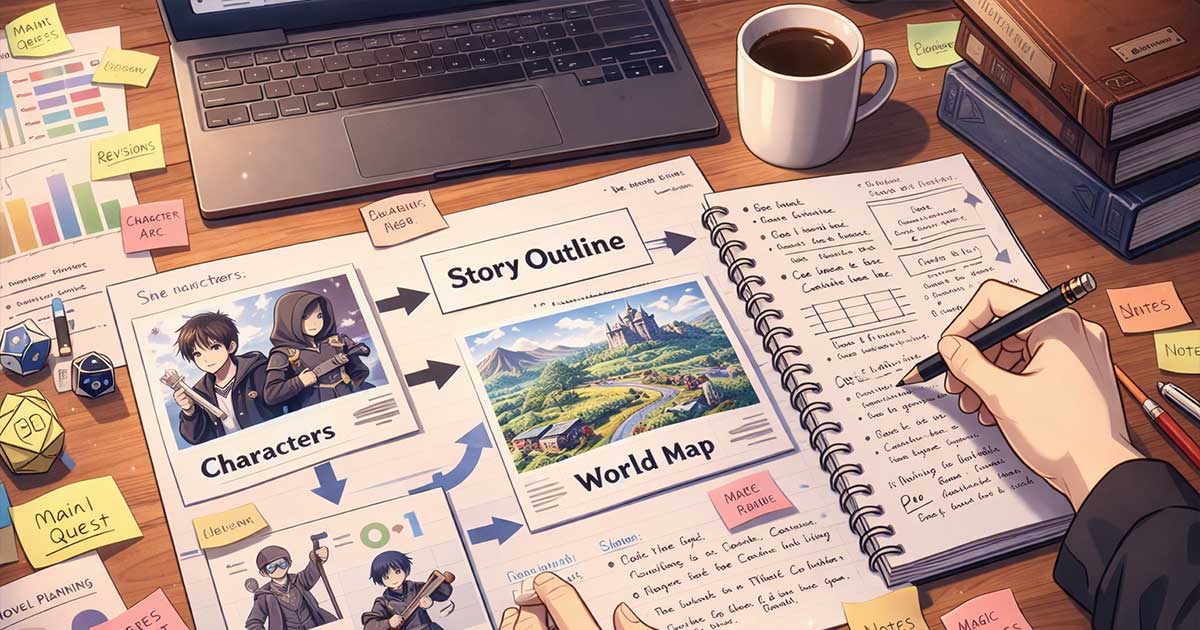

Writing — Methods, analysis, and behind-the-scenes craft
Writing forms the foundation upon which all dimensions of a narrative are built: storytelling, characters, worlds, and progression. This section approaches writing not as spontaneous inspiration, but as a structured process shaped by deliberate choices, techniques, and narrative trade-offs.
The focus here lies on the construction of a story: structural organization, rhythm management, character development, and the articulation between plot, world, and stakes. Writing is examined as a coherent set of mechanisms whose mastery determines readability, emotional impact, and narrative solidity.
Insights drawn from the development of the series ISEKAI – The Otherworlder’s Heir are used as concrete reference points. Reflections on narrative decisions, progressive refinements, and constraints specific to serialized storytelling help illustrate how a work evolves over time, from initial intent to published form.
Particular attention is given to writing practices as they apply to light novels and isekai. The conventions, reader expectations, and narrative tools specific to these formats are examined to show how writing choices adapt to a defined framework without compromising coherence or depth.
This space is intended for readers and writers seeking to better understand the mechanics of storytelling. It offers analytical perspectives and experience-based insights aimed at refining narrative method, critical awareness, and long-term creative consistency.
-

The Role of the Mentor in a Light Novel Isekai
In a light novel isekai, the mentor plays a central role in the protagonist’s progression. More than a simple guide, they shape the character’s transformation, influence their decisions, and directly contribute to their development. But unlike in traditional fantasy, the mentor in an isekai is not meant to accompany the hero all the way to…
-

Regaining Control Over Your Files in the Face of Microsoft’s Opaque Mechanisms
This article explains how to prevent Word from using the cloud and enforce local saving. The Opaque Strategy of Microsoft Office The evolution of Microsoft Office tools is accompanied by a gradual shift toward the cloud. In practice, this transition does not occur in a transparent manner. It operates in a largely opaque way, without…
-

Can You Write a Light Novel in the West Without Losing Its Essence?
The global popularity of light novels, especially within fantasy and isekai settings, raises an increasingly common question among Western authors: Is it possible to write a light novel in the West without losing what makes the genre unique? At first glance, the answer may seem obvious. The narrative codes are visible, the tropes are recognizable,…
-

Showing Rather Than Naming: A Key Principle of Japanese Narrative
In many Japanese narratives—whether light novels, manga, or anime—characters’ emotions and intentions are rarely stated directly. Instead of declaring what a character feels or thinks, the narrative reveals it through actions, gestures, or reactions. When encountering a Japanese light novel for the first time, this emotional restraint can sometimes be surprising. Characters often express their…
-

The Narrative Style of the Light Novel: Inner Voice, Intimacy, and Reader Alignment
The light novel is not merely an editorial format. It is a narrative stance. A direct relationship with the reader. A deliberately embraced sense of proximity. A mode of writing that favors inner voice, immediate emotion, and the gradual alignment between protagonist and audience. In ISEKAI The Otherworlder’s Heir, this principle is fully embraced. The…
-

Authority Figures in Fantasy Light Novels
Authority Figures in ISEKAI The Otherworlder’s Heir In many fantasy and isekai light novel stories, a protagonist’s development does not rely solely on adventure or the acquisition of new powers. It often depends on a network of authority figures that shape the hero’s psychology, values, and place in the world. These figures go beyond the…
-

Writing Light Novel Dialogue: Efficiency, Subtext, and Emotional Impact
In a light novel, dialogue is not narrative filler.In an isekai, it becomes a lens for cultural dissonance.In fantasy, it shapes power dynamics. In ISEKAI The Otherworlder’s Heir, every exchange is designed as a miniature dramatic confrontation, even when it appears light on the surface. Here is how. Subtext: What Is Left Unsaid Creates Tension…
-

Choosing the Narrative Tense in a Light Novel
Which narrative tense should you use when writing a light novel?Should an isekai or fantasy light novel be written in the present or in the past? This question often comes up among aspiring authors. Yet when we look at the dominant practices of Japanese storytelling, a clear pattern emerges: most light novels rely on past-tense…
-

Serialization as a Narrative Engine in Japanese Storytelling
Although serialization is often associated with dramatic tension, certain Japanese narrative structures rely on a slightly different logic. Kishōtenketsu is a notable example. This classical structure consists of four stages: Unlike Western narrative models that primarily revolve around conflict, this structure places greater emphasis on surprise or revelation. In modern serialized storytelling, this logic can…
-

Writing a Child Protagonist Without Infantilizing Them
In many light novels, especially in isekai and fantasy stories, choosing a child as the protagonist is not merely a narrative gimmick. It follows a specific narrative logic: showing the formation of a consciousness, allowing the reader to witness the evolution of a character before their personality has fully crystallized. This approach differs from certain…