
Articles & Writing Insights
Welcome to the section dedicated to writing and to the behind-the-scenes of my work as an author.
Here you will find articles about light novels, worldbuilding, isekai storytelling, narrative development, and the creative methods behind the series ISEKAI The Otherworlder’s Heir.
Whether I’m sharing writing tips, reflecting on pacing or world design, discussing illustration, or exploring creative decisions, this page gathers all the content that reveals how a story comes to life.
Whether you are a curious reader, a fantasy enthusiast, or an aspiring writer looking for guidance, I hope these articles offer a helpful and inspiring perspective.
Recent posts
-
Manga Adapted from a Light Novel: What Really Changes in the Narrative

Why do some manga adaptations of a Light Novel feel faster, more spectacular, yet sometimes less psychologically dense?Why do others successfully condense the story without weakening its emotional weight? The answer lies not in quality, but in structure. When a story moves from a textual system to a visual system, it undergoes a form of…
-
Magical Systems in Isekai: Rules, Limits, and Narrative Stakes

In an isekai story, magic is never just background decoration. It structures the world, defines social hierarchies, shapes conflicts, and guides the protagonist’s arc. In a light novel, it also becomes a rhythmic engine: progression, revelations, limitations, and strategy. Understanding how to design a coherent magical system is essential for writing a strong and lasting…
-
The Psychological Evolution of Arius Across the Volumes

Introduction — Fragility and Coherence in an Isekai Light Novel In a Light Novel, and especially in an isekai fantasy, character progression is often associated with rising power. Yet power alone does not create long-term reader attachment. What truly sustains engagement is psychological coherence. In this article, I examine Arius’s psychological evolution across the volumes,…
-
Writing a Fantasy Saga Differently: The Narrative Skeleton Before the Text
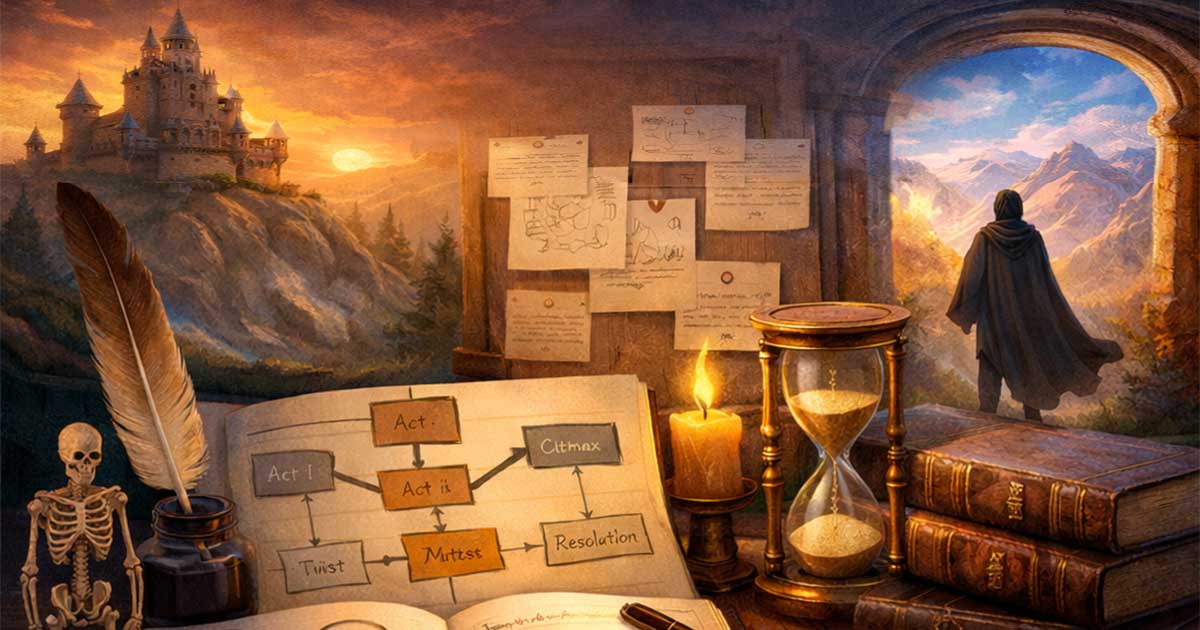
Before drafting the first line of a novel, it is possible to build the story as an architectural structure. This approach, which I call the narrative skeleton, consists of fixing the progression of events before telling them. It offers a structured way to plan a saga and to work on narrative arcs with a clear,…
-
Understanding the Difference Between Isekai and Fantasy
Isekai vs Fantasy: What Truly Sets Them Apart Confusion between isekai and fantasy is common, particularly when the isekai genre is first encountered through contemporary light novels. Yet the difference between isekai and fantasy is not merely a matter of vocabulary—it lies in the very structure of the narrative. Fantasy refers to a broad literary…
-
Lineage, Legacy, and Narrative Responsibility in an Isekai
Isekai worldbuilding, legacy, and power in fantasy In an isekai story, changing worlds does not always mean starting from nothing. Sometimes, the past is already waiting there—embedded in a name, a bloodline, or a lineage the world recognizes long before the protagonist understands its weight. This article explores lineage and legacy in isekai worldbuilding, not…
-
What an Independent Author Can Build That No One Else Ever Will
When people talk about publishing, the discussion often focuses on visibility, distribution, or advertising. Traditional publishers undeniably have strong assets in this area: established networks, access to bookstores, sometimes even media exposure. It would be pointless to deny that. Yet this comparison overlooks a more fundamental reality: publishers and independent authors do not operate under…
-
Common Mistakes When Writing an Isekai
Writing an isekai often feels deceptively easy. The genre is codified, popular, and extensively explored. Many beginner writers are drawn to it thinking that following a few formulas is enough to produce an effective story. In reality, it is precisely this apparent accessibility that makes it a particularly demanding field. The most common mistakes do…
-
How to Write a Light Novel: From Concept to Volume Structure
Most light novel projects fail not because of style, but because of structure. Writing a light novel is not about telling a simplified long story. It is a precise architecture, designed for serialization, emotional progression, and sustained tension. Pasted text When applied to the isekai fantasy genre, every structural decision becomes even more strategic: the…
-
Why Light Novels Emphasize Action and Inner Monologue

Light novels often prioritize action and inner monologue, a narrative choice that frequently puzzles readers accustomed to Western fantasy novels. This orientation is sometimes perceived as a simplification of writing or a stylistic weakness. In reality, it rests on a coherent narrative logic, closely tied to the structure of the medium and the reading experience…