

Writing method — Process, discipline, and craft tools to write, rewrite, and sustain a series
Writing method does not refer to a universal formula or a rigid framework applied mechanically. It describes a conscious, evolving approach through which an author structures their work, organizes ideas, and gives form to what they seek to convey. Behind every accomplished text lies a method—sometimes intuitive, sometimes deliberate—always shaped by experience.
Writing involves constant choices: point of view, pacing, scene construction, and the management of information. The way an author approaches narration, develops narrative writing, or maintains narrative coherence is rarely the result of pure improvisation. A method helps channel inspiration without suffocating it, offering structure when uncertainty arises.
In speculative fiction, this structuring becomes even more essential. Building a fantasy world, developing a coherent worldbuilding, or articulating a consistent lore requires careful organization. Writing methods act as a guiding thread between the universe, the characters, and the plot, preventing inconsistencies and tonal breaks.
A method is never fixed. It evolves with projects, reading habits, and practical constraints. Some authors rely on detailed planning, others progress through successive adjustments, allowing the text to transform through revision. In every case, a writing method is built over time, through direct engagement with the text, and becomes an integral part of the author’s journey.
rassembleuse in nature, this section offers reflections, analyses, and experience-based insights into writing methods, shedding light on the structural choices that transform narrative intention into a controlled, coherent, and living text.
-

Serialization as a Narrative Engine in Japanese Storytelling
Although serialization is often associated with dramatic tension, certain Japanese narrative structures rely on a slightly different logic. Kishōtenketsu is a notable example. This classical structure consists of four stages: Unlike Western narrative models that primarily revolve around conflict, this structure places greater emphasis on surprise or revelation. In modern serialized storytelling, this logic can…
-

Writing a Child Protagonist Without Infantilizing Them
In many light novels, especially in isekai and fantasy stories, choosing a child as the protagonist is not merely a narrative gimmick. It follows a specific narrative logic: showing the formation of a consciousness, allowing the reader to witness the evolution of a character before their personality has fully crystallized. This approach differs from certain…
-

Mana and Aether: How Fantasy Reinvents the Sources of Magic
Mana and aether have become two central concepts in modern fantasy. Whether we are speaking about high fantasy, RPGs, or light novel isekai, these two terms structure a significant part of contemporary magic systems. But what do they actually mean?Is there an official definition?Are they interchangeable, or fundamentally different? In this article, we will compare…
-

The Rhythm in Light Novels: Narrative Pace, Emotional Beats, and Reader Engagement
Understanding narrative rhythm in a light novel—and even more so the rhythm in an isekai—is essential to maintaining reader engagement. Contrary to a common misconception, rhythm is not simply a matter of speed. It is a precise rhythmic structure that organizes emotions, revelations, and narrative progression. In ISEKAI The Otherworlder’s Heir, rhythm management is not…
-

Light Novel — How to Find Your Voice in a Codified Genre
In a Light Novel, whether it is an Isekai or a more traditional Fantasy, creativity never operates outside a framework. It unfolds within established narrative conventions: progression, archetypes, power systems, accessible rhythm, and clear focalization. That framework is neither restrictive nor limiting. It is the terrain on which an authorial voice becomes visible. The real…
-
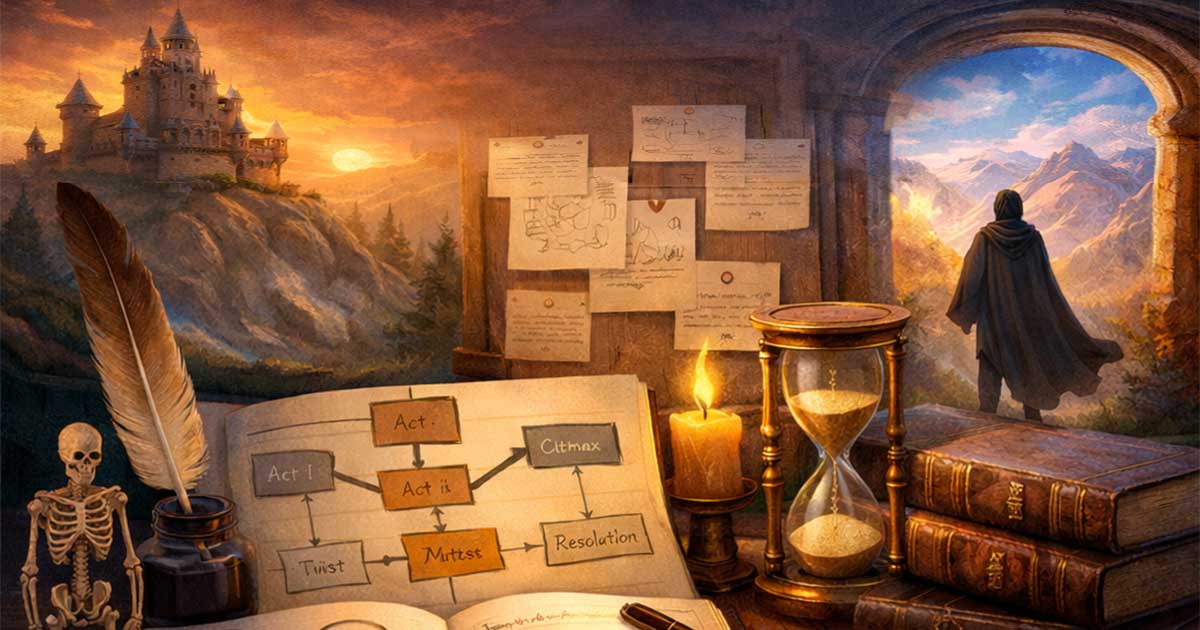
Writing a Fantasy Saga Differently: The Narrative Skeleton Before the Text
Before drafting the first line of a novel, it is possible to build the story as an architectural structure. This approach, which I call the narrative skeleton, consists of fixing the progression of events before telling them. It offers a structured way to plan a saga and to work on narrative arcs with a clear,…
-
What an Independent Author Can Build That No One Else Ever Will
When people talk about publishing, the discussion often focuses on visibility, distribution, or advertising. Traditional publishers undeniably have strong assets in this area: established networks, access to bookstores, sometimes even media exposure. It would be pointless to deny that. Yet this comparison overlooks a more fundamental reality: publishers and independent authors do not operate under…
-
Lineage, Legacy, and Narrative Responsibility in an Isekai
Isekai worldbuilding, legacy, and power in fantasy In an isekai story, changing worlds does not always mean starting from nothing. Sometimes, the past is already waiting there—embedded in a name, a bloodline, or a lineage the world recognizes long before the protagonist understands its weight. This article explores lineage and legacy in isekai worldbuilding, not…
-

How to Write a Light Novel: From Concept to Volume Structure
Most light novel projects fail not because of style, but because of structure. Writing a light novel is not about telling a simplified long story. It is a precise architecture, designed for serialization, emotional progression, and sustained tension. Pasted text When applied to the isekai fantasy genre, every structural decision becomes even more strategic: the…
-

Why Light Novels Emphasize Action and Inner Monologue
Light novels often prioritize action and inner monologue, a narrative choice that frequently puzzles readers accustomed to Western fantasy novels. This orientation is sometimes perceived as a simplification of writing or a stylistic weakness. In reality, it rests on a coherent narrative logic, closely tied to the structure of the medium and the reading experience…