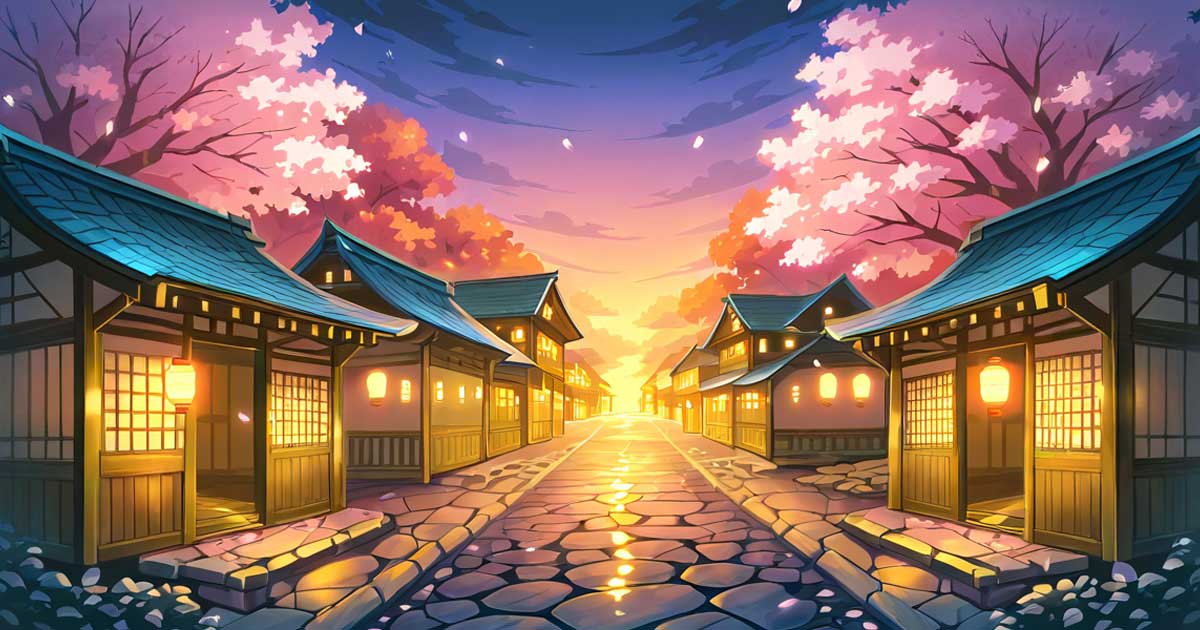

Japanese inspirations — Narrative sensibility, rhythm, and the art of implication
Japanese inspirations hold a distinctive place in contemporary fantasy, and even more so within the light novel tradition. They are not limited to recognizable aesthetics or surface references, but stem from a particular way of thinking about storytelling. They shape how a narrative unfolds, how emotions are suggested rather than stated, and how a world reveals itself gradually instead of through direct exposition.
This approach often favors lived experience over explanation. Silence carries as much weight as dialogue, gestures become narrative signals, and repetition functions as a tool of rhythm rather than a flaw. This sensibility directly informs narrative consistency, where each scene flows into the next without rupture, as well as narrative writing that embraces implication, restraint, and slow progression as strengths.
Japanese influences also shape the way characters evolve. Growth is not always linear or spectacular; it often emerges through small decisions, hesitation, and quiet failures. This perspective feeds into character development and strengthens immersion, leaving space for the reader to project emotions and meaning rather than having everything spelled out.
These influences naturally resonate with genres such as isekai, manga, and light novel style, where the world is never static but constantly reshaped through the protagonist’s perception. They encourage authors to think of their universe as a sensitive, evolving space—sometimes fragmented—rather than a fully mapped system defined from the outset.
This section brings together articles that examine Japanese inspirations in their many forms: their cultural roots, their impact on narrative structure and character portrayal, and the ways they can enrich modern fantasy without imitation, in service of a coherent universe and a compelling reading experience.
-

Why Light Novels Favor Internal Narration
In many light novels, especially within isekai and Japanese fantasy, one characteristic appears repeatedly: the significant emphasis placed on the protagonist’s thoughts. The reader does not merely see what the character does. They also hear their hesitations, reasoning, contradictions, immediate reactions, and interpretations of the world around them. For some Western readers, this approach can…
-

Integrating Economy into Worldbuilding Without Weighing Down the Narrative
Why Economy Often Becomes a Problem in Worldbuilding Economy is one of the most difficult elements to integrate into a fantasy universe or a light novel isekai setting. When it is absent, the world quickly loses credibility. Cities seem to function “by magic,” armies appear without logistics, guilds feel as though they exist solely to…
-

The Power of Suggestion in Japanese Storytelling
Introduction: Why Suggestion Holds Such an Important Place in Japanese Storytelling Japanese storytelling often relies on a principle that surprises many Western readers: emotions are not always explained directly. In many light novels, manga, and anime, characters do not openly verbalize what they feel. Relationships evolve through hesitation, silence, incomplete gestures, or ambiguous reactions. For…
-

The Relationship to the Reader in Japanese Narrative: Understanding and Reproducing Immersive Storytelling
Introduction: Why Japanese Narratives Feel More Immersive In many light novels, isekai works, and Japanese fantasy narratives, a recurring phenomenon can be observed: the reader does not merely watch the story unfold — they experience it. This sense of immersion does not stem solely from stylistic choices or worldbuilding quality. It arises from a precise…
-

Ranobe and Otaku Culture
Ranobe and Otaku Culture: How Light Novels Fit into the Japanese Media Mix Ranobe are closely connected to what is known in Japan as otaku culture. The term otaku refers to someone who is deeply passionate about a specific area of popular culture, often with an unusually high level of knowledge and involvement. In contemporary…
-

The Importance of Focalization on the Protagonist
Introduction: Understanding Focalization in Light Novels and Isekai In a light novel—especially in isekai and fantasy—focalization is a core element of narrative writing. It determines the narrative point of view, the coherence of the story, and, above all, the reader’s immersion. Often confused with POV (point of view), focalization actually refers to the filter through…
-

Ranobe: Understanding the Japanese Light Novel Phenomenon
What Is a Ranobe? The term ranobe (ラノベ) is the Japanese abbreviation of raito noberu, a phonetic rendering of the English expression light novel. In modern Japanese, loanwords are often shortened for easier use. Over time, raito noberu became ra-nobe, and eventually simply ranobe. In Japan, the word refers to a specific type of illustrated…
-

Why Light Novels Are Not “Inferior” Fiction
Introduction: a widespread misunderstanding The term light novel is often misunderstood. When compared to traditional novels, it is frequently perceived as a simplified or lesser form of fiction. This perception is based on surface-level characteristics—shorter length, direct writing style, and the presence of illustrations—but it fails to reflect the actual nature of the format. In…
-

Can You Write a Light Novel in the West Without Losing Its Essence?
The global popularity of light novels, especially within fantasy and isekai settings, raises an increasingly common question among Western authors: Is it possible to write a light novel in the West without losing what makes the genre unique? At first glance, the answer may seem obvious. The narrative codes are visible, the tropes are recognizable,…
-

Showing Rather Than Naming: A Key Principle of Japanese Narrative
In many Japanese narratives—whether light novels, manga, or anime—characters’ emotions and intentions are rarely stated directly. Instead of declaring what a character feels or thinks, the narrative reveals it through actions, gestures, or reactions. When encountering a Japanese light novel for the first time, this emotional restraint can sometimes be surprising. Characters often express their…