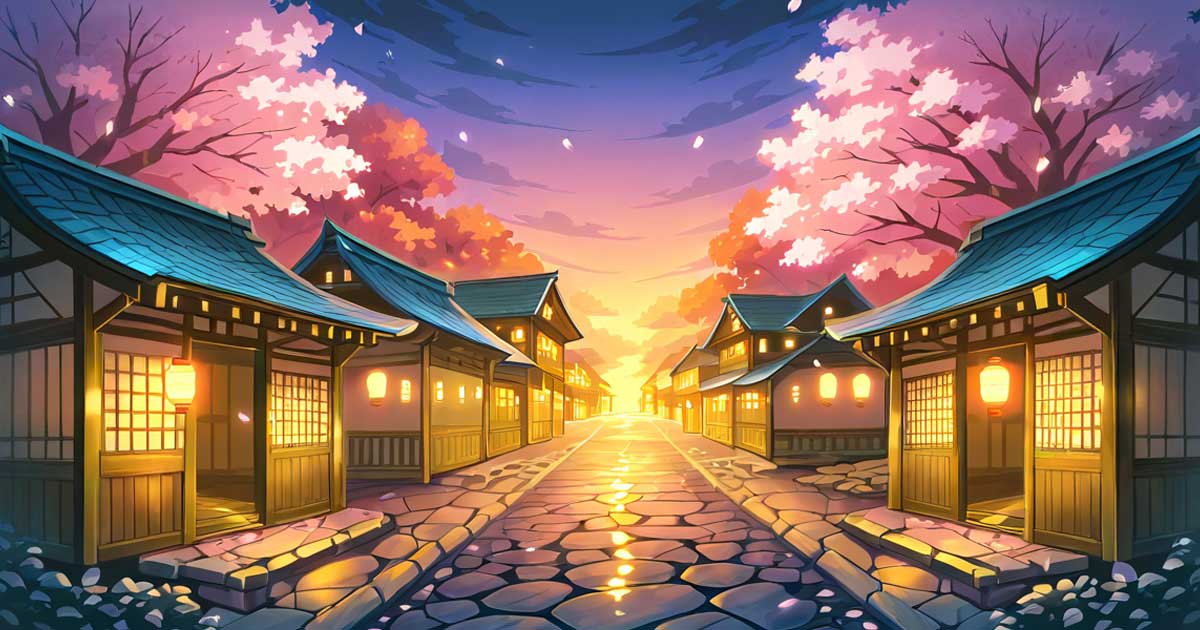

Japanese inspirations — Narrative sensibility, rhythm, and the art of implication
Japanese inspirations hold a distinctive place in contemporary fantasy, and even more so within the light novel tradition. They are not limited to recognizable aesthetics or surface references, but stem from a particular way of thinking about storytelling. They shape how a narrative unfolds, how emotions are suggested rather than stated, and how a world reveals itself gradually instead of through direct exposition.
This approach often favors lived experience over explanation. Silence carries as much weight as dialogue, gestures become narrative signals, and repetition functions as a tool of rhythm rather than a flaw. This sensibility directly informs narrative consistency, where each scene flows into the next without rupture, as well as narrative writing that embraces implication, restraint, and slow progression as strengths.
Japanese influences also shape the way characters evolve. Growth is not always linear or spectacular; it often emerges through small decisions, hesitation, and quiet failures. This perspective feeds into character development and strengthens immersion, leaving space for the reader to project emotions and meaning rather than having everything spelled out.
These influences naturally resonate with genres such as isekai, manga, and light novel style, where the world is never static but constantly reshaped through the protagonist’s perception. They encourage authors to think of their universe as a sensitive, evolving space—sometimes fragmented—rather than a fully mapped system defined from the outset.
This section brings together articles that examine Japanese inspirations in their many forms: their cultural roots, their impact on narrative structure and character portrayal, and the ways they can enrich modern fantasy without imitation, in service of a coherent universe and a compelling reading experience.
-

Choosing the Narrative Tense in a Light Novel
Which narrative tense should you use when writing a light novel?Should an isekai or fantasy light novel be written in the present or in the past? This question often comes up among aspiring authors. Yet when we look at the dominant practices of Japanese storytelling, a clear pattern emerges: most light novels rely on past-tense…
-

Serialization as a Narrative Engine in Japanese Storytelling
Although serialization is often associated with dramatic tension, certain Japanese narrative structures rely on a slightly different logic. Kishōtenketsu is a notable example. This classical structure consists of four stages: Unlike Western narrative models that primarily revolve around conflict, this structure places greater emphasis on surprise or revelation. In modern serialized storytelling, this logic can…
-

Non-Western Temporal Models in Isekai and Fantasy Worlds
Although many fantasy worlds draw inspiration from medieval Europe, isekai settings are deeply influenced by Asian history. Several historical periods offer rich foundations for fantasy worldbuilding. Feudal Japan (Heian, Kamakura, Edo periods) These eras rely on a social structure very different from European feudalism. Key characteristics: Mini narrative scenario In a kingdom inspired by feudal…
-

Mana and Aether: How Fantasy Reinvents the Sources of Magic
Mana and aether have become two central concepts in modern fantasy. Whether we are speaking about high fantasy, RPGs, or light novel isekai, these two terms structure a significant part of contemporary magic systems. But what do they actually mean?Is there an official definition?Are they interchangeable, or fundamentally different? In this article, we will compare…
-

Fantasy Books
Fantasy Books: Exploring the Unique Richness of Japanese Fantasy When people talk about fantasy books, many immediately think of medieval kingdoms, dragons, and heroic quests typical of Western fantasy. But by turning our gaze slightly eastward, we discover another way of dreaming: a form of Japanese fantasy with its own rhythm, atmosphere, philosophy, and emotional…
-
5 Common Mistakes When Writing an Isekai (And Why Most Stories Fail)
Writing an isekai often feels deceptively easy. The genre is codified, popular, and extensively explored. Many beginner writers are drawn to it thinking that following a few formulas is enough to produce an effective story. In reality, it is precisely this apparent accessibility that makes it a particularly demanding field. The most common mistakes do…
-
Why I Chose to Write an Isekai
Reader frustrations, authorial choice, and an assumed narrative framework Introduction — Why isekai naturally imposed itself I did not choose to write an isekai because it was fashionable.It imposed itself on me as the most natural response to my frustrations as a reader and to my ambitions as an author. Before writing, I spent a…
-
Understanding Kishōtenketsu in Light Novels
Why some Japanese stories do not revolve around conflict, but around a path Introduction When Western readers encounter a Japanese light novel — and even more so an isekai — they may experience a form of narrative dissonance that is difficult to articulate. The story seems to progress slowly. Certain scenes appear anecdotal. Important elements…
-
Japanese Narrative vs Western Narrative
Foundations and Narrative Framework Introduction The question of Japanese narrative versus Western narrative is not merely a matter of cultural contrast. It involves structural choices, a philosophy of storytelling, and a different relationship between author, character, and reader. In the context of light novels and, more specifically, isekai, this difference becomes not only visible, but…
-
Writing with Artificial Intelligence: Method and Limits
Method, Tone, and Tools Writing a light novel means constantly balancing emotion, coherence, and readability. Artificial intelligence helps me maintain that balance—without ever taking the pen from my hands. Writing Choices Writing is built on precise choices: level of language, tone, rhythm, and point of view. In a light novel, these elements are decisive. I…