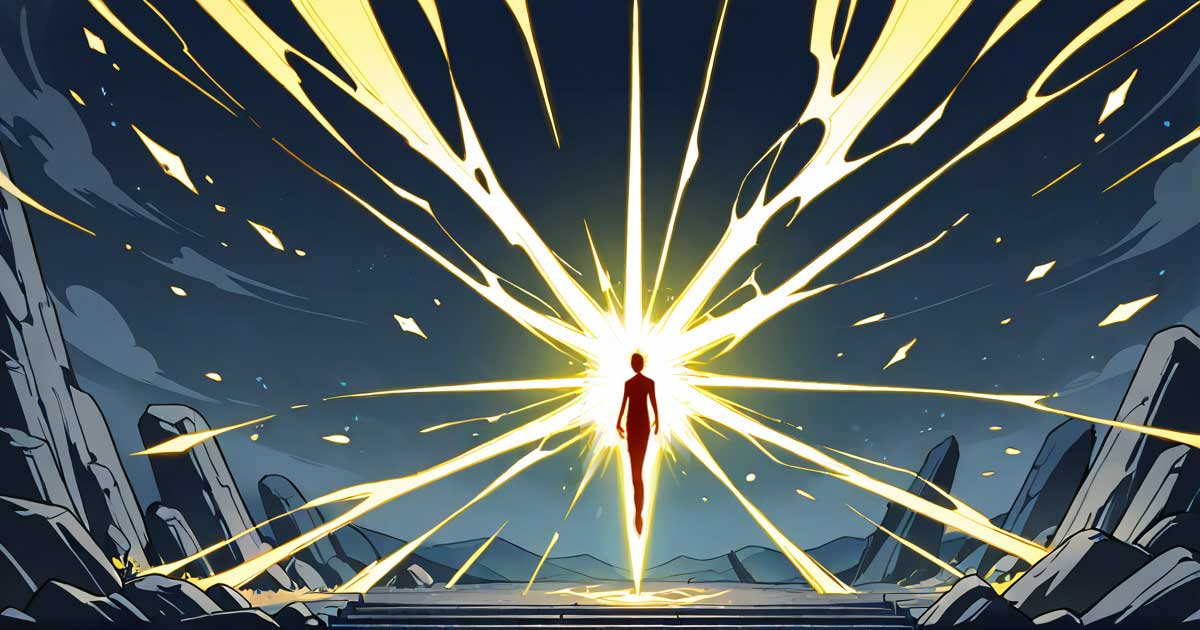

Power scaling — Curves, gaps, and progression stakes
Power growth is one of the most delicate engines in fantasy storytelling. It is not merely about becoming stronger, but about learning to control new abilities, paying their cost, and facing the consequences that come with them. When handled well, it gives the reader a clear and almost physical sense of progression, without reducing characters to simple numbers.
In isekai and light novel narratives, power growth often sits at the heart of the reading experience. It structures anticipation, shapes narrative arcs, and turns each challenge into a meaningful step forward. Power gained too quickly weakens tension; progress that is too slow drains momentum. The balance lies in sustaining immersion while preserving the internal logic of the world.
This dynamic closely interacts with game mechanics. Level systems, unlocked skills, limitations imposed by fatigue, magic, or experience provide an invisible framework that structures advancement. They support the evolution of skills and directly shape power progression, reinforcing narrative consistency and preventing arbitrary outcomes.
Yet power growth is never purely mechanical. It affects psychology, relationships, and a protagonist’s place within the world. Each victory alters how others perceive the character, attracts new threats, and creates expectations. In a fantasy world, growing stronger can mean losing innocence, disrupting political balances, or even igniting a fantasy war. This is where worldbuilding gives true depth to progression.
This section brings together articles that analyze and contextualize power growth as a narrative tool, a dramatic driver, and a long-term structural element, shedding light on how it shapes story arcs, characters, and the reader’s experience over time.
-

Integrating Economics Into Worldbuilding Without Weighing Down the Narrative
The Real Problem Is Not the Economy The real problem is an economy that becomes invisible when it should carry weight. In many fantasy, Light Novel, or Isekai stories, the economy exists only on the surface of the world. Capitals are vast, yet nothing seems to sustain them.Armies cross entire continents with no visible logistics.Guilds…
-

How Light Novels Use Short-Arc Structure
Introduction: an often invisible mechanism This structural choice directly shapes how a reader enters, leaves, and returns to a story. Understanding this structure is not only a matter of analyzing a narrative format.It means acquiring a directly usable tool for structuring a fantasy light novel effectively. Definition: what is a short arc in a light…
-

The Role of the Mentor in a Light Novel Isekai
In a light novel isekai, the mentor plays a central role in the protagonist’s progression. More than a simple guide, they shape the character’s transformation, influence their decisions, and directly contribute to their development. But unlike in traditional fantasy, the mentor in an isekai is not meant to accompany the hero all the way to…
-

Serialization as a Narrative Engine in Japanese Storytelling
Although serialization is often associated with dramatic tension, certain Japanese narrative structures rely on a slightly different logic. Kishōtenketsu is a notable example. This classical structure consists of four stages: Unlike Western narrative models that primarily revolve around conflict, this structure places greater emphasis on surprise or revelation. In modern serialized storytelling, this logic can…
-

The Optimal Structure of an Isekai: Conflict, Progression, and Revelation
An effective isekai does not rely solely on transporting the protagonist into another world. This starting point is a catalyst, not a narrative structure. Understanding the best structure for an isekai light novel means organizing three fundamental forces: conflict, progression, and revelation. In ISEKAI The Otherworlder’s Heir, this narrative architecture forms the backbone of the…
-

Archetypes of Protagonists in Isekai
Archetypes of Protagonists in Isekai: From Fantasized Power to Moral Burden Isekai is not merely about changing worlds. It rests on a precise narrative promise: that of a protagonist placed in a radically new environment, where his abilities, choices, and responsibilities redefine his identity. In isekai light novels, this promise often takes the form of…
-
5 Common Mistakes When Writing an Isekai (And Why Most Stories Fail)
Writing an isekai often feels deceptively easy. The genre is codified, popular, and extensively explored. Many beginner writers are drawn to it thinking that following a few formulas is enough to produce an effective story. In reality, it is precisely this apparent accessibility that makes it a particularly demanding field. The most common mistakes do…
-
How to Write a Light Novel: From Concept to Volume Structure
Most light novel projects fail not because of style, but because of structure. Writing a light novel is not about telling a simplified long story. It is a precise architecture, designed for serialization, emotional progression, and sustained tension. Pasted text When applied to the isekai fantasy genre, every structural decision becomes even more strategic: the…
-
Why Some Light Novels Last (Arcs, Pacing, and Long-Term Structure)
Why Do Some Isekai Sagas Endure… While Others Collapse? Why do some isekai series surpass ten volumes while maintaining narrative tension, while others lose momentum after only a few books? The answer rarely lies in the initial concept.It lies in the structure of the light novel. A light novel is a serialized novel of Japanese…
-
Why Isekai Works So Well: Immersion, Progression, and Narrative Fantasy
Introduction Isekai is not merely a subgenre of Japanese fantasy. It is an extremely effective narrative device, designed to quickly capture the reader, immerse them in a codified world, and guide them through a gradual rise in power. If it works so well—whether in light novels, manga, or anime—it is neither by chance nor a…