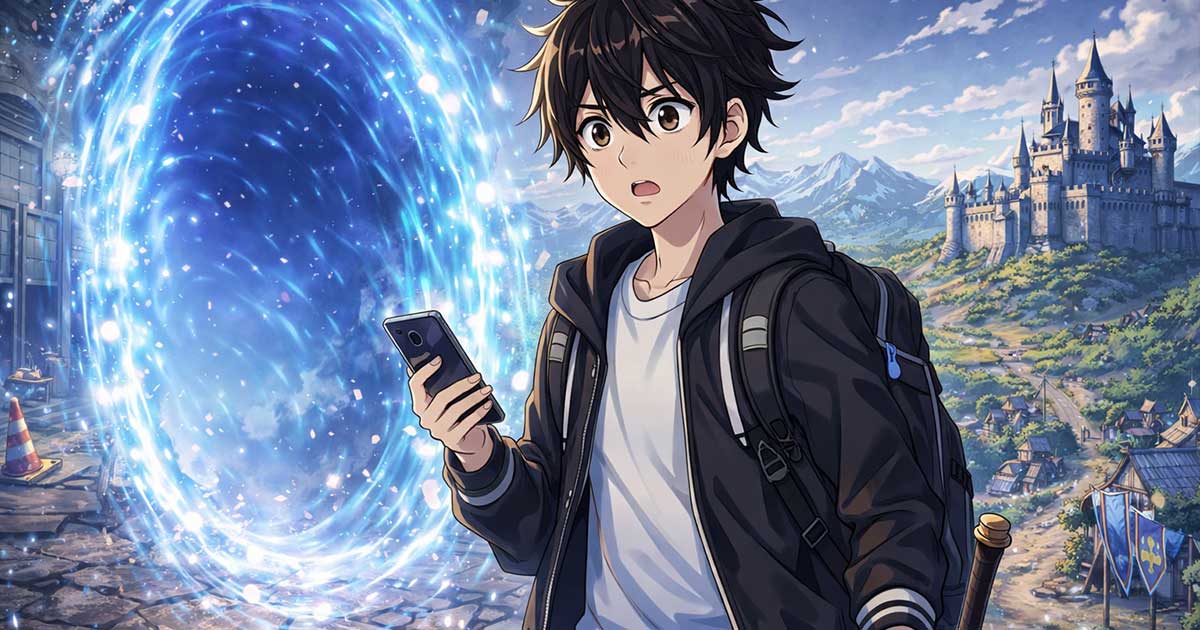

Transported to another world — Abrupt departure and new bearings
Transported to another world describes a narrative device built on a sudden rupture with familiar reality. The protagonist leaves their original world—willingly or not—and finds themselves immersed in a universe governed by different laws, values, and stakes. This passage marks a turning point: it immediately redefines both the character’s identity and the framework within which the story unfolds.
This transition can take many forms. It may occur through an abrupt transportation, a ritual summoning, an unexplained phenomenon, or a gradual shift into a parallel world. Whatever its modality, the passage creates a clear divide between before and after. The character does not merely cross a space; they enter a new world logic, with its own implicit rules and narrative possibilities.
This device is closely associated with isekai, but it extends far beyond that genre. Being transported to another world allows stories to explore the contrast between an individual and an unfamiliar environment, while offering the reader a strong point of narrative orientation. Memories of the original world become a tool for comparison, tension, or moral reference when confronted with a fantasy world shaped by different principles.
Such narratives also open the door to arcs of adaptation and progression. The protagonist must learn, observe, and often transform in order to survive and find their place. Systems of magic, social structures, and world mechanics become central to the journey. The act of transportation functions as a catalyst, revealing both the character’s limits and their potential.
This section brings together articles devoted to stories built around being transported to another world. The texts gathered here explore the forms this passage can take, its narrative implications, and the ways it shapes fictional worlds, character arcs, and reading experiences centered on discovery, rupture, and transformation.
-
Understanding the Difference Between Isekai and Fantasy
Isekai vs Fantasy: What Truly Sets Them Apart Confusion between isekai and fantasy is common, particularly when the isekai genre is first encountered through contemporary light novels. Yet the difference between isekai and fantasy is not merely a matter of vocabulary—it lies in the very structure of the narrative. Fantasy refers to a broad literary…
-
How to Share Worldbuilding Without Drowning the Reader – Fantasy & Isekai Writing
Balance, pacing, and information delivery in fantasy and isekai Introductory Summary Building a rich universe is essential in fantasy and isekai, but poorly delivered worldbuilding can quickly weigh a story down. This article explores how to avoid infodumps, preserve narrative pacing, and transmit information organically—without sacrificing depth or coherence. Introduction — The Invisible Worldbuilding Trap…
-
Why Isekai Works So Well: Immersion, Progression, and Narrative Fantasy
Introduction Isekai is not merely a subgenre of Japanese fantasy. It is an extremely effective narrative device, designed to quickly capture the reader, immerse them in a codified world, and guide them through a gradual rise in power. If it works so well—whether in light novels, manga, or anime—it is neither by chance nor a…
-
What Is an Isekai? Definition, Origins, and Genre Tropes
Isekai is one of the most popular genres in modern Japanese storytelling, spanning manga, light novels, and anime. It features a protagonist who is transported, summoned, or reincarnated into another world—often radically different from our own. Since the 2010s, isekai has experienced a spectacular rise. Sword Art Online, Re:Zero, Mushoku Tensei, Overlord—these titles pushed the…