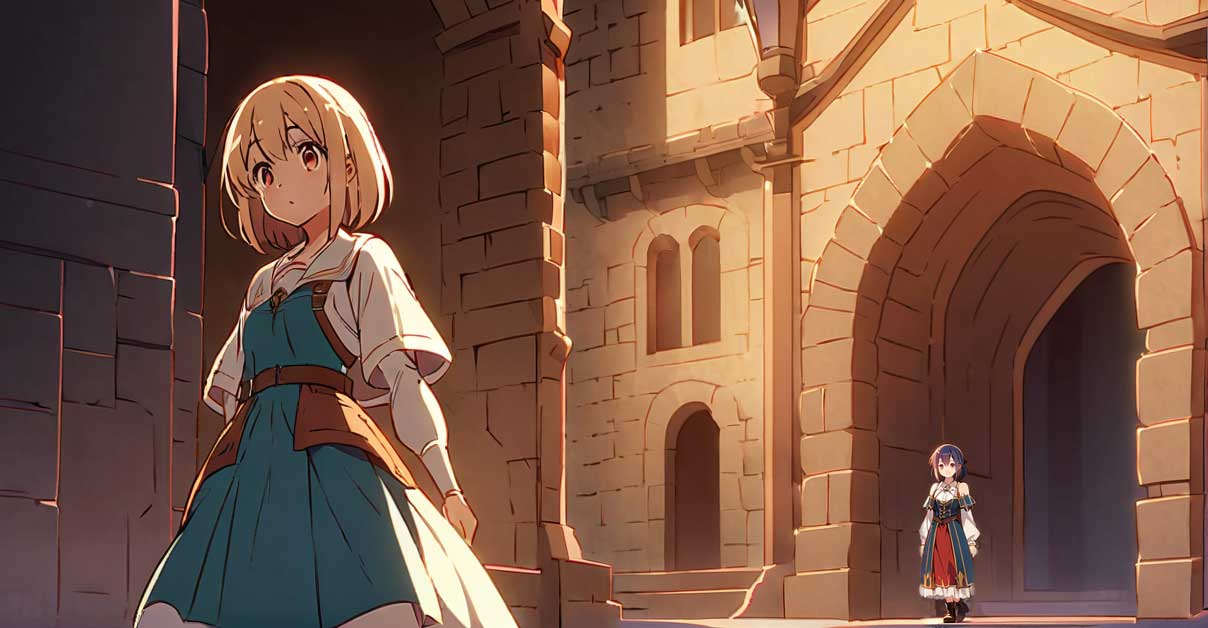
Born in Japan, the light novel is a fully fledged narrative format that is often misunderstood in the West. Neither a traditional novel, nor a manga, nor a simple spin-off of animation, it follows a very specific logic of reading, writing, and serialization.
It most commonly takes the form of relatively short volumes, sometimes accompanied by a few illustrations, conceived as visual support rather than as an autonomous mode of storytelling.
To understand what a light novel truly is means understanding why it exists, how it is conceived, and why it cannot be reduced to a simple “illustrated novel.”
The Origins of the Light Novel: A Format Born in Japan
The light novel emerged in Japan in the late 1990s and became fully structured during the 2000s. It primarily targets a teenage and young adult audience, but its defining characteristic does not lie in the age of its readers—it lies in its publishing culture.
From the outset, the light novel was designed as a serial format, published in short to medium-length volumes, often accompanied by a few black-and-white illustrations. These images do not replace the text in telling the story; they highlight key moments, reinforce the visual identity of the world, and anchor the characters in the reader’s imagination.
Unlike the traditional Western novel, the light novel was born within an ecosystem where novels, manga, and anime constantly coexist. It may inspire manga or animated adaptations, but it remains an autonomous work, conceived first and foremost for reading. It is not a by-product; it is often the narrative matrix itself.
It is therefore less a “style” than a Japanese editorial format, with its own codes, rhythm, and specific expectations.
Light Novel ≠ Traditional Novel
A light novel does not seek to emulate the literary density, contemplative slowness, or stylistic neutrality of the traditional novel. Its narrative philosophy is different.
The narration is generally more direct, more focused on the protagonist’s immediate experience. The point of view is clear, often internal, and the reader is invited to follow the character’s mental process almost in real time.
Action is readable and fluid, designed to be understood without unnecessary descriptive overload.
Where the traditional novel may multiply points of view, digressions, and symbolic layers, the light novel favors clarity, rhythm, and immersion. This does not mean simplification; it means intention.
This approach explains why the light novel can feel disorienting to readers accustomed to Western conventions. It does not seek to impress through form, but to carry the reader along a continuous narrative progression.
This difference in narrative philosophy is explored in greater detail in a dedicated article on the distinctions between the novel, the manga, and the light novel.
A Narrative Designed for Progression
This is one of the pillars of the light novel.
The story is built around the protagonist’s progression—physical, mental, emotional, or symbolic. The character evolves, learns, fails, and tries again. Each narrative arc serves a precise function: advancing to the next threshold.
This progression can take several forms:
- the acquisition of skills or powers,
- an increase in responsibility,
- psychological maturation,
- an expanded understanding of the world.
Seriality plays a fundamental role here. Each volume is conceived as a step, never as a definitive ending. The reader is not merely buying a story; they are committing to a journey.
It is within this framework that the connection between the light novel and isekai becomes natural. Isekai perfectly exploits this logic of progression: a new world, new rules, gradual empowerment, psychological adaptation. The light novel offers the ideal format for this kind of evolving narrative.
Why the Light Novel Is Often Misunderstood in the West
In the West, the light novel suffers from several persistent misunderstandings.
First, it is frequently confused with a “young adult novel,” or even with a simplified product. This perception completely ignores the structural richness of the format and its own narrative demands.
Second, the very term light novel is misleading. “Light” does not mean superficial, but accessible, fluid, and designed for regular, immersive reading. The literal translation has contributed to a cultural underestimation of the format.
Finally, manga or anime adaptations further blur the picture. Many readers discover these worlds through images, without realizing that the original work is a narrative text, often deeper and more nuanced than its adaptations.
To understand the light novel is to accept that it follows different rules—and that it is not meant to conform to traditional Western standards.
Can a Light Novel Be Written in French?
Yes—but not by imitation.
Writing a light novel in French does not mean artificially reproducing Japanese mannerisms or copying a foreign structure. It means understanding the codes and adapting them intelligently.
A French light novel respects:
- a clear focalization,
- controlled pacing,
- a progression-oriented narrative,
- an assumed seriality,
- a balance between action, introspection, and world-building.
The French language is perfectly capable of carrying this type of story, provided one does not attempt to disguise a traditional novel as something else. It is a conscious narrative choice, not a compromise.
Why The Otherworlder’s Heir Fits the Light Novel Format
The Otherworlder’s Heir was conceived from the outset within the logic of the light novel format, not out of opportunism, but out of narrative coherence.
The choice of a tightly focused point of view, a structured progression of the protagonist, clearly identified narrative arcs, and a world that gradually reveals itself aligns fully with the philosophy of the format.
The tone, the balance between action, introspection, humor, and tension, as well as the assumed seriality, all belong to a precise narrative tradition.
This is not about claiming a label, but about embracing a framework. The light novel offers the ideal space to tell a story of transformation, inheritance, and rising power—without abandoning narrative rigor.
Conclusion
The light novel is neither a subgenre nor a passing trend. It is an autonomous narrative format, born from a specific editorial culture, designed for progression, seriality, and immersion.
To understand it is to give oneself the means to write it with accuracy—and to read it without prejudice.
────────────────────────
Author’s Note
Even when a project is conceived from the outset within a light novel framework, the act of writing often reveals necessary adjustments. The Otherworlder’s Heir is no exception.
While writing, I came to understand that certain structures—particularly in the first volume—did not fully meet the demands of the format. To remain consistent with serial narration and the progression expected of a light novel, I had to rethink that organization and split the story into two distinct parts.
This decision is not a renunciation, but a direct consequence of learning through writing. The light novel is a format that is truly understood by practicing it—and experience remains, to this day, the best teacher.