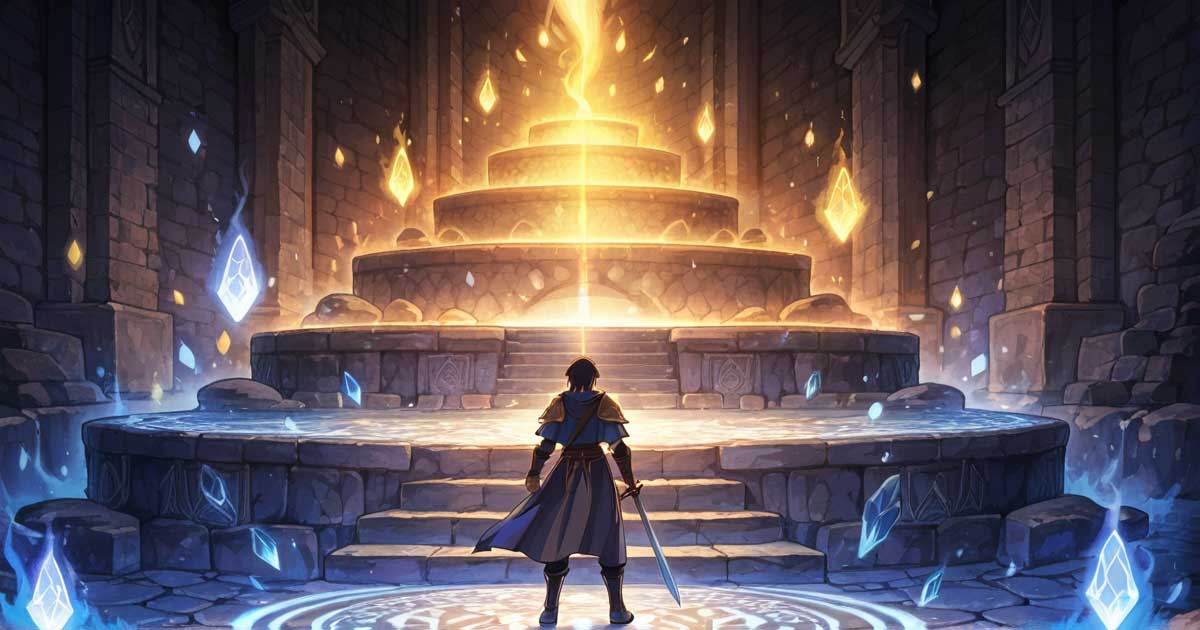

Power progression — Milestones, tension, and controlled ascent
Power Progression refers to the way a character gains abilities, mastery, and influence over the course of a story. Far from being a simple accumulation of strength, it structures the reader’s expectations and gives meaning to the trials endured. When handled well, each step feels earned, legible, and rich in consequences.
Within a fantasy world, power progression follows defined rules. Whether it relies on magic, skill systems, or a level system, it must remain consistent with the world’s lore and its overall balance. Readers accept rising power when they understand the underlying logic—and its limits.
Progression becomes truly meaningful when it is tied to character development. Growing stronger often means losing innocence, taking on greater responsibility, or facing moral dilemmas. In isekai as well as in the light novel, this dynamic deepens immersion by giving readers clear markers of what has changed—and what can no longer be ignored.
Power progression also shapes narrative rhythm. training arcs, successive confrontations, and clearly defined thresholds serve as narrative milestones. They organize tension, prepare major conflicts, and avoid the pitfall of sudden, unearned power. In epic fantasy as well as portal fantasy, progression conditions the credibility of the stakes.
From a narrative writing perspective, the challenge lies in showing growth without reducing it to numbers or lists. Changes must be felt through action, choice, and relationships, preserving narrative consistency and emotional impact.
This section places in perspective the different forms of power progression in fantasy and light novels, their implicit rules, and their narrative effects. It outlines a reading path that clarifies how rising power structures a story, before leading into articles that analyze its mechanisms, successes, and potential pitfalls.
-

Integrating Economics Into Worldbuilding Without Weighing Down the Narrative
The Real Problem Is Not the Economy The real problem is an economy that becomes invisible when it should carry weight. In many fantasy, Light Novel, or Isekai stories, the economy exists only on the surface of the world. Capitals are vast, yet nothing seems to sustain them.Armies cross entire continents with no visible logistics.Guilds…
-

The Role of the Mentor in a Light Novel Isekai
In a light novel isekai, the mentor plays a central role in the protagonist’s progression. More than a simple guide, they shape the character’s transformation, influence their decisions, and directly contribute to their development. But unlike in traditional fantasy, the mentor in an isekai is not meant to accompany the hero all the way to…
-

Worldbuilding Guide for Isekai
Worldbuilding Guide for Isekai: Building Another World Without Losing Narrative Tension The Core Principle: A Rule Revealed Through Failure A magic system should never be explained before it is experienced. Mini-scene 1 — The Rule Revealed Through Collapse The protagonist attempts to activate an inherited power for the first time.He has been told he is…
-

How to Avoid Inconsistent Magic Systems
Magic systems are at the core of worldbuilding in fantasy, light novels, and isekai. Yet many become inconsistent, weakening both narrative tension and the credibility of the story. Building a coherent magic system is not about making it realistic, but about ensuring narrative consistency, clarity, and integration within the broader world. Here is a clear…
-

Can You Write a Light Novel in the West Without Losing Its Essence?
The global popularity of light novels, especially within fantasy and isekai settings, raises an increasingly common question among Western authors: Is it possible to write a light novel in the West without losing what makes the genre unique? At first glance, the answer may seem obvious. The narrative codes are visible, the tropes are recognizable,…
-

The Narrative Style of the Light Novel: Inner Voice, Intimacy, and Reader Alignment
The light novel is not merely an editorial format. It is a narrative stance. A direct relationship with the reader. A deliberately embraced sense of proximity. A mode of writing that favors inner voice, immediate emotion, and the gradual alignment between protagonist and audience. In ISEKAI The Otherworlder’s Heir, this principle is fully embraced. The…
-

The Relationship Between Power and Responsibility in a Narrative Universe
Power and Responsibility in Fantasy and Isekai: Building a Credible System In many fantasy stories, and especially in light novels and isekai, power occupies a central role. Magical power, political authority, military strength, or economic influence structure conflicts, alliances, and the evolution of characters. When a story grants extraordinary abilities to its characters without limits,…
-

Serialization as a Narrative Engine in Japanese Storytelling
Although serialization is often associated with dramatic tension, certain Japanese narrative structures rely on a slightly different logic. Kishōtenketsu is a notable example. This classical structure consists of four stages: Unlike Western narrative models that primarily revolve around conflict, this structure places greater emphasis on surprise or revelation. In modern serialized storytelling, this logic can…
-

The Optimal Structure of an Isekai: Conflict, Progression, and Revelation
An effective isekai does not rely solely on transporting the protagonist into another world. This starting point is a catalyst, not a narrative structure. Understanding the best structure for an isekai light novel means organizing three fundamental forces: conflict, progression, and revelation. In ISEKAI The Otherworlder’s Heir, this narrative architecture forms the backbone of the…
-

Fantasy Novels
Fantasy Novels: From Western Epic Sagas to Japanese Light Novel Worlds Yet behind this apparent unity lies a genre of remarkable richness. Fantasy has developed through multiple literary traditions: the great Western epic sagas on one side, and more recently the narrative universes shaped by Japanese light novels on the other. To understand modern fantasy…