
You can’t build a story on empty space
The issue is simple: when you set out to build an isekai and want to combine action, challenges, humor, romance, or drama, none of it can exist in a vacuum.
These elements do not emerge on their own. They arise from interactions, shaped by an environment, social rules, customs, and both implicit and explicit constraints.
This is precisely where lore becomes essential. It is not meant to decorate the story, but to give substance to what happens within it. Why does this conflict exist? Why does one group oppose another? What happened in the past for these tensions to still be active? Without coherent answers to these questions, the narrative rests on artificial constructs.
Building the world before writing the story
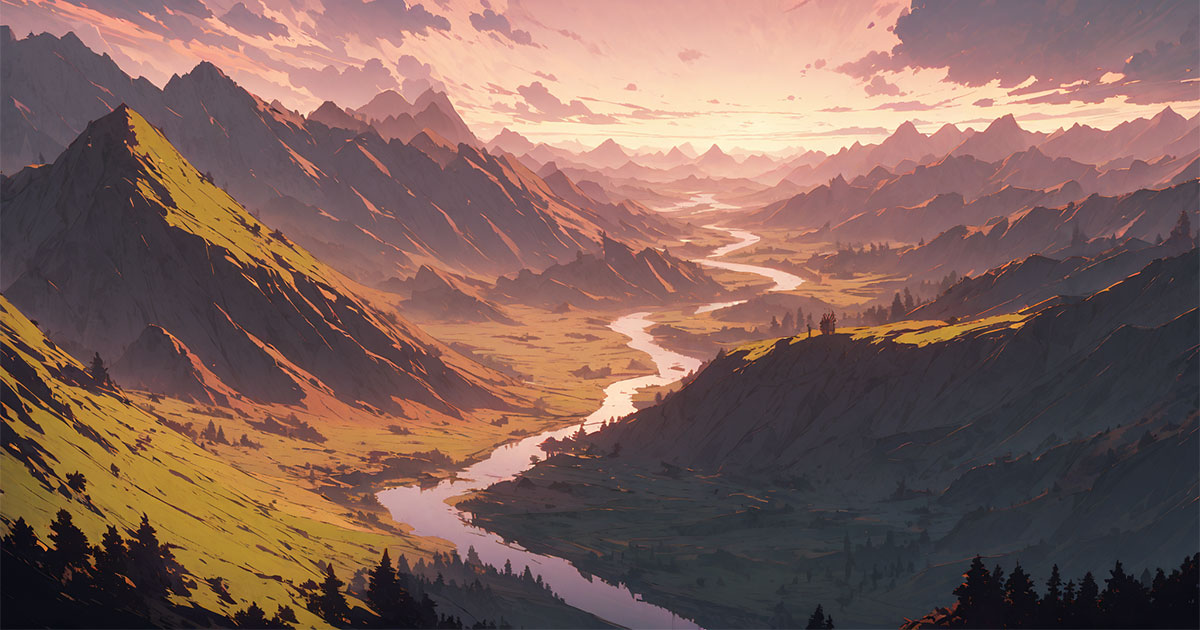
Before writing a single line of my saga, I was confronted with these fundamental questions. I knew what I wanted to tell, but that alone was not enough. I needed to take the time to build—and to physically imagine—the world in which the protagonist would evolve: what did this land look like? How large was it? Where were its limits?
Distance as a narrative constraint
The size of a world is never trivial. It imposes concrete limits. Even in a universe filled with magic, distance remains a determining factor. A character who arrives too late, another who cannot reach a place in time, information that takes weeks to travel—these situations all depend on parameters defined in advance. The more complex the plot becomes, the more essential it is to remain consistent with these constants.
At this stage, certain constraints—often invisible at first—begin to weigh on the writing itself. Imagine a kingdom sending an emissary to another, followed by an army. Depending on distance, geography, and existing infrastructure, can that army march on foot? Must it travel by sea? The choice is not trivial. Moving an army is not the same as moving a single person.
Even in a magical world, logistical realities remain: soldiers must eat, move together, set up camps, and secure roads. An army inevitably moves more slowly, and its route involves deliberate choices.
These parameters force certain paths to be favored over others, certain routes over theoretical shortcuts. Having established the lore in advance—distances, terrain, borders, routes of circulation—makes it possible to resolve these situations coherently, without improvisation. What matters is not the detail itself, but the structure it imposes on the whole.
Invisible rules that shape the world
This is how the work of lore deepened. After defining the world and its distances, I began to establish borders—not names, but limits. Areas governed by different rules. Spaces that do not obey the same logic. Then another question arose: what actually exists in this world? Dungeons, labyrinths—have they always existed? Do they serve a purpose? Do they have an origin? A reason to be?
This level of depth is not a luxury. It is necessary so that when questions arise within the isekai itself, the answers hold up. Not improvised responses, but ones rooted in an overarching logic. Gradually, this coherence is perceived by the reader, often without conscious awareness. They begin to believe in the world, to project themselves into it, to follow its internal logic.
The world then becomes real, psychologically speaking. The reader no longer observes from the outside—they follow, participate, and live alongside the characters.
That is the fundamental role of lore in an isekai: to offer lasting immersion and a richer reading experience that goes far beyond the mere accumulation of events.
Naming the world and defining time
These reflections also led me, almost in spite of myself, to two other fundamental questions—simple in appearance, yet deeply structuring.
The first concerns the planet itself. If this world exists, if it is inhabited, traversed, and named, then a question naturally arises: what is it called? And more importantly, where does that name come from? Why does it bear that name rather than another? This led me to a parallel, more personal reflection: why do we call our own planet “Earth”? The answer exists, of course, but it opens onto a history, a relationship to the world, a way of thinking about it. I will leave that reflection aside here, but it illustrates one thing clearly: even apparent self-evidences have an origin.
The second question, just as structuring, concerns time. Many isekai deliberately avoid precise references to dates, years, or even days. This is a perfectly valid narrative choice, and some stories handle it very well. Others use vague markers—notations such as “year X-740”—without ever questioning what that “X” actually means. Why that numbering? Based on what event? Is the world young, ancient, or simply undefined?
Of course, systems of dating have varied across cultures and eras, and there has never been a single universal reference point; but the core issue lies elsewhere.
In my case, the medieval framework I wanted to evoke still required temporal landmarks. Not to impose them on the reader, but to provide a coherent structure. Yet naming a year immediately raises another question: what is the founding event from which time is counted? In our own world, we know this reference. In another world, it must be conceived, chosen, and assumed.
Through my research, I discovered that before certain historical periods, time was often measured according to reigns—under the era of a king, an emperor, a sovereign. An interesting approach, but one that becomes difficult to sustain over the course of a long saga. I therefore chose a major founding event from which the chronology could be organized in a stable way.
This choice allowed me to do something rarely seen in isekai: indicating, at the beginning of each chapter, the precise date on which events take place. Not as a constraint imposed on the reader, but as a possibility. Those who simply want to follow the story can ignore it. Those who enjoy understanding, verifying, or going back can rely on it.
This temporal coherence serves the reader, but it also serves the writing. It forces me to respect my own rules, to maintain narrative continuity, and to avoid unintended inconsistencies. Once again, lore does not draw attention to itself—it supports everything beneath the surface.