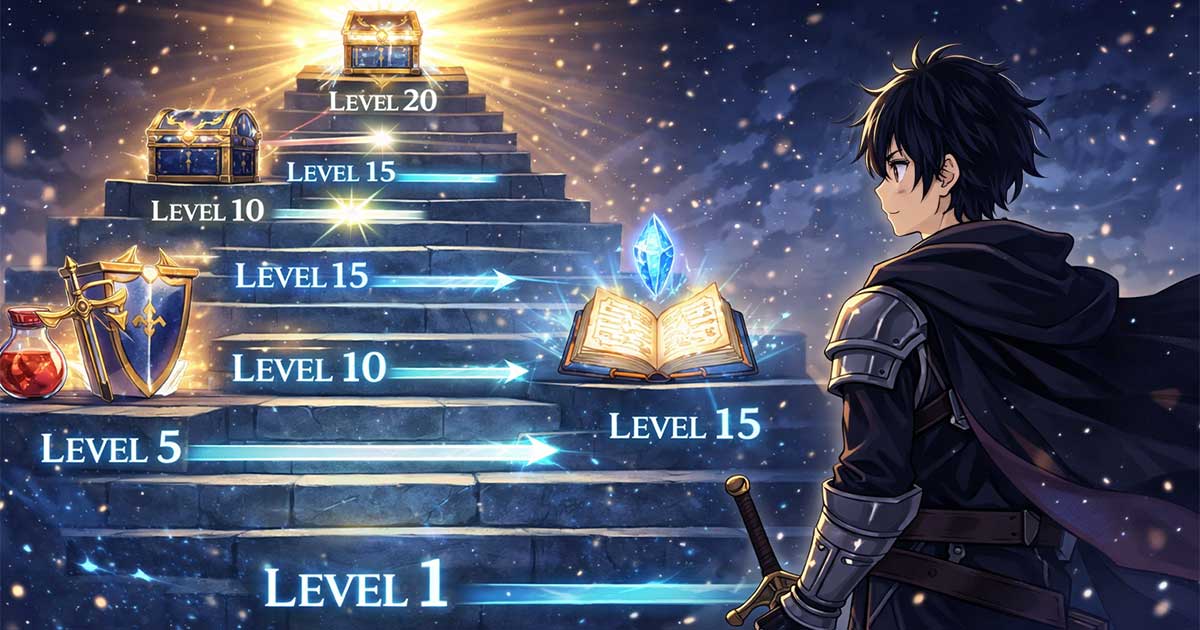

Level system — Thresholds, rewards, and progression tempo
Level system refers to a visible progression structure used to measure the growth of a character, a skill, or a potential. More than a number, it acts as a narrative marker: it makes time, effort, and accumulated trials tangible, while clearly establishing differences in power between individuals. Within a story, it allows growth to be understood without excessive exposition.
In fantasy and isekai narratives, the level system often draws inspiration from game design. It introduces thresholds, milestones, and expectations. Reaching a new level becomes both an objective and a symbol of transformation, as each step forward reshapes how the world, its dangers, and its responsibilities are perceived.
This structure works hand in hand with game mechanics, skill systems, and power progression. A level gained is never neutral: it unlocks new strategies, alters combat dynamics, and redefines a protagonist’s position relative to others. When handled carefully, it prevents arbitrary power jumps and strengthens narrative tension.
From a storytelling perspective, a level system supports narrative consistency. It sets clear boundaries and preserves credibility. A character does not become overwhelming by chance; advancement follows effort, failure, and repetition within a framework the reader can grasp. This clarity reinforces immersion and builds trust between the reader and the world.
At the scale of worldbuilding, a level system often extends beyond the individual. It influences social hierarchies, the perceived value of adventurers, the structure of guilds, and sometimes even economic balance. Within a fantasy world, knowing someone’s “level” can carry as much weight as a title or a lineage.
This section explores articles that examine the level system as a tool for progression, tension, and narrative structure, highlighting how it shapes pacing and supports the reader’s understanding as the story unfolds.
-

The Common Mistakes Western Authors Make When Imitating Japanese Light Novels
Why do Western authors often struggle to recreate the feeling of Japanese light novels, even when using familiar elements such as isekai settings, RPG systems, or anime-inspired archetypes? Over the past several years, more and more writers have tried to create light novels or isekai stories inspired by Japanese works. As a result, certain elements…
-

The Influence of Japanese Culture on Worldbuilding
Introduction: a form of worldbuilding built on different cultural reflexes Japanese worldbuilding often differs from the Western model through a stronger emphasis on social structures, visible hierarchies, and the protagonist’s integration into a collective system. In many Light Novels, Isekai stories, and Japanese fantasy fiction, the world tends to operate according to narrative priorities that…
-
Why Isekai Works So Well: Immersion, Progression, and Narrative Fantasy
Introduction Isekai is not merely a subgenre of Japanese fantasy. It is an extremely effective narrative device, designed to quickly capture the reader, immerse them in a codified world, and guide them through a gradual rise in power. If it works so well—whether in light novels, manga, or anime—it is neither by chance nor a…
-
What Is an Isekai? Definition, Origins, and Genre Tropes
Isekai is one of the most popular genres in modern Japanese storytelling, spanning manga, light novels, and anime. It features a protagonist who is transported, summoned, or reincarnated into another world—often radically different from our own. Since the 2010s, isekai has experienced a spectacular rise. Sword Art Online, Re:Zero, Mushoku Tensei, Overlord—these titles pushed the…