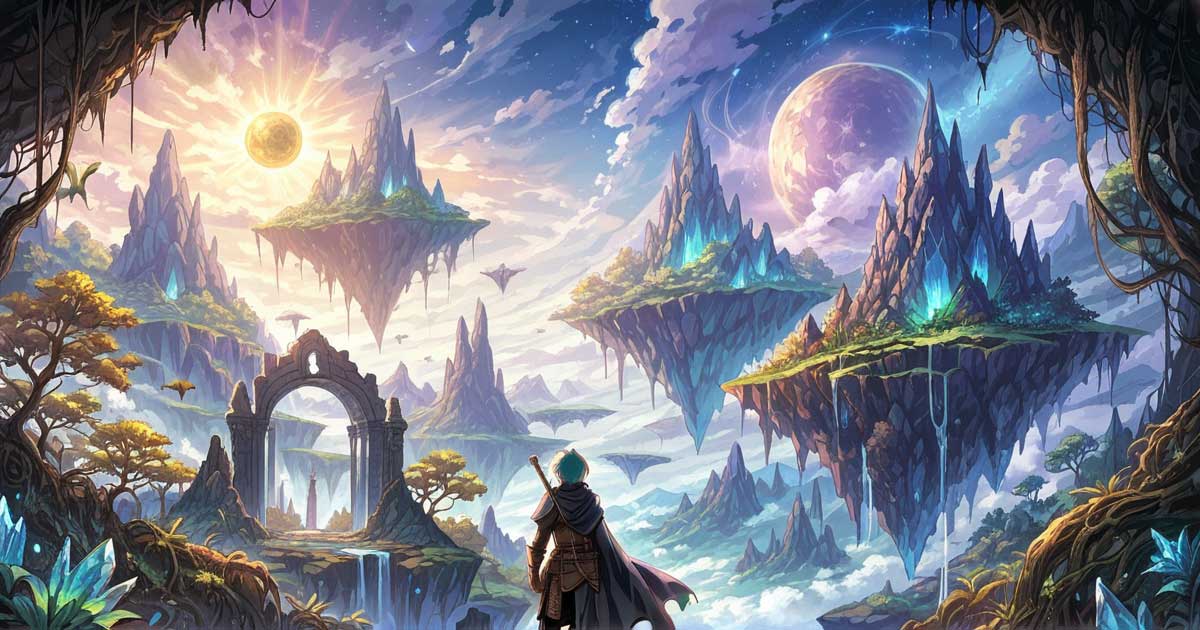

Parallel World — Otherness, discovery, and new laws
Parallel world evokes the idea of an elsewhere—distinct from the original reality yet governed by its own laws. It is not merely a change of scenery, but a shift in reference points, a rupture that confronts characters with a different logic of reality. Entering a parallel world means accepting that what once felt obvious no longer applies, and that new rules now shape choices, dangers, and opportunities.
The strength of a parallel world lies in its internal coherence. Even when it stands in sharp contrast to the original world, it must follow a readable structure. Worldbuilding plays a central role here, defining boundaries, systems, and tensions unique to that universe. Lore then adds depth, suggesting a history, myths, or conflicts that existed long before the protagonists arrived.
In many narratives, the parallel world acts as a revelator. By placing two realities in opposition, it exposes characters’ flaws, desires, and latent strengths. This mechanism is especially prominent in portal fantasy and isekai, where the passage between worlds becomes a narrative engine in its own right. The contrast between universes deepens immersion and reinforces the sense of displacement.
A parallel world is not limited to spectacle. It shapes progression, character development, and sometimes even the structure of the story itself. Systems of magic, social rules, or forms of power imposed by this other reality force protagonists to adapt, to learn, and at times to redefine who they are.
This section proposes to approach the parallel world as both a narrative and conceptual tool: a space where realities collide, a testing ground for the universe, and a powerful lever for exploring transformation, choice, and identity.
-

Why Politics Matters in an Isekai
Introduction: an often underestimated dimension This approach works at a small scale. But as soon as the world expands, a limitation appears: the setting stops existing beyond the protagonist. Without this layer, an isekai remains functional, but rarely credible. The goal of this article is to explain why politics is a structural tool of worldbuilding,…
-

The Importance of Focalization on the Protagonist
Introduction: Understanding Focalization in Light Novels and Isekai In a light novel—especially in isekai and fantasy—focalization is a core element of narrative writing. It determines the narrative point of view, the coherence of the story, and, above all, the reader’s immersion. Often confused with POV (point of view), focalization actually refers to the filter through…
-

Ranobe: Understanding the Japanese Light Novel Phenomenon
What Is a Ranobe? The term ranobe (ラノベ) is the Japanese abbreviation of raito noberu, a phonetic rendering of the English expression light novel. In modern Japanese, loanwords are often shortened for easier use. Over time, raito noberu became ra-nobe, and eventually simply ranobe. In Japan, the word refers to a specific type of illustrated…
-

Why Light Novels Are Not “Inferior” Fiction
Introduction: a widespread misunderstanding The term light novel is often misunderstood. When compared to traditional novels, it is frequently perceived as a simplified or lesser form of fiction. This perception is based on surface-level characteristics—shorter length, direct writing style, and the presence of illustrations—but it fails to reflect the actual nature of the format. In…
-

The Role of the Mentor in a Light Novel Isekai
In a light novel isekai, the mentor plays a central role in the protagonist’s progression. More than a simple guide, they shape the character’s transformation, influence their decisions, and directly contribute to their development. But unlike in traditional fantasy, the mentor in an isekai is not meant to accompany the hero all the way to…
-

Worldbuilding Guide for Isekai
Worldbuilding Guide for Isekai: Building Another World Without Losing Narrative Tension The Core Principle: A Rule Revealed Through Failure A magic system should never be explained before it is experienced. Mini-scene 1 — The Rule Revealed Through Collapse The protagonist attempts to activate an inherited power for the first time.He has been told he is…
-

Can You Write a Light Novel in the West Without Losing Its Essence?
The global popularity of light novels, especially within fantasy and isekai settings, raises an increasingly common question among Western authors: Is it possible to write a light novel in the West without losing what makes the genre unique? At first glance, the answer may seem obvious. The narrative codes are visible, the tropes are recognizable,…
-

The Narrative Style of the Light Novel: Inner Voice, Intimacy, and Reader Alignment
The light novel is not merely an editorial format. It is a narrative stance. A direct relationship with the reader. A deliberately embraced sense of proximity. A mode of writing that favors inner voice, immediate emotion, and the gradual alignment between protagonist and audience. In ISEKAI The Otherworlder’s Heir, this principle is fully embraced. The…
-

Writing Light Novel Dialogue: Efficiency, Subtext, and Emotional Impact
In a light novel, dialogue is not narrative filler.In an isekai, it becomes a lens for cultural dissonance.In fantasy, it shapes power dynamics. In ISEKAI The Otherworlder’s Heir, every exchange is designed as a miniature dramatic confrontation, even when it appears light on the surface. Here is how. Subtext: What Is Left Unsaid Creates Tension…
-

The Optimal Structure of an Isekai: Conflict, Progression, and Revelation
An effective isekai does not rely solely on transporting the protagonist into another world. This starting point is a catalyst, not a narrative structure. Understanding the best structure for an isekai light novel means organizing three fundamental forces: conflict, progression, and revelation. In ISEKAI The Otherworlder’s Heir, this narrative architecture forms the backbone of the…