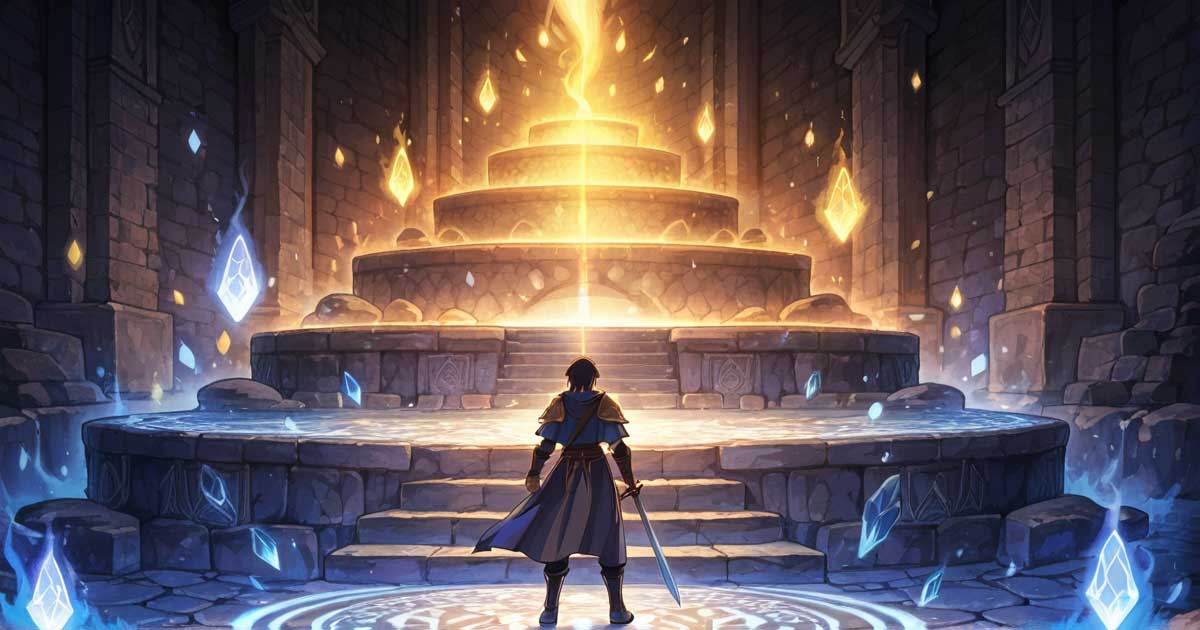

Power progression — Milestones, tension, and controlled ascent
Power Progression refers to the way a character gains abilities, mastery, and influence over the course of a story. Far from being a simple accumulation of strength, it structures the reader’s expectations and gives meaning to the trials endured. When handled well, each step feels earned, legible, and rich in consequences.
Within a fantasy world, power progression follows defined rules. Whether it relies on magic, skill systems, or a level system, it must remain consistent with the world’s lore and its overall balance. Readers accept rising power when they understand the underlying logic—and its limits.
Progression becomes truly meaningful when it is tied to character development. Growing stronger often means losing innocence, taking on greater responsibility, or facing moral dilemmas. In isekai as well as in the light novel, this dynamic deepens immersion by giving readers clear markers of what has changed—and what can no longer be ignored.
Power progression also shapes narrative rhythm. training arcs, successive confrontations, and clearly defined thresholds serve as narrative milestones. They organize tension, prepare major conflicts, and avoid the pitfall of sudden, unearned power. In epic fantasy as well as portal fantasy, progression conditions the credibility of the stakes.
From a narrative writing perspective, the challenge lies in showing growth without reducing it to numbers or lists. Changes must be felt through action, choice, and relationships, preserving narrative consistency and emotional impact.
This section places in perspective the different forms of power progression in fantasy and light novels, their implicit rules, and their narrative effects. It outlines a reading path that clarifies how rising power structures a story, before leading into articles that analyze its mechanisms, successes, and potential pitfalls.
-
Understanding the Difference Between Isekai and Fantasy
Isekai vs Fantasy: What Truly Sets Them Apart Confusion between isekai and fantasy is common, particularly when the isekai genre is first encountered through contemporary light novels. Yet the difference between isekai and fantasy is not merely a matter of vocabulary—it lies in the very structure of the narrative. Fantasy refers to a broad literary…
-
Common Mistakes When Writing an Isekai
Writing an isekai often feels deceptively easy. The genre is codified, popular, and extensively explored. Many beginner writers are drawn to it thinking that following a few formulas is enough to produce an effective story. In reality, it is precisely this apparent accessibility that makes it a particularly demanding field. The most common mistakes do…
-
How to Write a Light Novel: From Concept to Volume Structure
Most light novel projects fail not because of style, but because of structure. Writing a light novel is not about telling a simplified long story. It is a precise architecture, designed for serialization, emotional progression, and sustained tension. Pasted text When applied to the isekai fantasy genre, every structural decision becomes even more strategic: the…
-
The Structure of the Light Novel Explained: Arcs, Rhythm, and Serialization Logic
Why Do Some Isekai Sagas Endure… While Others Collapse? Why do some isekai series surpass ten volumes while maintaining narrative tension, while others lose momentum after only a few books? The answer rarely lies in the initial concept.It lies in the structure of the light novel. A light novel is a serialized novel of Japanese…
-
From Passionate Reader to Creator: My Path to Light Novels
The COVID Context It all began during the COVID period. Successive restrictions created an artificial isolation that many people deeply felt. Even simple everyday actions became complicated. Like many others, I started looking for ways to escape—forms of entertainment capable of lightening the weight of that unusual time. I am not a heavy television consumer.…
-
Why Isekai Works So Well: Immersion, Progression, and Narrative Fantasy
Introduction Isekai is not merely a subgenre of Japanese fantasy. It is an extremely effective narrative device, designed to quickly capture the reader, immerse them in a codified world, and guide them through a gradual rise in power. If it works so well—whether in light novels, manga, or anime—it is neither by chance nor a…
-
What Is a Light Novel?
Born in Japan, the light novel is a fully fledged narrative format that is often misunderstood in the West. Neither a traditional novel, nor a manga, nor a simple spin-off of animation, it follows a very specific logic of reading, writing, and serialization. It most commonly takes the form of relatively short volumes, sometimes accompanied…
-
What Is an Isekai? Definition, Origins, and Genre Tropes
Isekai is one of the most popular genres in modern Japanese storytelling, spanning manga, light novels, and anime. It features a protagonist who is transported, summoned, or reincarnated into another world—often radically different from our own. Since the 2010s, isekai has experienced a spectacular rise. Sword Art Online, Re:Zero, Mushoku Tensei, Overlord—these titles pushed the…