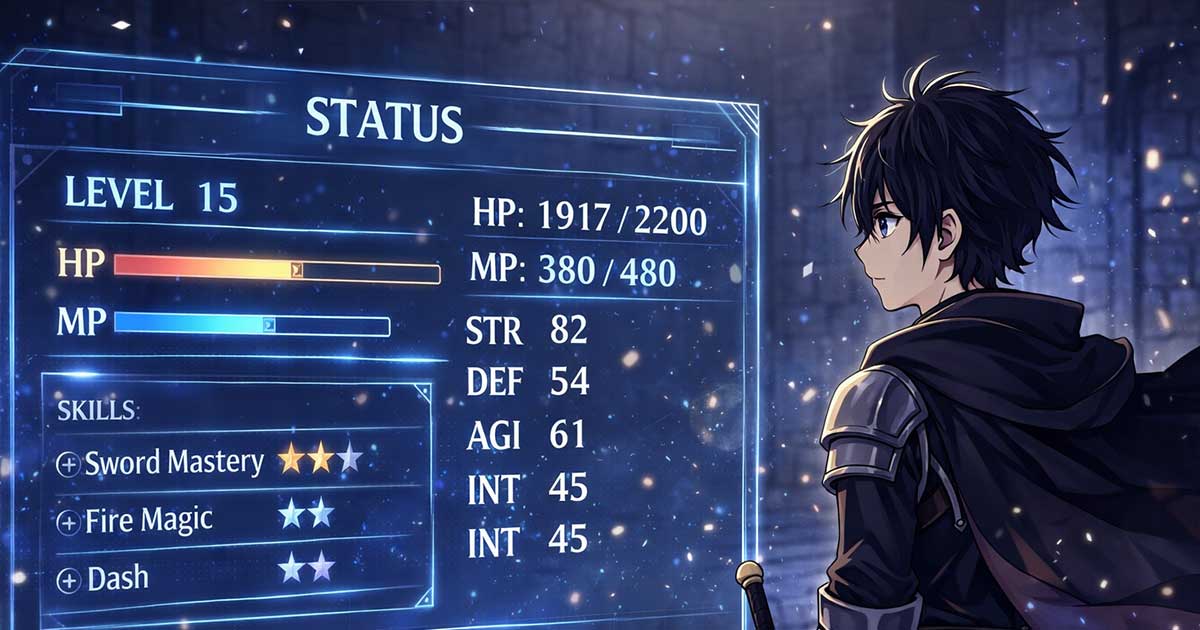

RPG system — Stats, constraints, and readable rules
RPG system refers to a visible set of rules that structures progression, abilities, and limitations within a narrative universe. Inspired by role-playing games, it does more than quantify power: it organizes how the world is read, clarifies stakes, and turns character growth into a measurable journey.
In fantasy narratives—and even more so in isekai—this kind of structure acts as an internal grammar. Points, levels, skills, thresholds, or restrictions are not meant to imitate gameplay, but to give readers clear reference points. Each rule creates expectations; each exception becomes a narrative event.
An effective RPG system naturally connects with game mechanics, skill systems, and power progression. It channels growth, prevents arbitrariness, and gives weight to effort. No gain is ever free: it is prepared, earned, or balanced by new constraints.
From a narrative perspective, this framework reinforces narrative consistency. Rules limit convenient shortcuts and force consequences to be acknowledged. A powerful character draws attention, alters social dynamics, and disrupts established balances. The system becomes a source of tension rather than a descriptive layer.
At the level of worldbuilding, an RPG system extends beyond the individual. It shapes guilds, hierarchies, economies, the value of adventurers, and sometimes even political structures. In a fantasy world, understanding the system often means understanding how the world rewards, restrains, or controls those who live within it.
This section explores the articles that examine RPG systems as narrative frameworks, showing how their rules shape pacing, credibility, and the reading experience throughout the story.
-

Why Isekai Works So Well: Immersion, Progression, and Narrative Fantasy
Introduction Isekai is not merely a subgenre of Japanese fantasy. It is an extremely effective narrative device, designed to quickly capture the reader, immerse them in a codified world, and guide them through a gradual rise in power. If it works so well—whether in light novels, manga, or anime—it is neither by chance nor a…
-
What Is an Isekai? Definition, Origins, and Genre Tropes
Isekai is one of the most popular genres in modern Japanese storytelling, spanning manga, light novels, and anime. It features a protagonist who is transported, summoned, or reincarnated into another world—often radically different from our own. Since the 2010s, isekai has experienced a spectacular rise. Sword Art Online, Re:Zero, Mushoku Tensei, Overlord—these titles pushed the…