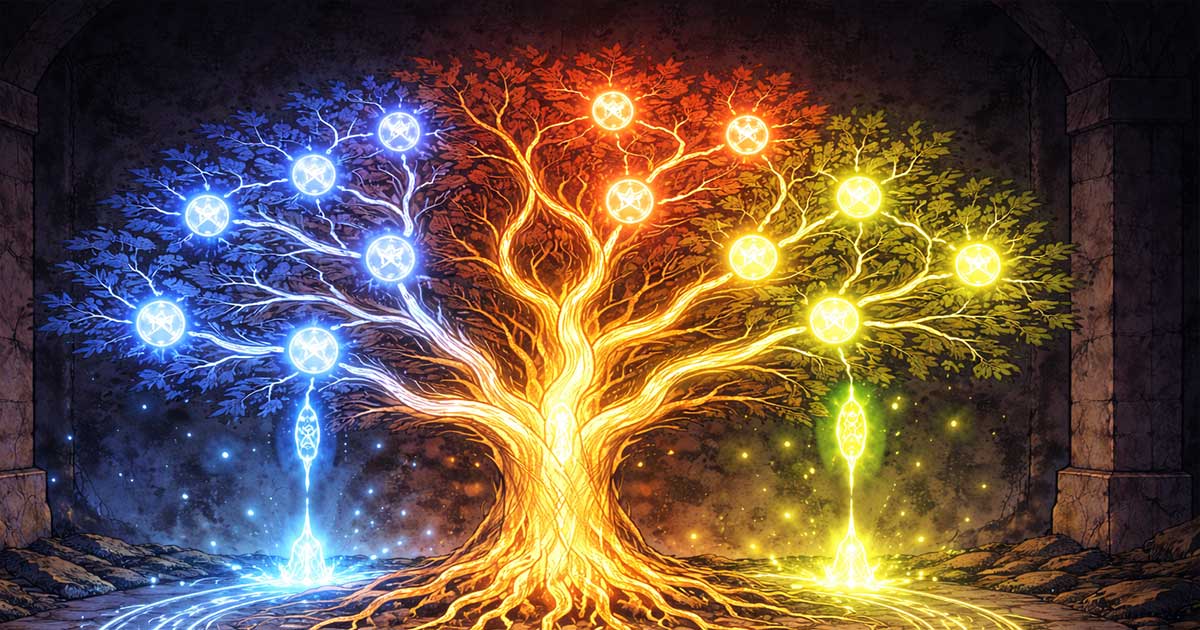

Skill system — Trees, specializations, and decisive choices
Skill system is a structural framework that organizes a character’s abilities, the conditions under which they are acquired, and the limits that define their use. It is not merely a list of powers, but a logic of progression that makes actions readable, choices meaningful, and consequences lasting. When well designed, a skill system supports the narrative without drawing attention to itself as a visible mechanic.
In fantasy worlds—and even more so in isekai narratives—this framework helps channel power and avoid arbitrariness. Skills provide a shared language between the story and the reader: what is possible, what is not yet accessible, and what comes at a cost. They directly reinforce immersion by embedding progression within a coherent and understandable structure.
A consistent skill system naturally interacts with game mechanics. It structures the evolution of abilities, frames the rise in power, and stabilizes overall power progression. Its real strength, however, lies in its narrative integration: a skill only matters if it changes how a character acts, thinks, or resolves conflict, and if it respects the story’s narrative consistency.
Beyond individual characters, the skill system contributes to worldbuilding. It reflects a worldview—what a society values, forbids, considers rare, or deems dangerous. In a fantasy world, skills may stem from magic, training, inheritance, or experience, shaping believable social, political, and military hierarchies.
This section focuses on articles that examine the skill system as a narrative structuring tool, a driver of progression, and a foundation for world construction, shedding light on how it shapes characters, stakes, and the long-term reading experience.
-

How to Write a Light Novel: From Concept to Volume Structure
Most light novel projects fail not because of style, but because of structure. Writing a light novel is not about telling a simplified long story. It is a precise architecture, designed for serialization, emotional progression, and sustained tension. Pasted text When applied to the isekai fantasy genre, every structural decision becomes even more strategic: the…
-

Why Isekai Works So Well: Immersion, Progression, and Narrative Fantasy
Introduction Isekai is not merely a subgenre of Japanese fantasy. It is an extremely effective narrative device, designed to quickly capture the reader, immerse them in a codified world, and guide them through a gradual rise in power. If it works so well—whether in light novels, manga, or anime—it is neither by chance nor a…