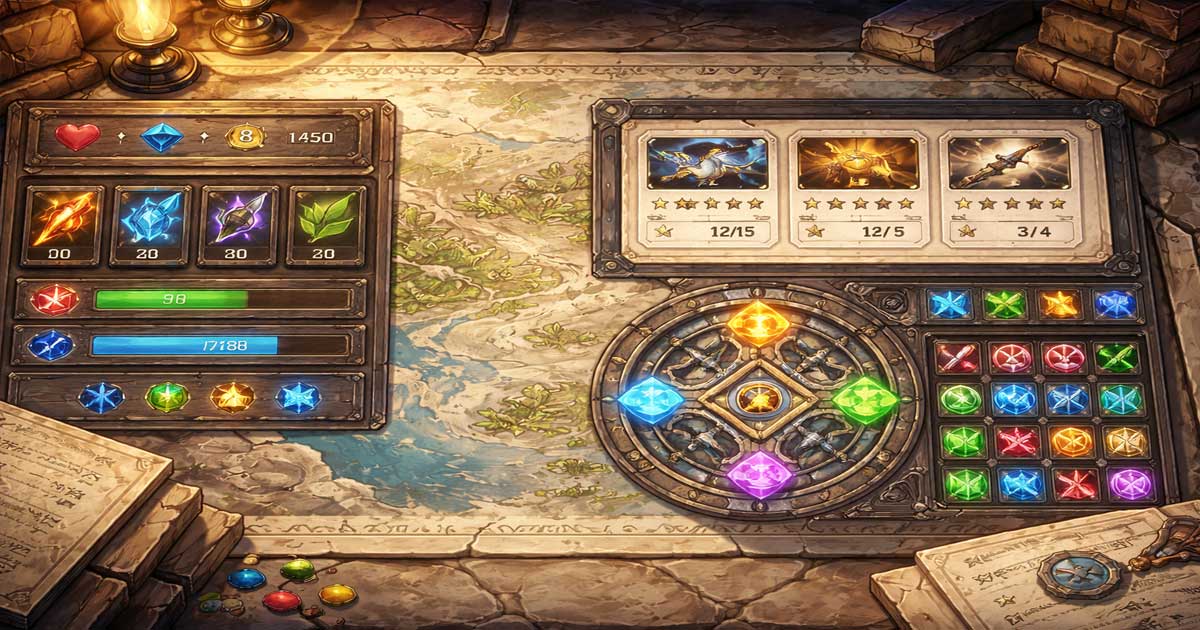

Game mechanics — Systems, rules, and reader clarity
Game mechanics refer to the set of rules, systems, and underlying logics that structure progression, choices, and limitations within a narrative universe inspired by gaming frameworks. They are not meant to turn a story into an interface, but to provide internal consistency to actions, stakes, and character development. When used carefully, they become an invisible language that guides the reading experience without weighing it down.
In fantasy narratives—and even more so in isekai—these mechanisms play a central role. Levels, skills, constraints, costs, power thresholds, or implicit rules help make sense of what would otherwise feel arbitrary. A victory feels earned only if it respects an established framework; a failure resonates when it follows a rule the reader has begun to understand. In this way, game mechanics directly reinforce immersion.
They naturally interact with narrative consistency. A well-defined rule influences how a scene is written, how tension is built, and how turning points are prepared. It supports the evolution of skills, frames the rise in power, and shapes power progression without making it feel automatic. In a light novel, this structure is often suggested rather than explained, allowing the reader to connect the dots.
Game mechanics are also part of a broader worldbuilding approach. A magic system, a skill system, or a RPG system is never neutral: it shapes societies, conflicts, hierarchies, and even the psychology of protagonists. Behind every rule lies a worldview and an authorial intent.
This section explores articles that examine, question, and contextualize game mechanics as narrative tools, tension drivers, and foundational elements of world construction, highlighting their role at the heart of the story and their impact on the reading experience.
-
Why Isekai Works So Well: Immersion, Progression, and Narrative Fantasy
Introduction Isekai is not merely a subgenre of Japanese fantasy. It is an extremely effective narrative device, designed to quickly capture the reader, immerse them in a codified world, and guide them through a gradual rise in power. If it works so well—whether in light novels, manga, or anime—it is neither by chance nor a…
-
What Is an Isekai? Definition, Origins, and Genre Tropes
Isekai is one of the most popular genres in modern Japanese storytelling, spanning manga, light novels, and anime. It features a protagonist who is transported, summoned, or reincarnated into another world—often radically different from our own. Since the 2010s, isekai has experienced a spectacular rise. Sword Art Online, Re:Zero, Mushoku Tensei, Overlord—these titles pushed the…