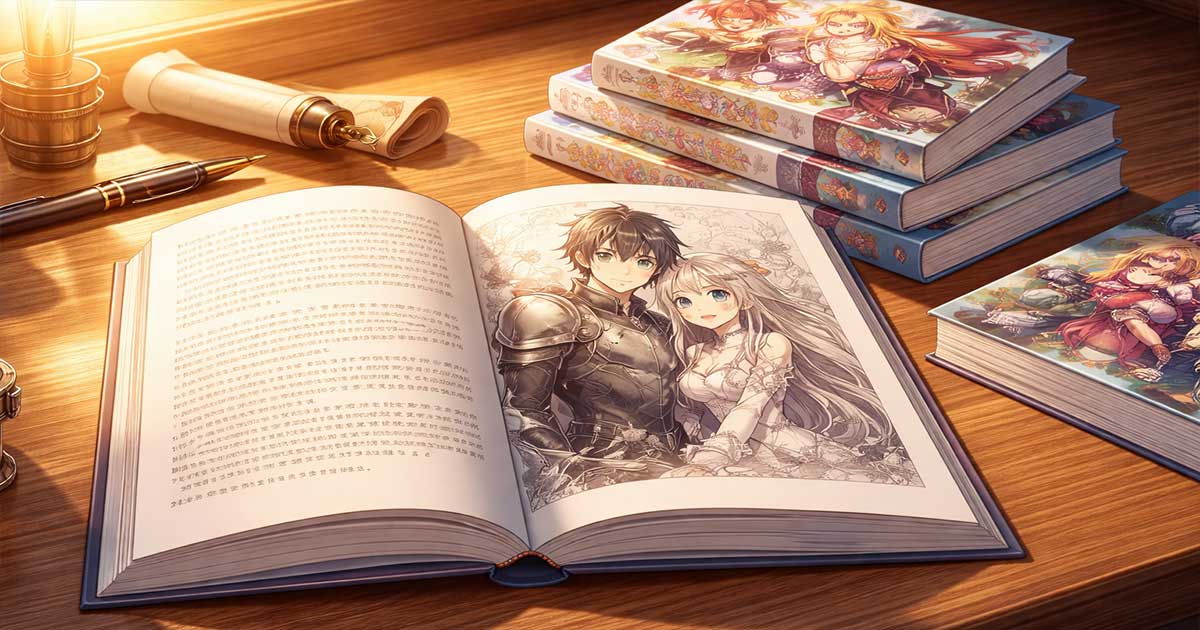

Light novel — Japanese narrative format blending prose, illustration, and serialized storytelling
The light novel refers to a Japanese narrative format situated at the crossroads of prose fiction, illustration, and serialization. It is characterized by a fluid writing style, strong readability, and a structure designed for progressive reading, often accompanied by illustrations that contribute to the work’s visual and narrative identity.
This format relies on a specific balance between narration, dialogue, and pacing. Texts favor clear progression, rapid immersion, and sustained attention to the reader’s experience. A light novel is therefore not defined solely by length or target audience, but by a distinct way of articulating story, structure, and narrative writing.
Light novels are closely connected to Japanese culture and belong to a broader narrative ecosystem in constant dialogue with manga and illustration. This proximity influences both thematic choices and the staging of characters, key scenes, and fictional worlds.
Many works of fantasy and isekai adopt the light novel format, whose serialized structure and narrative flexibility are particularly well suited to the exploration of complex worlds, gradual character development, and the construction of coherent systems.
This section brings together articles devoted to the light novel, examining its codes, uses, and narrative specificities. The associated texts explore the format as a full-fledged writing tool, capable of supporting immersive, structured, and sustainable storytelling.
-

Antagonists and Their Motivations
Introduction: Understanding a Common Mistake in Light Novels In a light novel, an isekai, or a fantasy work, the antagonist is often reduced to a simplistic function: that of an obstacle to eliminate. This approach is insufficient. Why is this distinction essential? Because it determines both: Definition: What Is a Narrative Antagonist? An antagonist is…
-

Ranobe and Otaku Culture
Ranobe and Otaku Culture: How Light Novels Fit into the Japanese Media Mix Ranobe are closely connected to what is known in Japan as otaku culture. The term otaku refers to someone who is deeply passionate about a specific area of popular culture, often with an unusually high level of knowledge and involvement. In contemporary…
-

The World as a Mirror of the Protagonist
Introduction: moving beyond decorative worldbuilding In many light novels, isekai, and fantasy stories, the world is often treated as a simple backdrop: coherent, rich, but disconnected from the protagonist.This approach significantly limits narrative impact. In storytelling, narrative worldbuilding is not just about creating a coherent universe—it is about structuring the protagonist’s arc. Effective worldbuilding does…
-

The Importance of Focalization on the Protagonist
Introduction: Understanding Focalization in Light Novels and Isekai In a light novel—especially in isekai and fantasy—focalization is a core element of narrative writing. It determines the narrative point of view, the coherence of the story, and, above all, the reader’s immersion. Often confused with POV (point of view), focalization actually refers to the filter through…
-

Ranobe: Understanding the Japanese Light Novel Phenomenon
What Is a Ranobe? The term ranobe (ラノベ) is the Japanese abbreviation of raito noberu, a phonetic rendering of the English expression light novel. In modern Japanese, loanwords are often shortened for easier use. Over time, raito noberu became ra-nobe, and eventually simply ranobe. In Japan, the word refers to a specific type of illustrated…
-

Why Light Novels Are Not “Inferior” Fiction
Introduction: a widespread misunderstanding The term light novel is often misunderstood. When compared to traditional novels, it is frequently perceived as a simplified or lesser form of fiction. This perception is based on surface-level characteristics—shorter length, direct writing style, and the presence of illustrations—but it fails to reflect the actual nature of the format. In…
-

The Role of the Mentor in a Light Novel Isekai
In a light novel isekai, the mentor plays a central role in the protagonist’s progression. More than a simple guide, they shape the character’s transformation, influence their decisions, and directly contribute to their development. But unlike in traditional fantasy, the mentor in an isekai is not meant to accompany the hero all the way to…
-

Worldbuilding Guide for Isekai
Worldbuilding Guide for Isekai: Building Another World Without Losing Narrative Tension The Core Principle: A Rule Revealed Through Failure A magic system should never be explained before it is experienced. Mini-scene 1 — The Rule Revealed Through Collapse The protagonist attempts to activate an inherited power for the first time.He has been told he is…
-

How to Avoid Inconsistent Magic Systems
Magic systems are at the core of worldbuilding in fantasy, light novels, and isekai. Yet many become inconsistent, weakening both narrative tension and the credibility of the story. Building a coherent magic system is not about making it realistic, but about ensuring narrative consistency, clarity, and integration within the broader world. Here is a clear…
-

Isekai Novel vs. Isekai Light Novel
Isekai Novel vs. Isekai Light Novel: Understanding the Narrative Distinction The isekai genre is now global. But not all isekai works fall under the category of light novels. Confusing an isekai novel with an isekai light novel means mixing two distinct narrative approaches. The difference is not merely about format or length—it concerns structure, pacing,…