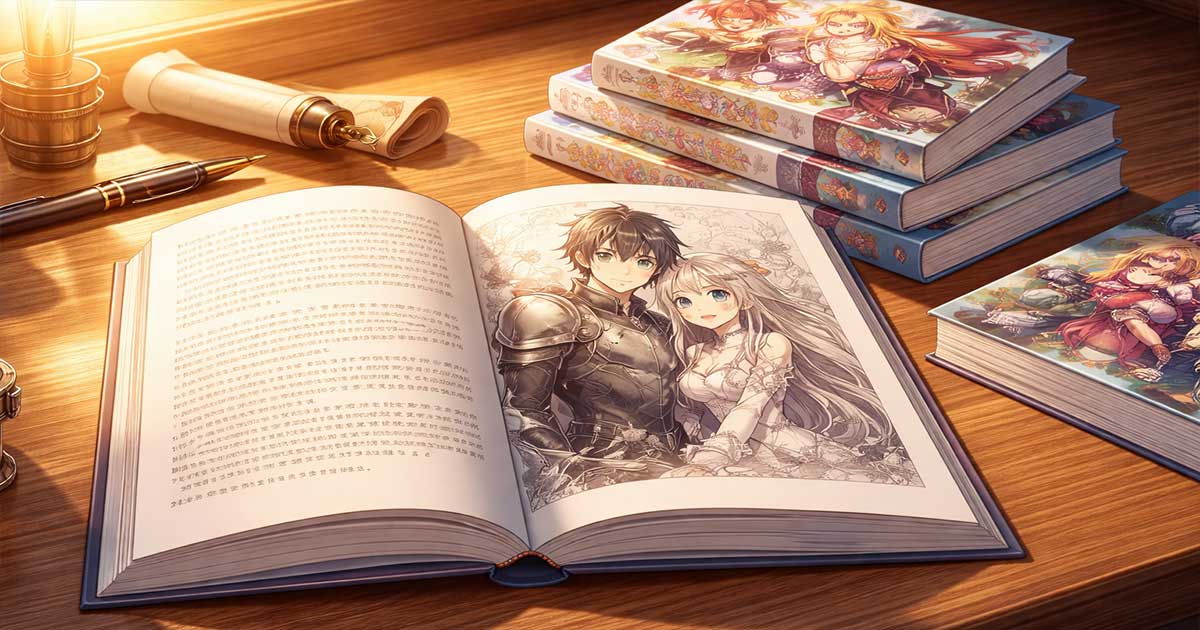

Light novel — Japanese narrative format blending prose, illustration, and serialized storytelling
The light novel refers to a Japanese narrative format situated at the crossroads of prose fiction, illustration, and serialization. It is characterized by a fluid writing style, strong readability, and a structure designed for progressive reading, often accompanied by illustrations that contribute to the work’s visual and narrative identity.
This format relies on a specific balance between narration, dialogue, and pacing. Texts favor clear progression, rapid immersion, and sustained attention to the reader’s experience. A light novel is therefore not defined solely by length or target audience, but by a distinct way of articulating story, structure, and narrative writing.
Light novels are closely connected to Japanese culture and belong to a broader narrative ecosystem in constant dialogue with manga and illustration. This proximity influences both thematic choices and the staging of characters, key scenes, and fictional worlds.
Many works of fantasy and isekai adopt the light novel format, whose serialized structure and narrative flexibility are particularly well suited to the exploration of complex worlds, gradual character development, and the construction of coherent systems.
This section brings together articles devoted to the light novel, examining its codes, uses, and narrative specificities. The associated texts explore the format as a full-fledged writing tool, capable of supporting immersive, structured, and sustainable storytelling.
-

Isekai Novel vs. Isekai Light Novel
Isekai Novel vs. Isekai Light Novel: Understanding the Narrative Distinction The isekai genre is now global. But not all isekai works fall under the category of light novels. Confusing an isekai novel with an isekai light novel means mixing two distinct narrative approaches. The difference is not merely about format or length—it concerns structure, pacing,…
-

Can You Write a Light Novel in the West Without Losing Its Essence?
The global popularity of light novels, especially within fantasy and isekai settings, raises an increasingly common question among Western authors: Is it possible to write a light novel in the West without losing what makes the genre unique? At first glance, the answer may seem obvious. The narrative codes are visible, the tropes are recognizable,…
-

Showing Rather Than Naming: A Key Principle of Japanese Narrative
When encountering a Japanese light novel for the first time, this emotional restraint can sometimes be surprising. Characters often express their feelings less explicitly, yet their gestures, expressions, and reactions reveal what they truly experience. This principle is often summarized by the well-known narrative rule “show, don’t tell.” Although this principle exists across many storytelling…
-

The Narrative Style of the Light Novel: Inner Voice, Intimacy, and Reader Alignment
The light novel is not merely an editorial format. It is a narrative stance. A direct relationship with the reader. A deliberately embraced sense of proximity. A mode of writing that favors inner voice, immediate emotion, and the gradual alignment between protagonist and audience. In ISEKAI The Otherworlder’s Heir, this principle is fully embraced. The…
-

Authority Figures in Fantasy Light Novels
Authority Figures in ISEKAI The Otherworlder’s Heir In many fantasy and isekai light novel stories, a protagonist’s development does not rely solely on adventure or the acquisition of new powers. It often depends on a network of authority figures that shape the hero’s psychology, values, and place in the world. These figures go beyond the…
-

Writing Light Novel Dialogue: Efficiency, Subtext, and Emotional Impact
In a light novel, dialogue is not narrative filler.In an isekai, it becomes a lens for cultural dissonance.In fantasy, it shapes power dynamics. In ISEKAI The Otherworlder’s Heir, every exchange is designed as a miniature dramatic confrontation, even when it appears light on the surface. Here is how. Subtext: What Is Left Unsaid Creates Tension…
-

Choosing the Narrative Tense in a Light Novel
Which narrative tense should you use when writing a light novel?Should an isekai or fantasy light novel be written in the present or in the past? This question often comes up among aspiring authors. Yet when we look at the dominant practices of Japanese storytelling, a clear pattern emerges: most light novels rely on past-tense…
-

Serialization as a Narrative Engine in Japanese Storytelling
Although serialization is often associated with dramatic tension, certain Japanese narrative structures rely on a slightly different logic. Kishōtenketsu is a notable example. This classical structure consists of four stages: Unlike Western narrative models that primarily revolve around conflict, this structure places greater emphasis on surprise or revelation. In modern serialized storytelling, this logic can…
-

The Optimal Structure of an Isekai: Conflict, Progression, and Revelation
An effective isekai does not rely solely on transporting the protagonist into another world. This starting point is a catalyst, not a narrative structure. Understanding the best structure for an isekai light novel means organizing three fundamental forces: conflict, progression, and revelation. In ISEKAI The Otherworlder’s Heir, this narrative architecture forms the backbone of the…
-

Fantasy Novels
Fantasy Novels: From Western Epic Sagas to Japanese Light Novel Worlds Yet behind this apparent unity lies a genre of remarkable richness. Fantasy has developed through multiple literary traditions: the great Western epic sagas on one side, and more recently the narrative universes shaped by Japanese light novels on the other. To understand modern fantasy…