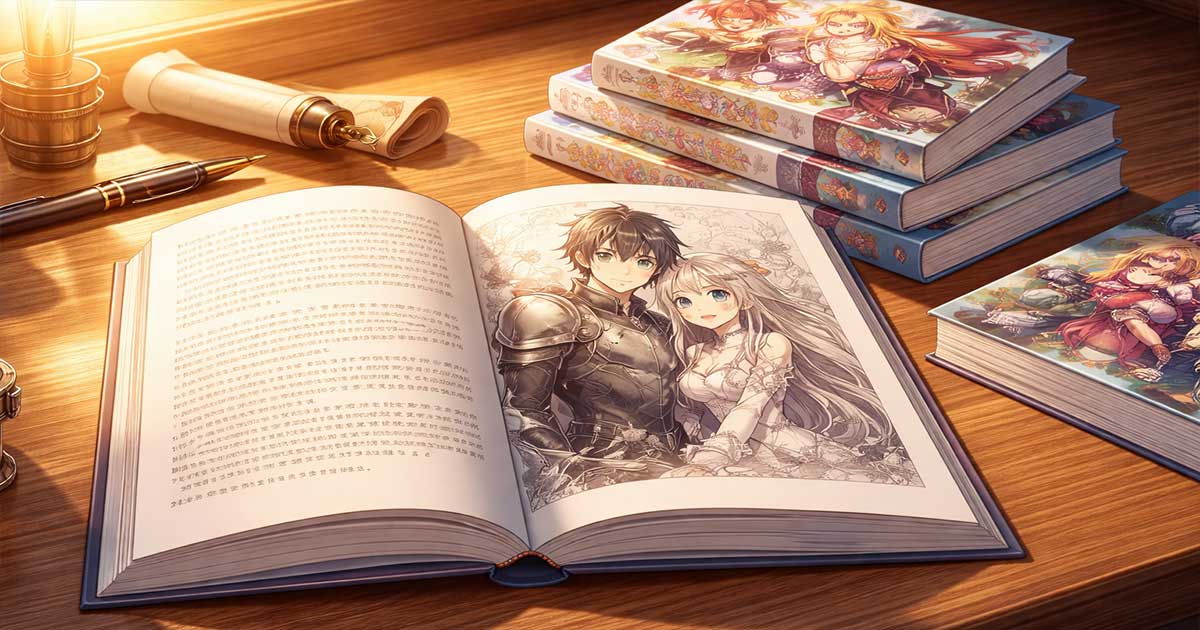

Light novel — Japanese narrative format blending prose, illustration, and serialized storytelling
The light novel refers to a Japanese narrative format situated at the crossroads of prose fiction, illustration, and serialization. It is characterized by a fluid writing style, strong readability, and a structure designed for progressive reading, often accompanied by illustrations that contribute to the work’s visual and narrative identity.
This format relies on a specific balance between narration, dialogue, and pacing. Texts favor clear progression, rapid immersion, and sustained attention to the reader’s experience. A light novel is therefore not defined solely by length or target audience, but by a distinct way of articulating story, structure, and narrative writing.
Light novels are closely connected to Japanese culture and belong to a broader narrative ecosystem in constant dialogue with manga and illustration. This proximity influences both thematic choices and the staging of characters, key scenes, and fictional worlds.
Many works of fantasy and isekai adopt the light novel format, whose serialized structure and narrative flexibility are particularly well suited to the exploration of complex worlds, gradual character development, and the construction of coherent systems.
This section brings together articles devoted to the light novel, examining its codes, uses, and narrative specificities. The associated texts explore the format as a full-fledged writing tool, capable of supporting immersive, structured, and sustainable storytelling.
-

Writing a Child Protagonist Without Infantilizing Them
In many light novels, especially in isekai and fantasy stories, choosing a child as the protagonist is not merely a narrative gimmick. It follows a specific narrative logic: showing the formation of a consciousness, allowing the reader to witness the evolution of a character before their personality has fully crystallized. This approach differs from certain…
-

Archetypes of Protagonists in Isekai
Archetypes of Protagonists in Isekai: From Fantasized Power to Moral Burden Isekai is not merely about changing worlds. It rests on a precise narrative promise: that of a protagonist placed in a radically new environment, where his abilities, choices, and responsibilities redefine his identity. In isekai light novels, this promise often takes the form of…
-

Non-Western Temporal Models in Isekai and Fantasy Worlds
Although many fantasy worlds draw inspiration from medieval Europe, isekai settings are deeply influenced by Asian history. Several historical periods offer rich foundations for fantasy worldbuilding. Feudal Japan (Heian, Kamakura, Edo periods) These eras rely on a social structure very different from European feudalism. Key characteristics: Mini narrative scenario In a kingdom inspired by feudal…
-

Mana and Aether: How Fantasy Reinvents the Sources of Magic
Mana and aether have become two central concepts in modern fantasy. Whether we are speaking about high fantasy, RPGs, or light novel isekai, these two terms structure a significant part of contemporary magic systems. But what do they actually mean?Is there an official definition?Are they interchangeable, or fundamentally different? In this article, we will compare…
-

The Rhythm in Light Novels: Narrative Pace, Emotional Beats, and Reader Engagement
Understanding narrative rhythm in a light novel—and even more so the rhythm in an isekai—is essential to maintaining reader engagement. Contrary to a common misconception, rhythm is not simply a matter of speed. It is a precise rhythmic structure that organizes emotions, revelations, and narrative progression. In ISEKAI The Otherworlder’s Heir, rhythm management is not…
-

Light Novel — How to Find Your Voice in a Codified Genre
In a Light Novel, whether it is an Isekai or a more traditional Fantasy, creativity never operates outside a framework. It unfolds within established narrative conventions: progression, archetypes, power systems, accessible rhythm, and clear focalization. That framework is neither restrictive nor limiting. It is the terrain on which an authorial voice becomes visible. The real…
-

Manga Adapted from a Light Novel: What Really Changes in the Narrative
Why do some manga adaptations of a Light Novel feel faster, more spectacular, yet sometimes less psychologically dense?Why do others successfully condense the story without weakening its emotional weight? The answer lies not in quality, but in structure. When a story moves from a textual system to a visual system, it undergoes a form of…
-

Magical Systems in Isekai: Rules, Limits, and Narrative Stakes
In an isekai story, magic is never just background decoration. It structures the world, defines social hierarchies, shapes conflicts, and guides the protagonist’s arc. In a light novel, it also becomes a rhythmic engine: progression, revelations, limitations, and strategy. Understanding how to design a coherent magical system is essential for writing a strong and lasting…
-

The Psychological Evolution of Arius Across the Volumes
Introduction — Fragility and Coherence in an Isekai Light Novel In a Light Novel, and especially in an isekai fantasy, character progression is often associated with rising power. Yet power alone does not create long-term reader attachment. What truly sustains engagement is psychological coherence. In this article, I examine Arius’s psychological evolution across the volumes,…
-
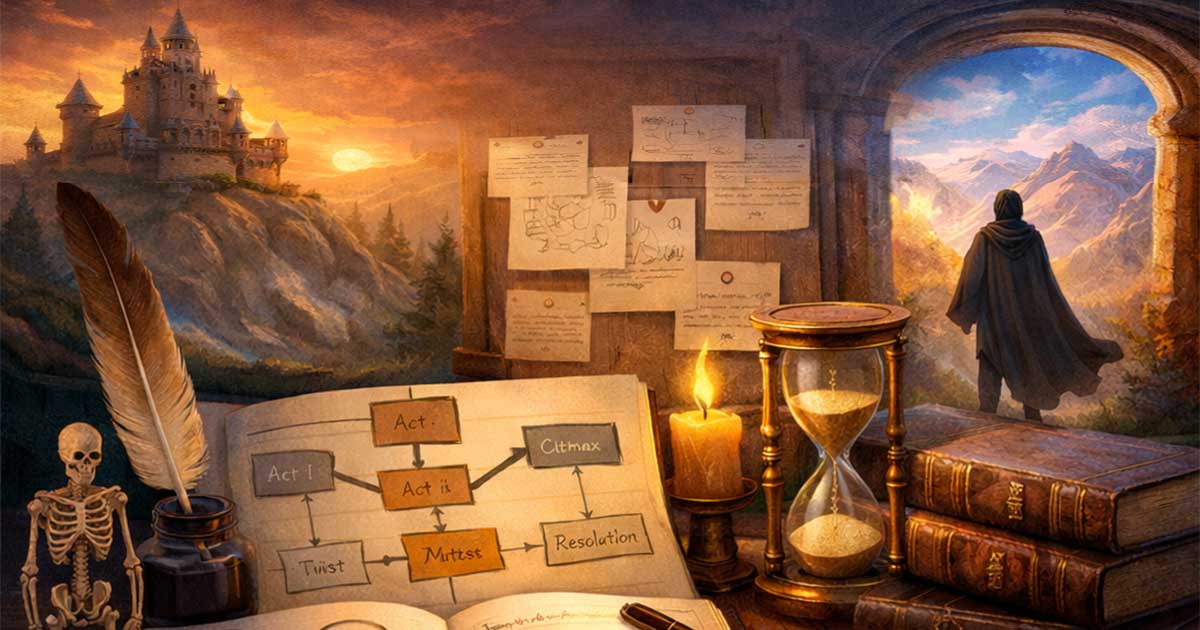
Writing a Fantasy Saga Differently: The Narrative Skeleton Before the Text
Before drafting the first line of a novel, it is possible to build the story as an architectural structure. This approach, which I call the narrative skeleton, consists of fixing the progression of events before telling them. It offers a structured way to plan a saga and to work on narrative arcs with a clear,…